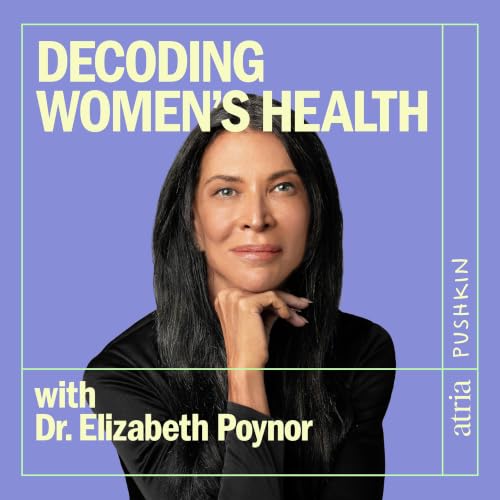
『Decoding Women's Health with Dr. Elizabeth Poynor』のカバーアート

Decoding Women's Health with Dr. Elizabeth Poynor

Decoding Women's Health with Dr. Elizabeth Poynor

著者: Pushkin Industries
無料で聴く

【Amazonプライム会員限定】今ならプレミアムプランが4か月 月額99円。

10月19日まで。※適用条件あり

Why is it still so hard for women to find reliable, modern health information about their own bodies? On Decoding Women's Health, Dr. Elizabeth Poynor, chair of women’s health & gynecology at the Atria Health Institute, shares expert insights on women’s health, hormones, and longevity science to help you thrive at any stage of midlife and beyond.

Dr. Poynor, a world-renowned gynecologic oncologist and advanced pelvic surgeon, speaks with leading physicians, researchers, and educators to share the latest science on women’s wellness, disease prevention, and what it really means to age on your own terms. Each episode explores a different aspect of how to improve your health during midlife—from heart disease and genetic risks to metabolism, hormones nutrition, cognitive health, and beyond.

Whether you're in perimenopause, postmenopause, or simply looking for tools to prepare for the next chapter, take charge of your health—now and for the future—with expert guidance and practical advice to help you thrive.

2026 Pushkin Industries 2025
科学 衛生・健康的な生活
エピソード
  • Decoding Sexual Health with Dr. Rachel Rubin
    2026/10/06

    Sex is supposed to be fun and feel good. So why are pain, low desire and changes in arousal so often treated as something women should simply live with?

    Dr. Poynor is joined by urologist and sexual medicine specialist Dr. Rachel Rubin for a candid, joyful conversation about women’s sexual health. They unpack what’s behind common sexual concerns, available treatments, and why these issues deserve the same curiosity and care as any other part of our health. Along the way, Dr. Rubin makes the case for talking about sex more openly – and for expecting more from the care we receive.

    Links to resources mentioned in this episode:

    For more information on the treatment options for vulvar pain: https://journals.lww.com/greenjournal/fulltext/10.1097/aog.0000000000001645~committee-opinion-no-673-persistent-vulvar-pain

    The American Urological Association’s clinical guideline on genitourinary syndrome of menopause: https://www.auanet.org/guidelines-and-quality/guidelines/genitourinary-syndrome-of-menopause

    Dr. Rubin offers continuing medical education courses for clinicians, as well as free educational sexual health resources: https://www.rachelrubinmd.com/education

    Learn more about Dr. Rubin’s Sexual Medicine Research Team: https://www.rachelrubinmd.com/research

    Read the FDA’s update on estradiol transdermal patch availability: https://www.fda.gov/drugs/drug-alerts-and-statements/fda-update-estradiol-transdermal-patch-availability

    Research on erectile dysfunction and its relationship to cardiovascular health: https://pmc.ncbi.nlm.nih.gov/articles/PMC10353735/

    Research on hormonal contraception and sexual function: https://www.sciencedirect.com/science/article/abs/pii/S1743609515312881

    More information on the FDA approval of flibanserin for hypoactive sexual desire in postmenopausal women: https://www.urologytimes.com/view/fda-approves-flibanserin-for-hypoactive-sexual-desire-disorder-in-postmenopausal-women

    Information about testosterone treatment available for women in New Zealand: https://www.androfeme.nz/

    Research on vibrator use among women: https://pubmed.ncbi.nlm.nih.gov/19453881/

    Prosayla, a resource from the International Society for the Study of Women’s Sexual Health (ISSWSH), can help you find clinicians who specialize in women’s sexual health: prosayla.com

    Dr. Rachel Rubin website: https://www.rachelrubinmd.com/

    Dr. Rachel Rubin on YouTube: https://www.youtube.com/@DrRachelRubin

    Dr. Rachel Rubin LinkedIn page: https://www.linkedin.com/in/rachel-rubin-7433b0134/

    Dr. Rachel Rubin on Instagram: https://www.instagram.com/drrachelrubin

    Dr. Rachel Rubin newsletter: https://www.rachelrubinmd.com/newsletter

    Dr. Elizabeth Poynor substack: https://poynorhealth.substack.com/

    Dr. Elizabeth Poynor on Instagram: https://www.instagram.com/poynorhealth

    Atria Health Library: content.atria.org

    Note: In this show, we use “women” as shorthand for people with XX chromosomes. We understand sex and gender are more complex, and acknowledge the experiences we describe reach beyond that word.

    See omnystudio.com/listener for privacy information.

    続きを読む 一部表示
    50 分
  • Decoding Cardiovascular Health with Dr. Anu Lala
    2026/09/22
    Heart disease is the number one killer of women, but unlike many other major diseases, there’s no single screening test that can tell you if you’re at risk. So how do you know where you stand? Dr. Poynor is joined by cardiologist Dr. Anuradha (Anu) Lala-Trindade (Lala), the program director for the Advanced Heart Failure and Transplant Fellowship at Mount Sinai and a professor of cardiology, population health, and obstetrics and gynecology. Together, they unpack the many factors that can shape a woman’s cardiovascular risk and break down why midlife is an especially important time to start paying attention to them. Resources mentioned during this episode: Dr. Anu Lala’s 14-part framework for an initial cardiology assessment: 1. Family history 2. Gynecologic history — pregnancy journey, fertility journey, and gynecologic surgeries, including fibroid surgeries 3. Laboratory results — genetic risk markers plus microalbuminuria (protein in the urine, as an early marker of cardiovascular-relevant kidney health) 4. History of high blood pressure — personal history, in-office reading, and family history 5. Cholesterol panel 6. Insulin resistance and inflammation biomarkers 7. History of autoimmune disease or inflammatory conditions 8. An EKG to check for any abnormalities 9. Weight and weight redistribution 10. Sleep 11. Movement (her preferred term over "exercise") 12. Diet — specifically processed food intake, alcohol, and food timing 13. Tobacco use and cessation 14. Mindfulness and well-being, or mind-body medicine Here are the numbers Dr. Lala wants women to know. 1. Blood pressure 2. Cholesterol panel 3. Lp(a) — a genetic marker of atherosclerosis, checked at least once 4. Hemoglobin A1c — a marker of insulin resistance, metabolic risk, or diabetes 5. Microalbuminuria For some women, she also recommends: 1. ApoB — not for everyone; informative specifically when LDL is elevated 2. Coronary artery calcium score — not for everyone; useful for those at intermediate-to-high risk, with high LDL, or with a relevant family history About Dr. Lala: https://profiles.mountsinai.org/anuradha-lala-trindade#about CDC overview of women and heart disease: https://www.cdc.gov/heart-disease/about/women-and-heart-disease.html National Heart, Lung, and Blood Institute resources for women and heart disease: https://www.nhlbi.nih.gov/health/coronary-heart-disease/women#How-do-symptoms-differ-for-women? A Harvard Health article on the heart attack gender gap: https://www.health.harvard.edu/blog/understanding-heart-attack-gender-gap-201604159495 Systolic Blood Pressure Intervention Trial (SPRINT) Study: https://www.nhlbi.nih.gov/science/systolic-blood-pressure-intervention-trial-sprint-study Hypertensive disorders of pregnancy and peripartum cardiomyopathy: A nationwide cohort study: https://journals.plos.org/plosone/article?id=10.1371%2Fjournal.pone.0211857 Increased risk of cardiovascular disease in women with endometriosis: A systematic review and meta-analysis: https://www.sciencedirect.com/science/article/pii/S0301211525003574 The 2022 hormone therapy position statement of The North American Menopause Society: https://menopause.org/wp-content/uploads/professional/nams-2022-hormone-therapy-position-statement.pdf If you're interested in using a risk calculator you can toggle to the left on the American Heart Association tool: https://professional.heart.org/en/guidelines-and-statements/prevent-calculator Auditory stimuli and heart rate variability: the role of music in cardiovascular regulation: https://pmc.ncbi.nlm.nih.gov/articles/PMC13229774/ Adjuvant music therapy for patients with hypertension: a meta-analysis and systematic review: https://link.springer.com/article/10.1186/s12906-023-03929-6 Effects of music in exercise and sport: A meta-analytic review: https://pubmed.ncbi.nlm.nih.gov/31804098/ Association between spirituality/religiousness and quality of life among healthy adults: a systematic review: https://pmc.ncbi.nlm.nih.gov/articles/PMC8529786/ Spirituality in Serious Illness and Health: https://jamanetwork.com/journals/jama/article-abstract/2794049 Acupuncture in persons with an increased stress level—Results from a randomized-controlled pilot trial: https://pmc.ncbi.nlm.nih.gov/articles/PMC7377446/ Effects of sleep deprivation and 4‐7‐8 breathing control on heart rate variability, blood pressure, blood glucose, and endothelial function in healthy young adults: https://pmc.ncbi.nlm.nih.gov/articles/PMC9277512/ Effects of voluntary slow breathing on heart rate and heart rate variability: A systematic review and a meta-analysis: https://pubmed.ncbi.nlm.nih.gov/35623448/ Note: In this show, we use “women” as shorthand for people with XX chromosomes. We understand sex and gender are more complex, and acknowledge the experiences we describe reach beyond that word.See omnystudio.com/listener for privacy information.
    続きを読む 一部表示
    57 分
  • Decoding Intermittent Fasting with Dr. Chris Rhodes
    2026/09/08

    How can the research behind intermittent fasting help us rethink the way we approach our nutrition and our daily habits? Dr. Chris Rhodes has spent much of his career studying the science of fasting. He joins the show to unpack how fasting works in the body and what the research tells us about its potential benefits.

    Dr. Rhodes earned his PhD in Nutritional Biochemistry at UC Davis and is also the co-founder of Mimio. We discuss why someone might try intermittent fasting - from longevity to weight loss - as well as the importance of strength training and personalized nutrition.

    Links to resources mentioned in this episode:

    For more studies on autophagy, check out: https://physoc.onlinelibrary.wiley.com/doi/full/10.1113/JP287938

    and https://pubmed.ncbi.nlm.nih.gov/41372565/

    Here's a meta-analysis looking at the effects of time restricted eating: https://pubmed.ncbi.nlm.nih.gov/41586347/

    Note: the glycine data we mention is only in mice: https://pmc.ncbi.nlm.nih.gov/articles/PMC6516426/

    Important caveat for this episode: the evidence is strongest in animal studies and human markers of aging. No intermittent fasting regimen has been shown to extend human lifespan or reduce mortality in humans.

    Note: In this show, we use “women” as shorthand for people with XX chromosomes. We understand sex and gender are more complex, and acknowledge the experiences we describe reach beyond that word.

    See omnystudio.com/listener for privacy information.

    続きを読む 一部表示
    49 分
adbl_web_anon_alc_button_suppression_t1
まだレビューはありません