エピソード

  • The Koala in Easy German
    2026/10/22
    Transcription: https://dailyfactsineasygerman.substack.com/p/the-koala-in-easy-german?showTranscript=true

    Discover "The Koala" in clear, natural German!

    Climb high into Australia's eucalyptus canopies with the sleepy Koala (Koala)! While they look like cuddly teddy bears, koalas are actually solitary marsupials with one of the most specialized and bizarre diets on Earth.

    Discover how they detoxify poisonous eucalyptus leaves, sleep up to 20 hours a day to conserve energy, hug tree trunks to stay cool during Australian heatwaves, and why mother koalas feed their joeys a special substance called "pap."

    Key Topics & Highlights:
    • Koalas survive almost entirely on toxic eucalyptus leaves that would be lethal to almost any other mammal.
    • To digest tough, fibrous leaves, a koala's specialized gut fermenter (caecum) can be up to two meters long.
    • Mother koalas produce a special transitional food called 'pap' to inoculate their joey's gut with vital bacteria.
    • On scorching hot days, koalas hug smooth tree trunks, which are several degrees cooler than the surrounding air.

    Key German Vocabulary:
    • der Koala (koala)
    • der Baum (tree)
    • das Blatt (leaf)
    • schlafen (to sleep)

    Chapters:
    00:00 - Introduction & Australia's Sleepy Marsupial
    04:12 - Surviving on Lethal Eucalyptus
    10:32 - The Two-Meter Gut & Unique Digestion
    15:10 - Tree-Hugging for Heat Relief & Joeys
    16:32 - Habitat Loss, Wildfires & Conservation

    Audio: 100% German • Spoken slowly and clearly (0.8x speed)

    This is a public episode. If you would like to discuss this with other subscribers or get access to bonus episodes, visit dailyfactsineasygerman.substack.com
    続きを読む 一部表示
    22 分
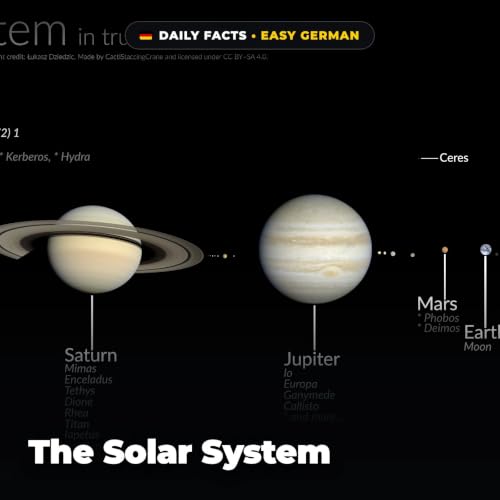
  • The Solar System in Easy German
    2026/10/21
    Transcription: https://dailyfactsineasygerman.substack.com/p/the-solar-system-in-easy-german?showTranscript=true

    Discover "The Solar System" in clear, natural German!

    Embark on an epic cosmic tour of our home in space: the Solar System (Sonnensystem)! Born 4.6 billion years ago from a swirling cloud of gas and dust, our cosmic neighborhood stretches far beyond what the eye can see.

    Explore the four rocky inner worlds, the crushing pressures inside gas giant Jupiter, ringed Saturn, and the icy frontiers of the Kuiper Belt and Oort Cloud where comets are born.

    Key Topics & Highlights:
    • Our solar system formed roughly 4.6 billion years ago from the gravitational collapse of a giant molecular dust cloud.
    • The Sun holds over 99.8% of all the mass in the entire solar system.
    • Jupiter's atmosphere has atmospheric pressures so extreme that any entering spacecraft is crushed within minutes.
    • Beyond Neptune lies the Kuiper Belt, home to dwarf planet Pluto and millions of icy celestial bodies.

    Key German Vocabulary:
    • das Sonnensystem (solar system)
    • der Planet (planet)
    • die Sonne (sun)
    • der Weltraum (space / universe)

    Chapters:
    00:00 - Introduction & Our Cosmic Neighborhood
    02:36 - Formation 4.6 Billion Years Ago
    05:13 - The Rocky Inner Planets & Earth's Sanctuary
    06:52 - Gas Giants & Ringed Saturn
    12:26 - Kuiper Belt, Oort Cloud & The Outer Void

    Audio: 100% German • Spoken slowly and clearly (0.8x speed)

    This is a public episode. If you would like to discuss this with other subscribers or get access to bonus episodes, visit dailyfactsineasygerman.substack.com
    続きを読む 一部表示
    13 分
  • The Red Panda in Easy German
    2026/10/20
    Transcription: https://dailyfactsineasygerman.substack.com/p/the-red-panda-in-easy-german?showTranscript=true

    Discover "The Red Panda" in clear, natural German!

    Meet the adorable Red Panda (Roter Panda), the original "Firefox" of the misty Himalayan forests! Despite their name, these arboreal acrobats are not closely related to giant pandas, forming their own unique animal family.

    Discover their clever survival habits: wrapping their bushy tails around their faces like cozy blankets in winter, and dangling all four legs from tree branches to cool down in summer while consuming mounds of bamboo.

    Key Topics & Highlights:
    • The red panda was discovered and named decades before the giant panda, and belongs to its own distinct taxonomic family.
    • In winter, red pandas wrap their thick, bushy striped tails over their faces like a blanket to stay warm.
    • On hot summer days, they stretch out flat on cool tree branches with all four legs dangling into the air.
    • Like giant pandas, they possess a modified wrist bone that acts as a 'false thumb' to grasp bamboo stalks.

    Key German Vocabulary:
    • der Panda (panda)
    • der Bambus (bamboo)
    • der Schwanz (tail)
    • der Ast (tree branch)

    Chapters:
    00:00 - Introduction & The Original Firefox of the Himalayas
    03:47 - Arboreal Life & Unique Evolutionary Family
    07:35 - False Thumbs & The Mounds of Bamboo
    11:16 - Bushy Tail Blankets & Summer Cooling
    14:18 - Conservation in Misty Mountain Forests

    Audio: 100% German • Spoken slowly and clearly (0.8x speed)

    This is a public episode. If you would like to discuss this with other subscribers or get access to bonus episodes, visit dailyfactsineasygerman.substack.com
    続きを読む 一部表示
    21 分
  • The Polar Bear in Easy German
    2026/10/19
    Transcription: https://dailyfactsineasygerman.substack.com/p/the-polar-bear-in-easy-german?showTranscript=true

    Discover "The Polar Bear" in clear, natural German!

    Venture into the freezing Arctic ice desert to meet the Polar Bear (Eisbär), the undisputed apex predator of the far north. Beneath their thick, translucent white coat lies jet-black skin designed to absorb solar warmth.

    Discover how mother polar bears hibernate in snow dens to nurse tiny cubs with milk as rich as whipping cream, how they patiently hunt seals at breathing holes, and why melting sea ice threatens their future.

    Key Topics & Highlights:
    • A polar bear's fur is actually transparent and hollow, reflecting light while its underlying skin is completely black.
    • Mother bears fast for months inside snow dens while nursing tiny newborn cubs with milk containing 30% fat.
    • They possess an incredible sense of smell, able to detect a seal under a meter of snow from over a kilometer away.
    • Polar bears are classified as marine mammals because they spend most of their lives on drifting sea ice hunting seals.

    Key German Vocabulary:
    • der Eisbär (polar bear)
    • die Kälte (cold)
    • das Fell (fur / coat)
    • die Robbe (seal)

    Chapters:
    00:00 - Introduction & Apex Predator of the Arctic
    01:58 - Hollow Fur, Black Skin & Cold Adaptation
    04:11 - Hunting Seals on Drifting Sea Ice
    06:28 - Winter Dens & Nursing Tiny Cubs
    09:11 - Melting Sea Ice & The Future of Polar Bears

    Audio: 100% German • Spoken slowly and clearly (0.8x speed)

    This is a public episode. If you would like to discuss this with other subscribers or get access to bonus episodes, visit dailyfactsineasygerman.substack.com
    続きを読む 一部表示
    11 分
  • The South Pole Expedition in Easy German
    2026/10/18
    Transcription: https://dailyfactsineasygerman.substack.com/p/the-south-pole-expedition-in-easy-german?showTranscript=true

    Discover "The South Pole Expedition" in clear, natural German!

    Journey to the bottom of the world in 1911, where Norwegian explorer Roald Amundsen led a daring, secret expedition to conquer the South Pole.

    Learn how Amundsen secretly changed his route from the Arctic to Antarctica, relied on indigenous Inuit survival techniques and hardy Greenland sled dogs, and overcame bitter -56°C temperatures and internal team rivalries to plant the Norwegian flag first.

    Key Topics & Highlights:
    • Amundsen kept his plan to reach the South Pole a total secret from his own crew and sponsors until they were already at sea.
    • Unlike British rival Robert Falcon Scott, Amundsen relied exclusively on skis and 52 well-trained Greenland sled dogs.
    • An aborted first attempt in extreme -56°C frost nearly cost lives and led to a bitter clash with explorer Hjalmar Johansen.
    • On December 14, 1911, Amundsen's five-man team became the very first humans to stand at the geographic South Pole.

    Key German Vocabulary:
    • der Südpol (South Pole)
    • die Expedition (expedition)
    • der Schlittenhund (sled dog)
    • das Eis (ice)

    Chapters:
    00:00 - Introduction & The Race for the South Pole
    01:58 - Amundsen vs Scott: Two Contrasting Approaches
    04:31 - Dogs, Skis, and the Norwegian Triumph (1911)
    08:58 - The Tragic Fate of Scott's Team
    10:57 - The Frozen Continent's Legacy & Lessons

    Audio: 100% German • Spoken slowly and clearly (0.8x speed)

    This is a public episode. If you would like to discuss this with other subscribers or get access to bonus episodes, visit dailyfactsineasygerman.substack.com
    続きを読む 一部表示
    12 分
  • Elephants in Easy German
    2026/10/17
    Transcription: https://dailyfactsineasygerman.substack.com/p/elephants-in-easy-german?showTranscript=true

    Discover "Elephants" in clear, natural German!

    Step into the fascinating world of Elephants (Elefanten), the largest and gentlest giants on land. Did you know that elephants can actually "hear" seismic rumbles through sensitive receptors in their giant feet?

    Explore the multifunctionality of the trunk with over 40,000 muscles, their tight-knit matriarchal family groups led by experienced grandmothers, and the extraordinary empathy and memory that make them truly unique.

    Key Topics & Highlights:
    • Elephants communicate over miles using deep infrasound that travels through the ground and is felt by their feet.
    • An elephant's trunk contains over 40,000 individual muscles and can lift heavy logs as well as pick a single blade of grass.
    • Herds are led by an older matriarch whose decades of memory guide the family to water during severe droughts.
    • Elephants exhibit deep emotional bonds, mourning deceased family members and greeting friends with joyful trumpeting.

    Key German Vocabulary:
    • der Elefant (elephant)
    • der Rüssel (trunk)
    • die Herde (herd)
    • das Gedächtnis (memory)

    Chapters:
    00:00 - Introduction & Earth's Largest Land Mammals
    02:25 - Complex Matriarchies & Emotional Bonds
    05:53 - Trunks, Tusks & Acoustic Rumbling
    09:17 - Ecosystem Engineers in Savannas and Forests
    11:13 - Poaching, Conservation & Final Thoughts

    Audio: 100% German • Spoken slowly and clearly (0.8x speed)

    This is a public episode. If you would like to discuss this with other subscribers or get access to bonus episodes, visit dailyfactsineasygerman.substack.com
    続きを読む 一部表示
    12 分
  • The Bald Eagle in Easy German
    2026/10/16
    Transcription: https://dailyfactsineasygerman.substack.com/p/the-bald-eagle-in-easy-german?showTranscript=true

    Discover "The Bald Eagle" in clear, natural German!

    Soar into the skies with the Bald Eagle (Weißkopfseeadler), the majestic national bird of the United States! Discover how these incredible birds build the largest tree nests in the animal kingdom—weighing as much as a small car.

    Learn about their dramatic "cartwheel display" mating ritual high above the ground, how chemical pesticides like DDT nearly drove them to extinction, and how strict conservation helped their population stage a triumphant recovery.

    Key Topics & Highlights:
    • Bald eagles build giant tree nests up to 4 meters deep and weighing over two tons.
    • During courtship, eagle pairs lock talons in midair and free-fall spinning toward the earth before pulling apart.
    • The widespread use of pesticide DDT made their eggshells brittle, causing numbers to crash in the 20th century.
    • Protected by federal law and environmental bans, bald eagles have made one of history's greatest wildlife recoveries.

    Key German Vocabulary:
    • der Adler (eagle)
    • das Nest (nest)
    • die Flügel (wings)
    • jagen (to hunt)

    Chapters:
    00:00 - Introduction & The American Icon
    01:50 - Physical Traits & Size
    03:15 - Giant Nests & Habitat
    05:20 - Hunting & Flight Tactics
    08:00 - The Threat of Extinction & DDT
    09:50 - Conservation Victory & Conclusion

    Audio: 100% German • Spoken slowly and clearly (0.8x speed)

    This is a public episode. If you would like to discuss this with other subscribers or get access to bonus episodes, visit dailyfactsineasygerman.substack.com
    続きを読む 一部表示
    12 分
  • The Alpine Ibex in Easy German
    2026/10/15
    Transcription: https://dailyfactsineasygerman.substack.com/p/the-alpine-ibex-in-easy-german?showTranscript=true

    Discover "The Alpine Ibex" in clear, natural German!

    Discover the dramatic rescue of the Alpine Ibex (Alpensteinbock), one of Europe's greatest conservation triumphs! By 1820, this majestic mountain goat was hunted down to just ~100 individuals in Italy's Gran Paradiso.

    Learn how King Victor Emmanuel II created a royal hunting reserve to save the species, and how audacious Swiss gamekeepers smuggled live ibex kids across the Alps in 1906 to bring the species roaring back to Switzerland.

    Key Topics & Highlights:
    • Uncontrolled hunting for meat, horns, and folk medicine reduced the entire world population of ibex to around 100 in Italy.
    • Italian King Victor Emmanuel II declared Gran Paradiso a royal reserve in 1821, saving the last herd from extinction.
    • When Italy refused to sell ibex to Switzerland, Swiss gamekeepers hired poachers to smuggle young ibex across the border in 1906.
    • Today, over 50,000 Alpine ibex thrive across the Alps in Switzerland, Italy, Austria, France, and Germany.

    Key German Vocabulary:
    • der Steinbock (alpine ibex)
    • die Hörner (horns)
    • die Alpen (Alps)
    • der Schmuggel (smuggling)

    Chapters:
    00:00 - Introduction & The King of the Alps
    03:59 - Master Climbers & Gravity-Defying Hooves
    13:20 - Medieval Hunting & Near Extinction
    16:31 - Royal Gran Paradiso Sanctuary & Reintroduction
    17:06 - Thriving in the European Alps Today

    Audio: 100% German • Spoken slowly and clearly (0.8x speed)

    This is a public episode. If you would like to discuss this with other subscribers or get access to bonus episodes, visit dailyfactsineasygerman.substack.com
    続きを読む 一部表示
    26 分