エピソード

  • What We Lose When We Separate Science From Emotion | Dr. Taylor Cummings
    2026/07/13

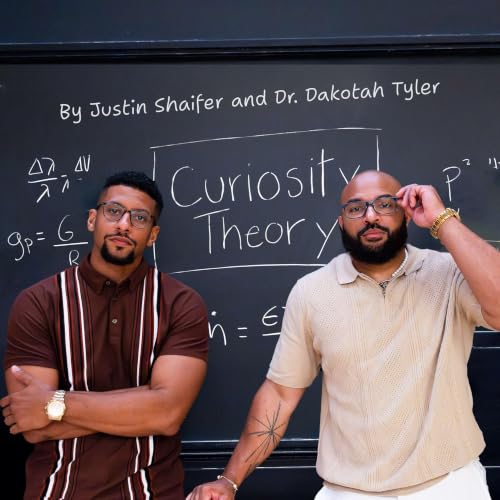
    In this episode of Curiosity Theory, hosts Dr. Dakotah Tyler and Justin Shaifer sit down with Dr. Taylor Cummings, educational psychologist and founder of The Self-Love Doc, for a conversation about what Western science gets wrong about knowledge, healing, and the human experience.

    The discussion moves from her dissertation, titled The Miseducation of Taylor Cummings, and how colonial frameworks shaped what we call legitimate science, to what happens when you strip emotion, language, and African-centered ways of knowing out of the picture entirely. From there they get into embodiment and why most people have never been taught to understand their own bodies, how K-12 education kills curiosity before it ever gets started, and what self-love actually means when you look at it through the lens of educational psychology rather than a motivational caption.

    The conversation also dives into her personal story of misdiagnosis, going on and then coming off an SSRI, and finding her own path to healing through identity and consciousness. She breaks down why depression and mental illness might be better understood as systems problems rather than individual failures, what evolutionary mismatch tells us about modern life, how African-centered and Akan healing traditions offer frameworks Western psychology is only beginning to catch up to, and why carbon, stardust, and the cosmos have more to do with self-knowledge than most people realize.

    Chapters

    00:00:00 Intro and meeting Dr. Taylor Cummings
    00:03:00 The Miseducation of Taylor Cummings: her dissertation explained
    00:04:20 How Western science stripped emotion and African knowledge from the picture
    00:13:25 Embodiment: why we don't know our own bodies
    00:14:17 How K-12 kills curiosity and what education gets wrong
    00:19:00 What self-love actually means from a psychology perspective
    00:22:00 Her personal journey: injury, community college, and trusted mentors
    00:26:05 What psychology gets wrong about grief and loss
    00:31:30 Her SSRI story: misdiagnosis, medication, and finding her own path
    00:34:06 African-centered healing traditions and the Akan
    00:42:14 Why depression might be a systems problem not a personal one
    00:47:49 Evolutionary mismatch: we were never meant to live like this
    00:56:00 Carbon, stardust, and what the cosmos has to do with consciousness
    01:12:51 Consciousness, energy, and collective connection
    01:25:13 The Decolonize Your Mind resource guide
    01:26:06 Where to find Dr. Taylor

    Follow us
    @curiositytheorypod
    @dr.starkid
    @mr.fascinate

    Guests
    Dr. Taylor Cummings | @theselflovedoc

    Visit our Merch Store
    https://www.curiositytheorypod.com/merch

    Join our Patreon
    https://www.patreon.com/c/CuriosityTheory

    If you enjoy the conversation, subscribe and share Curiosity Theory with someone who's curious about the universe.

    続きを読む 一部表示
    1 時間 27 分
  • Skilled Trades Are Six Figure Careers That the World Needs | Joshua Regis
    2026/07/03

    In this episode of Curiosity Theory, hosts Dr. Dakotah Tyler and Justin Shaifer sit down with Joshua Regis, co-founder and CEO of KritKarr, an AI-powered platform for auto repair, for a conversation about fixing one of the most broken industries in America, what the trades are actually worth, and who gets to write the future.

    The discussion moves from Josh's path out of traditional school and into automotive work, how he discovered that a car contains every trade skill in existence, and how the flat rate pay system exploits the mechanics who keep the industry running. From there they get into what KritKarr is building, how AI diagnostics and mobile mechanics can bring trust and transparency back to auto repair, and why skilled trades are a six-figure opportunity that almost nobody is talking about.

    The conversation also dives into whether robots will replace mechanics and why the human touch still matters, how automation is set to widen the wealth gap, the SpaceX IPO and what commercializing space actually means for regular people, whether we should be trying to colonize Mars before fixing things on Earth, and what Afrofuturism has to say about who controls the narrative of the future. It opens on the Tulsa Race Massacre and the question of what Black Wall Street could have become, and that thread runs underneath everything.

    Chapters

    00:00:00 Intro and meeting Joshua Regis
    00:03:00 Black Wall Street, the Tulsa Race Massacre, and what could have been
    00:07:28 Sci-fi, anime, and the Tony Stark effect
    00:14:50 How Josh went from struggling in school to becoming a mechanic
    00:15:44 Why a car contains every trade skill in existence
    00:20:35 Flat rate vs hourly: how the auto industry underpays mechanics
    00:27:42 What KritKarr is and how it works
    00:29:55 Skilled trades as a six-figure career opportunity
    00:35:00 Will robots replace mechanics? The human touch debate
    00:41:56 Automation, the wealth gap, and universal basic income
    00:50:56 The SpaceX IPO and what commercializing space actually means
    00:57:08 Mars colonies: who benefits and at what cost?
    01:00:18 Solar panels in space and the future of energy
    01:07:50 Should we fix Earth before trying to leave it?
    01:14:18 Afrofuturism, Black culture, and who controls the future's narrative
    01:17:00 Where to find Josh and KritKarr

    Follow us
    @curiositytheorypod
    @dr.starkid
    @mr.fascinate

    Guests
    Joshua Regis

    Visit our Merch Store
    https://www.curiositytheorypod.com/merch

    Join our Patreon
    https://www.patreon.com/c/CuriosityTheory

    Check out KritKarr
    https://www.kritkarr.com/

    If you enjoy the conversation, subscribe and share Curiosity Theory with someone who's curious about the universe.
    続きを読む 一部表示
    1 時間 18 分
  • The Cosmos Is A Black Aesthetic | Dr. Chanda Prescod-Weinstein
    2026/06/22

    In this episode of Curiosity Theory, hosts Dr. Dakotah Tyler and Justin Shaifer sit down with Dr. Chanda Prescod-Weinstein, astrophysicist, cosmologist, writer, and author of Disordered Cosmos and the new The Edge of Space-Time: Particles, Poetry and the Cosmic Dream Boogie, for one of the most wide-ranging conversations the pod has had yet.

    The discussion moves from how a blog post at Perimeter Institute became the seed of her first book, to what neutrinos actually are, why they are among the strangest particles in the Standard Model, and why they may have played a quiet but essential role in making life on Earth possible. From there they get into Population III stars, how the first heavy elements ever got made, and the surprisingly contested question of what separates a galaxy from a globular cluster.

    The conversation also dives into the philosophy of science and Dr. Prescod-Weinstein's concept of white empiricism, the idea that white supremacy and patriarchy shape what counts as legitimate knowledge and who gets treated as a credible scientist. She talks about what her new book offers readers who are skeptical that physics is for them, why the cosmos is a Black aesthetic, how hip hop and Big K.R.I.T. ended up in a physics book, and why access to a dark night sky is a social justice issue, not just an astronomy one.

    Chapters

    00:00:00 Intro and meeting Dr. Chanda Prescod-Weinstein
    00:02:30 How a blog post became Disordered Cosmos
    00:04:50 Blue Sky, Threads, and whiteness in online spaces
    00:09:00 Being one of few Black women at the frontier of physics
    00:11:45 Science communication, community accountability, and the book-before-tenure risk
    00:15:27 What are neutrinos? Three flavors and oscillation explained
    00:25:00 Why neutrinos may be essential to life on Earth
    00:30:00 Population III stars and the origin of every heavy element
    00:35:00 What makes a galaxy? Globular clusters, dark matter, and contested definitions
    00:44:55 Neanderthal DNA and an unexpected dental tangent
    00:49:40 Philosophy of science and the concept of white empiricism
    00:52:00 How white supremacy and patriarchy shape what counts as valid science
    01:02:30 The Edge of Spacetime: what readers can expect
    01:04:48 Poetry, hip hop, and the cosmos as a Black aesthetic
    01:08:40 Objectivity, mythology, and storytelling in science
    01:14:00 Dark sky access as a social justice issue
    01:19:52 Who science is written for and to
    01:23:14 On courage, haters, and Kat Williams
    01:25:18 Where to find Dr. Chanda and her books

    Follow us
    @curiositytheorypod
    @dr.starkid
    @mr.fascinate

    Guests
    Dr. Chanda Prescod-Weinstein

    Visit our Merch Store
    https://www.curiositytheorypod.com/merch

    Join our Patreon
    https://www.patreon.com/c/CuriosityTheory

    If you enjoy the conversation, subscribe and share Curiosity Theory with someone who's curious about the universe.

    続きを読む 一部表示
    1 時間 26 分
  • The Rocket Engines That Don't Burn Fuel | Dr. Naia Butler-Craig
    2026/06/16

    In this episode of Curiosity Theory, hosts Dr. Dakotah Tyler and Justin Shaifer sit down with Dr. Naia Butler-Craig, a newly minted aerospace engineer and NASA electric propulsion researcher, for a conversation about rocket science, how we actually move through space, and where humans are headed next.

    The discussion moves from her path through grad school and into NASA to how electric propulsion works and why it beats chemical rockets on efficiency, what it would really take to get people to the Moon and Mars, and what living and working at the agency is like from the inside. Along the way, she breaks down what is happening inside a Krypton Hall effect thruster and why plasma, not combustion, is the future of deep space travel.

    The conversation also dives into why astrology is not astronomy, how to think about trust and misinformation in science, the engineering and people behind the missions we take for granted, and the surprising ways space tech is advancing medicine on Earth through Avatar tissue chips. It closes on the sci-fi and the curious childhood that set her on this path in the first place.

    Chapters

    00:00:00 Intro and meeting Dr. Naia Butler-Craig
    00:01:15 Her path into NASA and life inside the agency
    00:11:43 Electric propulsion vs chemical rockets explained
    00:17:23 Getting humans to the Moon and Mars
    00:24:04 Why astrology is not astronomy
    00:31:50 Trust, misinformation, and relying on science
    00:37:00 Is NASA still competent? The engineering behind spaceflight
    00:46:01 Avatar chips: how space tech advances medicine
    00:58:50 How sci-fi and a curious childhood shaped her
    01:03:34 Inside a Krypton Hall effect thruster
    01:11:37 Where to find Naia and final thoughts

    Follow us
    @curiositytheorypod
    @dr.starkid
    @mr.fascinate

    Guests
    Dr. Naia Butler-Craig

    Visit our Merch Store
    https://www.curiositytheorypod.com/merch

    Join our Patreon
    / curiositytheory

    続きを読む 一部表示
    1 時間 12 分
  • What Dark Matter Actually Is | KeShawn Ivory (dark.mattering)
    2026/06/08

    In this episode of Curiosity Theory, hosts Dr. Dakotah Tyler and Justin Shaifer sit down with KeShawn Ivory, a soon-to-be PhD astrophysicist who studies the large-scale structure of the universe, for a deep conversation about dark matter, cosmology, and the invisible stuff that holds the universe together.

    The discussion moves from what dark matter actually is to how the universe became clumpy and lumpy instead of smooth, why the first atoms appeared minutes after the Big Bang, and how primordial black holes (a mountain's worth of mass packed into the size of a proton) became one of the more compelling candidates for what dark matter might be. Along the way, they get into how scientists detect something they can't see, what counts as evidence, and how scientific consensus actually moves.
    The conversation also dives into the hunt for dark matter through detection experiments, the role of skepticism in good science, what it means to know something, and KeShawn's favorite idea of all: that dark matter works as a framework for any force that is deeply impactful but hard to see, from race and systemic disparities in sociology to genomic dark matter in biology and trauma in art.
    Chapters
    00:00:00 Intro and meeting KeShawn Ivory
    00:02:30 The PhD as a credential and the path to science communication
    00:08:55 What dark matter actually is
    00:10:00 Why the universe is clumpy: large-scale structure
    00:11:30 The early universe and the first atoms
    00:20:30 The cosmic microwave background and the universe's baby picture
    00:30:00 How we know dark matter is really there
    00:33:30 Primordial black holes as a dark matter candidate
    00:40:00 Dark stars and other exotic candidates
    00:47:40 Healthy skepticism and how scientific consensus moves
    00:53:00 Science, truth, and what it means to know something
    00:59:00 The hunt for dark matter: WIMPs, axions, and detectors
    01:08:00 How theory predicts the particles we look for
    01:17:50 Astrosociology: dark matter as a lens on race and systemic forces
    01:24:10 Dark matter as a storytelling tool in biology and art
    01:26:18 Where to find Kishan and Black Space Week
    Follow us
    @curiositytheorypod
    @dr.starkid
    @mr.fascinate
    Guests
    Kishan Ivory (Dark Mattering)
    Visit our Merch Store
    https://www.curiositytheorypod.com/merch
    Join our Patreon
    / curiositytheory
    If you enjoy the conversation, subscribe and share Curiosity Theory with someone who's curious about the universe.

    続きを読む 一部表示
    1 時間 28 分
  • Curiosity and Why Old Ideas Have To Die
    2026/06/01

    Dakotah and Justin revisit the original idea behind Curiosity Theory: curiosity as a North Star. That quickly turns into an argument over whether wanting to know what is in someone’s fridge counts as curiosity or just being nosy.

    The conversation eventually gets more serious. They talk about the courage required to question beliefs, why scientific progress often threatens ideas people consider sacred, and the difference between an old belief being useful and actually understanding why it works.

    Then they get into aging, genetic engineering, designer babies, and immortality. If we eventually learn how to extend human life dramatically, who gets access first? And would society become better, or would the most powerful people simply hold power for even longer?

    Visit our Merch Store
    https://www.curiositytheorypod.com/merch

    Join our Patreon
    https://www.patreon.com/c/CuriosityTheory

    Follow the show @curiositytheorypod

    Hosted by Dr. Dakotah Tyler and Justin Shaifer

    Stay curious.

    続きを読む 一部表示
    1 時間 9 分
  • Stay Curious and Eat Your Grits & Eggs | Deante Kyle
    2026/05/21

    In this collaboration episode of Curiosity Theory and Grits & Eggs Podcast, Dr. Dakotah Tyler and Justin Shaifer sit down with Deante Kyle and Big Ice Kup Kat for an unfiltered conversation about AI, capitalism, social media, internet culture, and the future of humanity.

    They discuss the rise of artificial intelligence, billionaires and wealth inequality, the psychology of social media addiction, and whether modern technology is actually improving human life. The conversation also dives into online culture, work, relationships, movies, internet misinformation, and the increasingly strange direction society seems to be heading.

    This episode is more explicit and unfiltered than a typical Curiosity Theory episode, but we wanted the conversation to remain authentic and uncensored.

    Visit our Merch Store
    https://www.curiositytheorypod.com/merch

    Join our Patreon
    https://www.patreon.com/c/CuriosityTheory

    Follow the show @curiositytheorypod

    Hosted by Dr. Dakotah Tyler and Justin Shaifer

    Stay curious.

    続きを読む 一部表示
    1 時間 33 分
  • Space Is Bigger Than Your Brain Can Handle | Epic Spaceman
    2026/05/12

    Dr. Dakotah Tyler and Justin Shaifer sit down with Toby from Epic Spaceman, the YouTube creator known for using cinematic animations to make the scale of the universe easier to understand.

    They talk about cosmic scale, visual storytelling, interstellar travel, whether future humans would still be human, what telescopes actually see when we look at stars, Betelgeuse going supernova, why UFOs are probably not alien spacecraft, and where microbial life might exist in our own solar system.

    Visit our Merch Store
    https://www.curiositytheorypod.com/merch

    Join our Patreon
    https://www.patreon.com/c/CuriosityTheory

    Follow the show @curiositytheorypod

    Hosted by Dr. Dakotah Tyler and Justin Shaifer

    Stay curious.

    続きを読む 一部表示
    1 時間 19 分