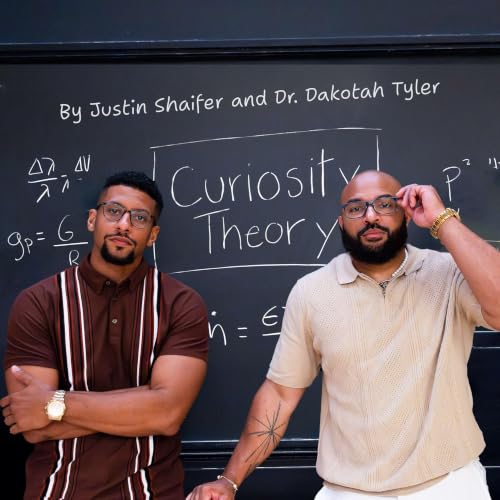
『Curiosity Theory』のカバーアート

Curiosity Theory

Curiosity Theory

著者: Dr. Dakotah Tyler & Justin Shaifer
無料で聴く

A podcast about sharpening your curiosity through science, stories, and bold questions. With Astrophysicist Dr. Dakotah Tyler & STEM Educator Justin Shaifer.


Support the podcast by subscribing to our Patreon: https://www.patreon.com/CuriosityTheory

© 2026 Curiosity Theory
科学
エピソード
  • The Cosmos Is A Black Aesthetic | Dr. Chanda Prescod-Weinstein
    2026/06/22

    In this episode of Curiosity Theory, hosts Dr. Dakotah Tyler and Justin Shaifer sit down with Dr. Chanda Prescod-Weinstein, astrophysicist, cosmologist, writer, and author of Disordered Cosmos and the new The Edge of Space-Time: Particles, Poetry and the Cosmic Dream Boogie, for one of the most wide-ranging conversations the pod has had yet.

    The discussion moves from how a blog post at Perimeter Institute became the seed of her first book, to what neutrinos actually are, why they are among the strangest particles in the Standard Model, and why they may have played a quiet but essential role in making life on Earth possible. From there they get into Population III stars, how the first heavy elements ever got made, and the surprisingly contested question of what separates a galaxy from a globular cluster.

    The conversation also dives into the philosophy of science and Dr. Prescod-Weinstein's concept of white empiricism, the idea that white supremacy and patriarchy shape what counts as legitimate knowledge and who gets treated as a credible scientist. She talks about what her new book offers readers who are skeptical that physics is for them, why the cosmos is a Black aesthetic, how hip hop and Big K.R.I.T. ended up in a physics book, and why access to a dark night sky is a social justice issue, not just an astronomy one.

    Chapters

    00:00:00 Intro and meeting Dr. Chanda Prescod-Weinstein
    00:02:30 How a blog post became Disordered Cosmos
    00:04:50 Blue Sky, Threads, and whiteness in online spaces
    00:09:00 Being one of few Black women at the frontier of physics
    00:11:45 Science communication, community accountability, and the book-before-tenure risk
    00:15:27 What are neutrinos? Three flavors and oscillation explained
    00:25:00 Why neutrinos may be essential to life on Earth
    00:30:00 Population III stars and the origin of every heavy element
    00:35:00 What makes a galaxy? Globular clusters, dark matter, and contested definitions
    00:44:55 Neanderthal DNA and an unexpected dental tangent
    00:49:40 Philosophy of science and the concept of white empiricism
    00:52:00 How white supremacy and patriarchy shape what counts as valid science
    01:02:30 The Edge of Spacetime: what readers can expect
    01:04:48 Poetry, hip hop, and the cosmos as a Black aesthetic
    01:08:40 Objectivity, mythology, and storytelling in science
    01:14:00 Dark sky access as a social justice issue
    01:19:52 Who science is written for and to
    01:23:14 On courage, haters, and Kat Williams
    01:25:18 Where to find Dr. Chanda and her books

    Follow us
    @curiositytheorypod
    @dr.starkid
    @mr.fascinate

    Guests
    Dr. Chanda Prescod-Weinstein

    Visit our Merch Store
    https://www.curiositytheorypod.com/merch

    Join our Patreon
    https://www.patreon.com/c/CuriosityTheory

    If you enjoy the conversation, subscribe and share Curiosity Theory with someone who's curious about the universe.

    続きを読む 一部表示
    1 時間 26 分
  • The Rocket Engines That Don't Burn Fuel | Dr. Naia Butler-Craig
    2026/06/16

    In this episode of Curiosity Theory, hosts Dr. Dakotah Tyler and Justin Shaifer sit down with Dr. Naia Butler-Craig, a newly minted aerospace engineer and NASA electric propulsion researcher, for a conversation about rocket science, how we actually move through space, and where humans are headed next.

    The discussion moves from her path through grad school and into NASA to how electric propulsion works and why it beats chemical rockets on efficiency, what it would really take to get people to the Moon and Mars, and what living and working at the agency is like from the inside. Along the way, she breaks down what is happening inside a Krypton Hall effect thruster and why plasma, not combustion, is the future of deep space travel.

    The conversation also dives into why astrology is not astronomy, how to think about trust and misinformation in science, the engineering and people behind the missions we take for granted, and the surprising ways space tech is advancing medicine on Earth through Avatar tissue chips. It closes on the sci-fi and the curious childhood that set her on this path in the first place.

    Chapters

    00:00:00 Intro and meeting Dr. Naia Butler-Craig
    00:01:15 Her path into NASA and life inside the agency
    00:11:43 Electric propulsion vs chemical rockets explained
    00:17:23 Getting humans to the Moon and Mars
    00:24:04 Why astrology is not astronomy
    00:31:50 Trust, misinformation, and relying on science
    00:37:00 Is NASA still competent? The engineering behind spaceflight
    00:46:01 Avatar chips: how space tech advances medicine
    00:58:50 How sci-fi and a curious childhood shaped her
    01:03:34 Inside a Krypton Hall effect thruster
    01:11:37 Where to find Naia and final thoughts

    Follow us
    @curiositytheorypod
    @dr.starkid
    @mr.fascinate

    Guests
    Dr. Naia Butler-Craig

    Visit our Merch Store
    https://www.curiositytheorypod.com/merch

    Join our Patreon
    / curiositytheory

    続きを読む 一部表示
    1 時間 12 分
  • What Dark Matter Actually Is | KeShawn Ivory (dark.mattering)
    2026/06/08

    In this episode of Curiosity Theory, hosts Dr. Dakotah Tyler and Justin Shaifer sit down with KeShawn Ivory, a soon-to-be PhD astrophysicist who studies the large-scale structure of the universe, for a deep conversation about dark matter, cosmology, and the invisible stuff that holds the universe together.

    The discussion moves from what dark matter actually is to how the universe became clumpy and lumpy instead of smooth, why the first atoms appeared minutes after the Big Bang, and how primordial black holes (a mountain's worth of mass packed into the size of a proton) became one of the more compelling candidates for what dark matter might be. Along the way, they get into how scientists detect something they can't see, what counts as evidence, and how scientific consensus actually moves.
    The conversation also dives into the hunt for dark matter through detection experiments, the role of skepticism in good science, what it means to know something, and KeShawn's favorite idea of all: that dark matter works as a framework for any force that is deeply impactful but hard to see, from race and systemic disparities in sociology to genomic dark matter in biology and trauma in art.
    Chapters
    00:00:00 Intro and meeting KeShawn Ivory
    00:02:30 The PhD as a credential and the path to science communication
    00:08:55 What dark matter actually is
    00:10:00 Why the universe is clumpy: large-scale structure
    00:11:30 The early universe and the first atoms
    00:20:30 The cosmic microwave background and the universe's baby picture
    00:30:00 How we know dark matter is really there
    00:33:30 Primordial black holes as a dark matter candidate
    00:40:00 Dark stars and other exotic candidates
    00:47:40 Healthy skepticism and how scientific consensus moves
    00:53:00 Science, truth, and what it means to know something
    00:59:00 The hunt for dark matter: WIMPs, axions, and detectors
    01:08:00 How theory predicts the particles we look for
    01:17:50 Astrosociology: dark matter as a lens on race and systemic forces
    01:24:10 Dark matter as a storytelling tool in biology and art
    01:26:18 Where to find Kishan and Black Space Week
    Follow us
    @curiositytheorypod
    @dr.starkid
    @mr.fascinate
    Guests
    Kishan Ivory (Dark Mattering)
    Visit our Merch Store
    https://www.curiositytheorypod.com/merch
    Join our Patreon
    / curiositytheory
    If you enjoy the conversation, subscribe and share Curiosity Theory with someone who's curious about the universe.

    続きを読む 一部表示
    1 時間 28 分
adbl_web_anon_alc_button_suppression_t1
まだレビューはありません