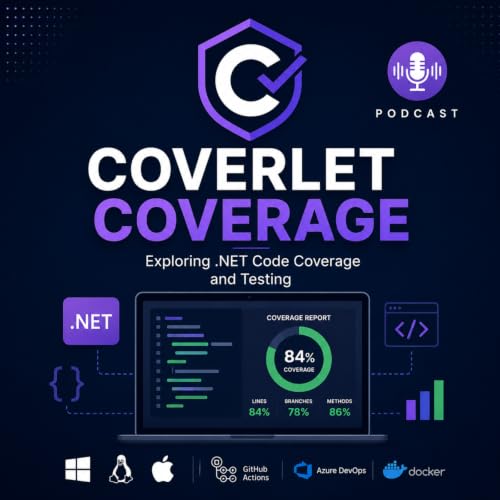
Welcome to Episode 1 of the Coverlet Coverage Podcast. In this episode, we introduce the fundamentals of .NET code coverage and explain how Coverlet helps developers understand which parts of an application are executed during automated testing.
Code coverage measures the sections of source code that run while unit tests are executed. It provides useful information about line coverage, branch coverage, and method coverage, helping developers review how their tests interact with application code. Coverage reports do not determine software quality on their own, but they offer valuable insights that can support testing and maintenance.
We also introduce Coverlet, an open-source code coverage framework designed for modern .NET applications. Coverlet supports Windows, Linux, and macOS and integrates with popular testing frameworks such as xUnit, NUnit, and MSTest. It can be used in local development environments as well as automated build and testing workflows.
During this episode, we explain the differences between line coverage, branch coverage, and method coverage, along with practical examples of how coverage reports can help developers better understand their testing process. We also discuss why coverage information is useful when applications grow, new features are added, or existing code is updated.
In addition, this episode provides a brief overview of the different Coverlet integration options, including Coverlet Collector, Coverlet MSBuild, Coverlet Console, and Coverlet MTP. These topics will be explored in greater detail in future episodes.
Topics covered in this episode include:
• Introduction to .NET code coverage
• What code coverage measures
• Line, branch, and method coverage
• Introduction to Coverlet
• xUnit, NUnit, and MSTest support
• Cross-platform compatibility
• Automated testing concepts
• Coverage reports
• Continuous Integration basics
• Development workflows
• Software maintenance
• Future podcast topics
This episode is intended for .NET developers, software engineers, students, and anyone interested in learning the basics of code coverage and automated testing. No previous experience with Coverlet is required, making this a suitable starting point for listeners who want to understand the role of code coverage in modern .NET development.
In future episodes, we will explore installation, configuration, report generation, supported output formats, and practical examples that demonstrate how Coverlet can be used in everyday .NET projects.


 1 分
1 分