『Computer Science Off Course』のカバーアート

Computer Science Off Course

Computer Science Off Course

著者: Felienne Hermans & Hanna Schraffenberger
無料で聴く

The Computer Science Off Course podcast brings you one paper or book each week to widen your view on what Computer Science is, and what it could be.

Turing, Naur, Dreyfus, Laurel, and many more will bring some much-needed change in perspective for people who grew up on an information diet of only complex algorithms, programming, and math!

Read along with Felienne and Hanna, do the homework and see that there is more between heaven and earth than computers and compilers.

Felienne Hermans & Hanna Schraffenberger, 2026
教育 科学
エピソード
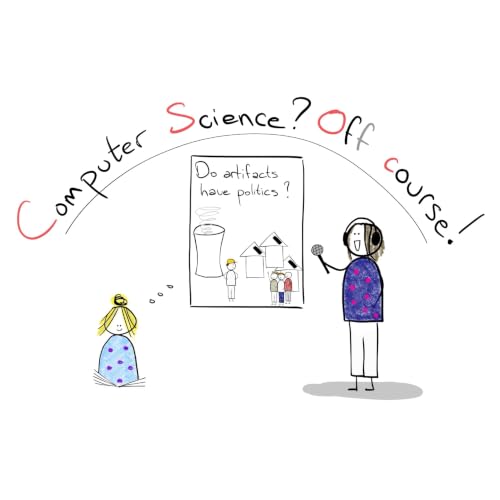
  • Langdon Winner - Do Artifacts Have Politics?
    2026/09/08

    Does software have politics? Are LLMs like power plants? Do ships need captains? In this final episode of our first season, we discuss these questions and take a look at Langdon Winner's paper "Do Artifacts Have Politics?" (1980). Spoiler alert: the answer to the question in this paper's title is a big, bold YES! According to Winner, there are two ways in which artifacts can have political properties. In our episode, we illustrate these with examples and apply Winner's observations to current technologies such as LLMs. We explore how the political properties of software can be accounted for in Computer Science education and establish links to prior episodes. As always, Felienne considers new tattoos, and Hanna finally does the homework she's been assigned.

    Links:

    • Our Discord channel for the pod: https://discord.com/invite/Vt2Pcc44m6
    • Felienne’s blog post: https://www.felienne.nl/csoc-s01e10/
    • Hanna’s homework: https://homework.unedited.me/posts/csoc-s01e10-homework/

    Mentions and references:

    • Winner, L. (1980). Do Artifacts Have Politics? Daedalus, 109(1), 121–136. Published by: The MIT Press on behalf of American Academy of Arts & Sciences. URL: http://www.jstor.org/stable/20024652.
    • Article on Robert Moses' Southern State Parkway's bridges: Campanella, T. J. (2017, July 9). Robert Moses and his racist Parkway, explained. Bloomberg.com. URL: https://www.bloomberg.com/news/articles/2017-07-09/robert-moses-and-his-racist-parkway-explained
    • Winner's quote about the inevitable link between nuclear power and a techno-scientific industrial-military elite comes from: Mander, J. (1977). Four arguments for the elimination of television. William Morrow & Co.
    • Jansen, F., Schraffenberger, H., & Jacobs, B. (2026, April). Decidos: Accessible, Usable and Secure Voting in Low-stakes Elections Using Identity Wallets. In Proceedings of the Extended Abstracts of the 2026 CHI Conference on Human Factors in Computing Systems (pp. 1-8).
    • Kaltenbrunner, M., Jorda, S., Geiger, G., & Alonso, M. (2006, June). The reacTable*: A collaborative musical instrument. In 15th IEEE International Workshops on Enabling Technologies: Infrastructure for Collaborative Enterprises (WETICE'06) (pp. 406-411). IEEE.
    • Wall of Sound (2008). Student project at Stuttgart Media University (HdM). Team: Steffel Abel, Tobias Adam, Simon Brenner, Andreas Jäger, Christian Schilling and Hanna Schraffenberger. See: https://vimeo.com/2477598

    Audio and music credits:

    • Song: “Curiosity Rag” (1910) by James E.C. Kelly (public domain)
    • Sound effects and background sounds: Public domain/CC0 sounds from Freesound.org and self-recorded page-turning sounds
    • Audio editing: Hanna at Earpolish.com

    続きを読む 一部表示
    41 分
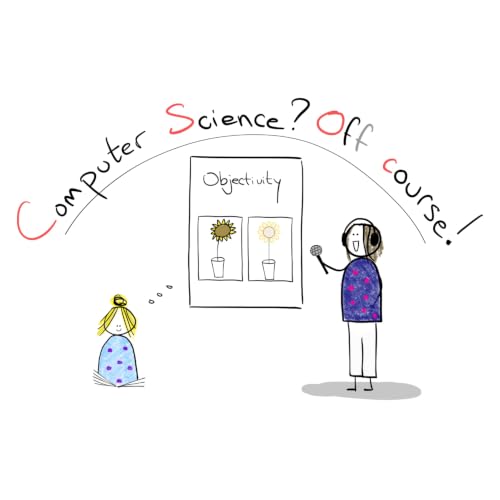
  • Lorraine Daston and Peter Galison - Objectivity
    2026/09/01

    Imagine you're a scientist. What is it you are seeking: objectivity or truth? In this episode of Computer Science Off Course, we reflect on the aims of science in general and Computer Science in particular. We discuss the notion of objectivity and the role of emotion and fear in research. We take a look at Lorraine Daston and Peter Galison's book "Objectivity" (2021) and walk you through the three periods in the history of objectivity. Also, there is talk about the shape of splashes and the beauty of flowers. Felienne has plans for one or two new tattoos, and Hanna refuses to choose between objectivity and truth! Whether you are a scientist or not, if you are interested in knowledge, this episode is for you.

    Mentions and references:

    • Daston, L., & Galison, P. L. (2021). Objectivity. Princeton University Press.
    • We have a discord, please join: https://discord.com/invite/Vt2Pcc44m6
    • Feynman, R. (1981). The beauty of a flower [Video]. https://www.bbc.co.uk/programmes/p018w2zl. Also available at: https://www.youtube.com/watch?v=ZbFM3rn4ldo
    • van Duijn, M. J. (2016). The lazy mindreader: A humanities perspective on mindreading and multiple-order intentionality (Doctoral dissertation, Leiden University).
    • Naur, P. (1985). Programming as theory building. Microprocessing and microprogramming, 15(5), 253-261.
    • Shownotes have a character limit. For more references, please have a look at the homework

    Links:

    • Felienne’s blog post: https://www.felienne.nl/csoc-s01e09/
    • Hanna’s homework: https://homework.unedited.me/posts/csoc-s01e09-homework/

    Audio and music credits:

    • Song: “Curiosity Rag” (1910) by James E.C. Kelly (public domain)
    • Sound effects and background sounds: Public domain/CC0 sounds from Freesound.org and self-recorded page-turning sounds
    • Audio editing: Hanna at Earpolish.com
    続きを読む 一部表示
    40 分
  • Gavin Mueller - Breaking Things at Work
    2026/08/25

    Are you a Luddite? No matter whether your answer is "yes," "no," or "maybe," this episode of Computer Science Off Course is for you. We discuss the book "Breaking Things at Work: The Luddites Are Right About Why You Hate Your Job" (2021) by Gavin Mueller. We talk about Luddism, both with a historical lens and from our current perspectives, and do not shy away from topics such as Marxism, Taylorism, and the question of whether computers can be good. Felienne brings various thought-provoking quotes and tells what she would love to break at work. Hanna, in contrast, ends up assembling T-shirts, confesses to being a hypocrite, and cites poetry for the homework.

    Mentions and references:

    • Mueller, G. (2021). Breaking things at work: The Luddites are right about why you hate your job. Verso Books.
    • Srinivasan, A. (2018). The aptness of anger. Journal of Political Philosophy, 26(2), 123-144.
    • Schwarz Cowan, R. (1983). More work for mother. The ironies of household technology from the open hearth to the microwave. Basic Books.
    • Gertz, N. (2024). Nihilism and technology. Bloomsbury Publishing.
    • Benjamin, W., & Jennings, M. W. (2010). The work of art in the age of its technological reproducibility [first version]. Grey Room, (39), 11-37. Original by Benjamin in French from 1936.
    • O'Hara, F. (1957). Why I am not a painter [Poem]. See: https://poets.org/poem/why-i-am-not-painter
    • Goldberg, M. (1955). Sardines [Painting]. Smithsonian American Art Museum, Washington, DC, United States. See: https://americanart.si.edu/blog/eye-level/2012/30/685/why-i-am-notpainter-michael-goldbergs-sardines
    • Offill, J. (2014). Dept. of Speculation. Granta Books.

    Links:

    • Felienne’s blog post: https://www.felienne.nl/csoc-s01e08/
    • Hanna’s homework: https://homework.unedited.me/posts/csoc-s01e08-homework/

    Audio and music credits:

    • Song: “Curiosity Rag” (1910) by James E.C. Kelly (public domain)
    • Sound effects and background sounds: Public domain/CC0 sounds from Freesound.org and self-recorded page-turning sounds
    • Audio editing: Hanna at Earpolish.com

    続きを読む 一部表示
    43 分
adbl_web_anon_alc_button_suppression_t1
まだレビューはありません