エピソード

  • User's Guide to Wiser AI
    2025/11/05

    Join us on Coach What Matters as we dive into the world of AI with a User's Guide to Wiser AI. Many of us are using AI for effective messaging, brainstorming, and image creation, but are we using it with an understanding of the AI's programmatic intentions? In this podcast, Leslie Szymborski and Cesar Flores share their first-hand learnings as well as the challenges and pitfalls of everyday use of AI, including:

    • Mirroring and Echo Chambers: Discover how AI can subtly reflect your own biases and create an echo chamber, especially during long conversations. Learn strategies to challenge AI's recommendations and avoid one-dimensional responses.
    • The Truth About Hallucinations: Unpack the concept of AI hallucinations – when models generate incorrect information without knowing it. Understand why this happens, how often, and what you can do to ensure reliable answers.
    • Detecting Bias: Explore how AI models can develop biases based on your prompts and usage patterns. Learn how to be explicit in your requests and understand the impact of compute power on answer quality.
    • Multi-Model Approach: For complex tasks like coding, hear why using multiple AI models (e.g., Grok, ChatGPT, Claude) can provide more robust and accurate results.
    • User Beware: Ultimately, the responsibility lies with the user to be aware of AI's limitations and implement checks and balances to ensure accuracy, especially when dealing with critical or private information.

    Outline:

    1. Introduction: Integrating AI into daily life (messaging, brainstorming, images) and the need for wiser usage.
    2. Challenges and Pitfalls of AI:
      • Mirroring the user and creating echo chambers.
      • The one-dimensional nature of AI vs. human interaction.
    3. Strategies for Effective Prompting:
      • Moving beyond search-like queries.
      • Role-based approaches for better recommendations.
      • Challenging AI's ideas: asking for advantages, disadvantages, and reasons not to follow recommendations.
    4. The Impact of Compute Power and Model Erosion:
      • How compute power affects answer quality.
      • The erosion of quality in long conversations and shortcut-taking.
      • The importance of checks and balances.
    5. AI Hallucinations:
      • Defining hallucinations and why they occur.
      • The increased likelihood in longer conversations.
      • Resetting conversations and clearing browser data for fresh interactions.
    6. Detecting and Mitigating Bias:
      • How word choice and usage patterns influence bias.
      • Differences between free and paid models.
      • The importance of explicit instructions.
    7. Multi-Model Usage (for complex tasks):
      • Why using multiple models is beneficial for coding and other complex problem-solving.
      • Examples of different AI models.
    8. Conclusion: User responsibility, awareness of limitations, and implementing guardrails for safe and effective AI use.
    続きを読む 一部表示
    33 分
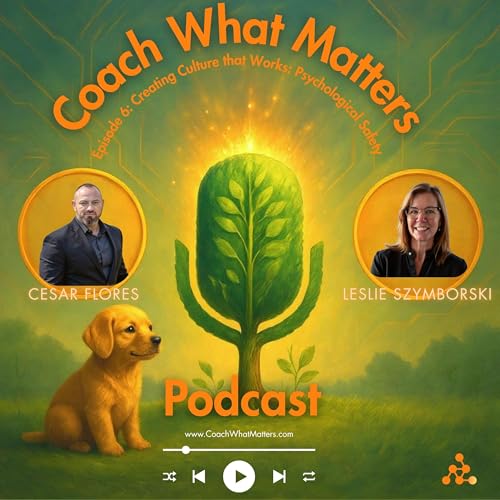
  • Creating Culture that Works: Psychological Safety
    2025/09/05

    Host Leslie Szymborski and guest Cesar Flores, a business coach, discuss the concept of psychological safety and its vital role in business success, innovation, and high-performing organizations. The episode begins by defining psychological safety, a term pioneered by Harvard professor Amy Edmondson, as a shared belief among team members that the team environment is safe for taking interpersonal risks. It's a climate of mutual trust and respect where individuals feel comfortable being themselves, continuously learning, and openly discussing mistakes.

    Key Takeaways:

    • The Current State of Psychological Safety: A Gallup poll revealed that only 28% of US employees in 2025 strongly agreed their opinions count at work, a slight decrease from 20174. This highlights the ongoing struggle leaders face in balancing a supportive environment with traditional command-and-control methods.
    • Defining Psychological Safety in Practice: Flores defines it as an environment where employees can bring their "best self to work" and feel confident in taking risks, making mistakes, and challenging ideas. However, this does not mean "anything goes". It is not a license for oversharing, a conflict-free zone, or a guarantee that one's ideas will always win. Instead, it is a balance of healthy discussion, sharing, and listening.
    • The Role of Leadership: Leaders are responsible for setting the tone for the entire employee experience, starting from the pre-interview process. They must be willing to balance three key concepts: psychological safety, emotional intelligence (self-awareness and building relationships), and compassionate candor (being honest with employees about performance in a non-ambiguous way).
    • Great Teams vs. Flawless Teams: The most effective teams aren't those that make the fewest mistakes, but rather those that are most willing to discuss them and learn from them. Conversely, a team that rarely shows mistakes might be too comfortable, not growing, or led by a strong personality who prevents new challenges. Leaders should allow teams to "self-heal" from within rather than intervening immediately, which can be detrimental.

    Tune in to learn more about how to cultivate a psychologically safe workplace that fosters growth, trust, and high performance.

    続きを読む 一部表示
    32 分
  • Why Coaching Matters
    2025/07/29

    Meet Cesar Flores, CEO and Enterprise Coach, Coach What Matters, LLC.

    Executive Coaching can lead to a 70% increase in individual performance, a 50% increase in team performance and a 48% increase in organizational performance.

    Hear about Cesar's path to Enterprise and Executive Coach.

    With overwhelming evidence that business coaching makes a profound impact on individual and organizational performance, what keeps company leaders from utilizing business coaching?

    What advantage can an enterprise coach give the CEO role? Solid coaching provides a partnership between coach and coachee, offering a mirror to CEOs and executives which exposes blind spots. Coaching provides an accountability feedback loop on behaviors and can help a business move from current state to desired state when the partnership is collaborative, confidential, and trusting.

    Ultimately, why does coaching matter?

    Listen to hear what it takes to see significant results from a great business coach!

    続きを読む 一部表示
    36 分
  • The Evolution of Project Delivery in Digital Technology
    2025/07/10

    In "The Evolution of Project Delivery in Digital Technology Companies," we're discussing Agile, Project Management, and The Why Blueprint to show you the operational realities. You’ll be surprised at Coach Cesar Flores' controversial comments on

    • The sale of agile
    • Surprising signals to organizational maturity
    • Improving your ‘flip of a coin’ chance at project success
    • The very future of the PMO (Project Management Office)

    Discover what's truly working (or not working) and what's next in digital project delivery. Also, we'll provide clarity on the guiding force behind The Why Blueprint(c).

    続きを読む 一部表示
    36 分
  • Impact of AI on Business Coaching
    2025/06/02

    Explore the transformative influence of artificial intelligence (AI) tools with Cesar Flores and Leslie Szymborski. They dive into the crucial question of whether a failure to adopt AI puts professionals at a disadvantage. Their discussion addresses the widespread conversation surrounding the potential displacement of Agile and Project leaders. Tune in to hear Cesar emphasize the vital role of leadership in navigating cultural shifts and upholding the fundamental business “Why”, all while leveraging AI's capabilities in pursuit of core strategic goals.

    続きを読む 一部表示
    31 分
  • Why Are We in Business: To Make Money
    2025/04/27

    Coach What Matters Podcast – Episode 2: Why Are We in Business: To Make Money

    In this thought-provoking second episode of Coach What Matters podcast, host Amber Cash is joined by Cesar Flores, Founder of Coach What Matters, for a deep dive into one of the most common yet complex questions in business: How do businesses shift from chasing revenue to building value-driven growth?

    Together, they explore the tension between chasing profit and delivering lasting value. Drawing from his 20+ years of executive coaching and leadership experience, Cesar unpacks how overemphasizing revenue as the primary measure of success can lead to short-term thinking, cultural burnout, and missed opportunities for sustainable growth.

    Amber and Cesar discuss how a revenue-first mindset often creates tunnel vision at the executive level, causes disconnection across teams, and impacts employee engagement. Backed by data and real-world examples, they highlight how reframing success around customer value and a company’s “why” creates a more resilient, motivated, and high-performing organization.

    The conversation also offers a practical framework for shifting toward a value-driven business model. From aligning your leadership teams and operational structures to understanding your ideal customer and building feedback loops, Cesar outlines how businesses can foster a self-sustaining ecosystem where revenue becomes the reward—not the goal.

    Whether you’re a founder, executive, or team leader, this episode will challenge you to reflect on the story your business is telling—and whether that story is grounded in purpose.

    Listeners are encouraged to visit www.CoachWhatMatters.com to check out previous episodes, explore the blog, and connect with the team for a consultation. You can also follow Coach What Matters on LinkedIn and Instagram for daily insights and strategies.

    Stay tuned for more episodes as we continue to explore what it really means to Coach What Matters.

    続きを読む 一部表示
    27 分
  • Starting with WHY
    2025/03/25

    Episode Summary: Coach What Matters Podcast – Episode 1: Starting with Why

    In this debut episode of the Coach What Matters podcast, host Amber Cash is joined by her three fellow founders of Coach What Matters—Cesar Flores, Leslie Szymborski, and Fejiro Sefia. Together, they share their decades of experience helping businesses tackle tough challenges and drive sustainable growth.

    The episode dives into the core philosophy of Coach What Matters, beginning with the importance of "Starting with Why." Cesar explains how businesses can easily lose sight of their core purpose when distracted by revenue targets and short-term goals. He emphasizes that a clear and consistent "why" is essential for making decisions that align with the company’s long-term vision, ultimately fostering a purpose-driven, impactful organization. Fejiro and Leslie build on this by discussing how focusing on "why" attracts the right talent, drives performance, and aligns a company’s vision with its operational execution.

    The team introduces their first offering, The Why Blueprint, a structured approach to creating sustainable success. They emphasize the importance of aligning executive leadership around core values, vision, and business metrics as a foundation for growth. Leslie and Fejiro discuss how The Why Blueprint helps organizations address strategy development and execution by ensuring leaders are aligned with the company’s purpose, while also building accountability and transparency across all levels.

    The episode concludes with a focus on navigating organizational change effectively. Cesar warns against excessive change, stressing the importance of clear communication, transparency, and involving employees in the process to maintain morale and trust.

    Listeners are invited to connect with Coach What Matters through their website www.CoachWhatMatters.com to request a consultation and check out their Blog or social media platforms for more insights.

    Stay tuned for future episodes where the team continues to unpack valuable strategies to help businesses thrive!

    続きを読む 一部表示
    23 分