• 2.41_Stop Giving Your Authority Away with Heather Zimmerman
    2026/09/09

    Episode SummaryIn this episode, I sit down with Heather Zimmerman for a conversation about self-trust, personal authority, and what happens when you stop looking outside yourself for all the answers.

    We explore the role that tools, systems, spiritual practices, dreams, and other forms of guidance can play in helping you understand yourself more deeply without becoming the authority over your experience. Heather shares how her background in psychology and human behavior pattern recognition intersects with her spiritual work, and we dig into the importance of learning how you receive, interpret, and trust information for yourself.

    We also talk about growth as a cyclical process. Revisiting something you thought you had already worked through does not necessarily mean you are back where you started. There may simply be another layer available to explore. Most importantly, we come back to what aligned leadership requires: continuing to practice what you teach, staying open to what you are still learning, and allowing your thoughts, words, and actions to reflect what you actually believe.

    In this episode, you’ll hear about:

    • Why tools and frameworks can support your growth without becoming the authority over your experience
    • The role trust plays in how you receive and interpret information
    • How Heather combines psychology, human behavior pattern recognition, and spiritual practices in her work
    • Why dreams can offer another space for processing, reflection, and exploration
    • How personal meaning can be more useful than relying solely on predetermined interpretations
    • Why growth, healing, and self-awareness can be cyclical rather than linear
    • What it means to practice what you teach as you continue to evolve
    • Heather’s definition of alignment as your thoughts, words, and actions moving in the same direction

    Key takeaways:

    • A tool can help you access your own wisdom without replacing it.
    • Something resurfacing does not automatically mean you failed to address it the first time. You may be encountering it from a different place with another layer available to explore.
    • Self-awareness continues to deepen as you revisit familiar questions through new experiences.
    • Aligned leadership asks you to embody and practice what you teach, not simply understand it intellectually.
    • You do not have to have all the answers to trust yourself as you continue learning.

    Call to ActionNotice where you automatically look outside yourself for an answer. What changes when you use the information available to you as support, then give yourself space to notice what you know?LinksCharting Your Course: https://www.atmaitri.com/chartingyourcourseWork with Heather: https://www.divineascensionco.comUse coupon code: PODCAST for 10% off any session or program (one time use).


    続きを読む 一部表示
    1 時間
  • 2.40_Building an Online Community That Feels Like Real Life with Deanna Seymour
    2026/09/02

    Episode Summary

    In this episode, I sit down with Deanna Seymour to talk about what it actually takes to build an online community around real human connection, especially when people have become accustomed to being told where to go, what to do, and how to participate online.

    We explore the tension between structure and autonomy, the unpredictable reality of creating spaces that depend on people actually showing up, and why the technology you choose matters less than creating an experience that supports the way you want people to connect. Deanna shares what she has learned building the Playhouse, including her decision to embrace GoBrunch instead of second-guessing whether she should be using the platforms everyone else expects.

    Our conversation also turns toward what happens when you give people more agency inside a community. You can choose your own table. You can leave when you need to. You can spend time talking about parenting with someone who happens to build websites and still walk away knowing exactly who you would recommend when someone needs a website.

    Most importantly, we come back to the idea that community doesn't have to recreate the rigid structures people are used to online. You can build enough structure to help people participate while still leaving room for friendship, choice, play, work, growth, and all the messiness of being human.

    In this episode, you’ll hear about:

    • Why building an online community is fundamentally different when the focus is on relationships rather than simply hosting people on a digital platform
    • How Deanna uses GoBrunch to give members more freedom to choose where they go and who they connect with
    • The tension between wanting autonomy and still needing enough structure to participate and get things done
    • Why people can be uncomfortable when they aren't automatically assigned a breakout room, activity, or prescribed way to engage
    • How consistent, informal connection can naturally lead to friendships, referrals, clients, and collaboration
    • What Deanna's personal Autumn season revealed about simplifying, refining, and talking more about what she has already created
    • Why creating something new isn't the only way to satisfy the desire to make, experiment, and play
    • What aligned leadership looks like when you make room for your strengths, your growth, and the parts you're still figuring out

    Key Takeaways

    • Structure and autonomy aren't opposites. The right structure can give people enough support to make their own choices instead of dictating every part of their experience.
    • Community requires participation. When connection is the product, the people inside the space aren't passive consumers. Their presence and relationships help create the experience.
    • You don't always need to create something new. Sometimes the next step is refining, communicating, or building around what you've already created.
    • Real relationships don't have to look like networking. Someone doesn't need to pitch their expertise in every conversation for you to know, trust, and eventually recommend them.
    • Aligned leadership includes being human. You can live your values, share what you know, and still acknowledge what you're learning or haven't figured out yet.

    Call to Action

    Think about the online spaces you participate in or create. Where could a little less control give people more room to connect, participate, and show up like themselves?

    Links

    Charting Your Course®: https://www.atmaitri.com/chartingyourcourse

    Deanna Seymour: https://deannaseymour.com/


    続きを読む 一部表示
    1 時間 10 分
  • 2.39_The More You Know Yourself, the More You Can Become with Robin Thomas
    2026/08/26

    Episode Summary


    In this episode, I sit down with Robin Thomas for a wonderfully nerdy conversation about what becomes possible when you keep getting to know yourself more deeply.

    We explore personal seasons, cycles of development, energy, spirituality, and the many frameworks we use to make sense of who we are. Robin and I compare the languages and systems we've each developed through years of observation and experimentation, finding surprising places where seemingly different approaches point toward similar patterns.

    We also dig into an important distinction around personal growth: moving forward doesn't always require going backward first. Parts of ourselves may become dormant, neglected, or left behind, but they don't disappear. We can recognize them, welcome them forward, and continue becoming from where we are now.

    Most importantly, we come back to the idea that knowing yourself isn't about finally arriving at a complete definition of who you are. The more of your own "book" you understand, the more intentionally you can participate in what comes next.


    In this episode, you'll hear about:

    • How your personal seasons can reveal patterns in your timing, energy, and development
    • Why frameworks can give you another layer of self-understanding without defining who you are
    • The relationship between personal cycles, collective cycles, and the seasons happening around us
    • Why you don't necessarily have to go backward or "excavate" your past in order to move forward
    • What happens when parts of yourself become dormant and how you can bring them forward again
    • How curiosity, observation, and experimentation can deepen your relationship with your own patterns
    • Why greater self-knowledge gives you more choice in how you participate in your own becoming
    • What aligned leadership looks like when you recognize the influence you have on the people around you

    Key Takeaways

    • Self-knowledge isn't a destination. You continue discovering new layers of yourself as you move through different experiences, seasons, and cycles.
    • You don't have to resolve everything in your past before you're allowed to move forward. You can welcome more of yourself into the life you're living now.
    • Frameworks are most useful when they give you information to explore rather than answers about who you're supposed to be.
    • The same information can mean something different at different points in your life. Your perspective changes because you change.
    • The more of yourself you know, the more intentionally you can become who you're here to be.

    Call to Action

    What part of your own "book" are you getting to know right now?

    Pay attention to what you're learning about yourself in this season without needing to immediately explain, fix, or turn it into an answer. Let yourself be curious about what this new information might make possible.

    LinksCharting Your Course

    Work with Robin!


    続きを読む 一部表示
    1 時間 5 分
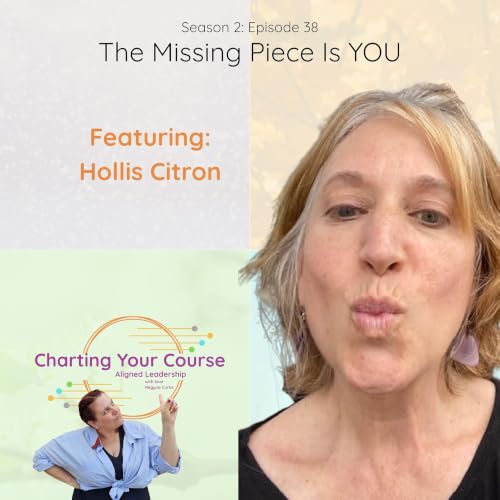
  • 2.38 The Missing Piece Is YOU with Hollis Citron
    2026/08/20

    Episode Summary

    In this episode, I sit down with Hollis Citron for a conversation about what happens when you stop trying to get everything right and actually bring yourself into the process.

    We explore the difference between following a framework and being present within it, why play and experimentation are valuable ways to learn, and how curiosity can help you recognize and interrupt the patterns shaping your choices. Hollis and I also talk about vulnerability, uncomfortable conversations, taking up space, and what it means to allow yourself to be fully human while you figure things out.

    Most importantly, we come back to a simple truth: you can have the strategy, structure, tools, and support, but if you remove yourself from the process, something essential is missing.


    In this episode, you’ll hear about:

    • Why the energy you bring to something can matter as much as the strategy you use
    • The difference between checking the boxes and actually being present in the process
    • Why play, experimentation, and making mistakes create opportunities for learning
    • How curiosity can help you interrupt familiar thought patterns
    • What vulnerability and uncomfortable conversations can reveal
    • How your personal timing influences the perspective you bring into collaborations
    • Why two people in very different seasons can use those differences to strengthen their work together
    • What it looks like to use structure as support without becoming rigid inside it

    Key Takeaways

    • A framework can give you structure, but you still have to bring yourself to it.
    • Play isn't separate from meaningful learning. It can create the space where discovery happens.
    • Curiosity gives you somewhere to go when you don't have an answer yet.
    • Understanding the perspective you're bringing into a collaboration can help you work with someone whose needs are different from yours.
    • Aligned leadership includes allowing yourself to be human, make mistakes, evolve, and show up as who you are now.

    Call to ActionPay attention to one place where you're trying especially hard to do something "right." What changes when you relax into the structure and give yourself permission to play?Links

    Charting Your Course: https://www.atmaitri.com/chartingyourcourse

    Love Beyond the Surface: https://www.iamcreativephilly.com/storiesoflove


    続きを読む 一部表示
    1 時間 20 分
  • 2.37_The Patterns That Shape Your Growth with Amani Roberts
    2026/08/12

    Episode SummaryIn this episode, I sit down with Amani Roberts to explore the patterns that shape your growth, both personally and professionally.

    I want you to understand how recognizing patterns can give you useful information about where you are, what keeps repeating, and what may need to change. Amani and I explore the connection between your personal development and your professional growth, the rhythms that exist within creative industries, and the role curiosity and creative risk can play in moving you forward.

    We also talk about what happens when different parts of who you are feel like they belong in different spaces, and how greater self-awareness can help you make choices that support where you actually want to go.

    Most importantly, this conversation comes back to paying attention. The sooner you recognize the patterns showing up in your relationships, business, creativity, and decisions, the more intentionally you can choose what happens next.

    In this episode, you’ll hear about:

    • How personal and professional patterns influence each other
    • Recognizing recurring patterns in relationships and business development
    • The difference between your internal timing and the external rhythms of your industry
    • Why curiosity can be just as powerful a driver as solving a specific need
    • What Amani has learned from moving between corporate, creative, academic, and entrepreneurial spaces
    • The importance of surrounding yourself with people who will tell you the truth and help you recognize your blind spots
    • Taking creative risks as a way to strengthen your creativity
    • Reinvention as a pathway for continued growth

    Key takeaways:

    • Recognizing a pattern gives you an opportunity to respond to it differently.
    • Personal growth and professional growth are intertwined. What is happening in one area can affect your capacity in the other.
    • Understanding your own internal rhythms can help you navigate external demands you cannot control.
    • Growth can require intentionally choosing people and environments that challenge you.
    • Creative risk does not have to be enormous. You can begin by doing one familiar thing differently.

    Call to ActionPay attention to something that keeps repeating in your life or business. Instead of immediately trying to change it, get curious about what the pattern might be showing you.LinksCharting Your CourseAmani Experience


    続きを読む 一部表示
    44 分
  • S2.E36_Building Structure That Creates Freedom_With Lindsay Johnson
    2026/08/05

    Episode Summary

    What if the freedom you're looking for isn't found by removing structure, but by creating the right kind of structure?

    In this episode, I sit down with Lindsay Johnson for a conversation about what it really takes to grow without losing yourself in the process. Together, we explore the relationship between self-trust, structure, and sustainable growth, and why so many entrepreneurs mistake freedom for the absence of boundaries.

    You'll hear why scaling is as much an internal process as it is a business strategy, how emotional intelligence influences your ability to lead, and why learning to let go is often the next step toward meaningful growth. Most importantly, I hope you walk away seeing that the right structure doesn't limit you. It creates the freedom to become more fully yourself.

    In this episode, you'll hear about:

    • Why structure creates freedom instead of restricting it
    • The difference between growing a business and simply getting more customers
    • How self-trust influences leadership, delegation, and decision making
    • Why perfectionism, people pleasing, and control can quietly limit growth
    • The importance of recognizing when you've outgrown a season, role, or room
    • How creating space to fully feel your emotions strengthens resilience and leadership
    • The riverbanks and tomato cage metaphors as examples of structure that supports natural growth


    Key takeaways

    • Freedom and structure are not opposites. The right structure gives your growth somewhere to go.
    • Scaling begins with your willingness to let go of old identities, habits, and responsibilities.
    • Feeling discomfort instead of avoiding it creates greater resilience, clarity, and self-trust.
    • You don't have to build your business alone. Sustainable growth comes through support and collaboration.
    • Every season eventually comes to completion, creating space for the next stage of growth.

    Call to ActionTake a few quiet minutes to reflect on where you might be holding on to something that has already run its course. Ask yourself what would become possible if you created structure that supported the next version of your growth instead of trying to control it.LinksCharting Your Course


    Lindsay Johnson

    Website: https://theradicalconnector.com

    YouTube: https://www.youtube.com/@radicallinds


    Books mentioned in this episode

    Burnout by Emily Nagoski and Amelia Nagoski
    https://www.goodreads.com/en/book/show/42397849-burnout

    Do Nothing by Celeste Headlee
    https://www.goodreads.com/en/book/show/52668196-do-nothing

    Laziness Does Not Exist by Devon Price
    https://www.goodreads.com/en/book/show/54304124-laziness-does-not-exist

    Nonviolent Communication by Marshall B. Rosenberg
    https://www.goodreads.com/en/book/show/71730.Nonviolent_Communication


    続きを読む 一部表示
    1 時間 10 分
  • 2.35_When a Framework Becomes a Cage with Mel McSherry
    2026/07/29

    Episode SummaryIn this episode, I sit down with Mel McSherry to explore a question that has become increasingly important in today's world of personality assessments, self-discovery tools, and business frameworks: When does a framework stop helping and start limiting who you believe you can become?

    I want you to understand that tools like Human Design, astrology, personality frameworks, and Charting Your Course are meant to deepen your relationship with yourself, not replace your own wisdom. Together, we explore how these tools can validate your experience, reveal new possibilities, and offer meaningful language for what you're living through without becoming labels that define or confine you.

    Most importantly, this conversation is an invitation to trust yourself more deeply, use every framework with curiosity, and remember that your uniqueness will always matter more than the system you're using to understand it.

    In this episode, you'll hear about:

    • Why frameworks are guides for exploration rather than identities to live inside
    • How timing changes the way you apply personal and business development tools
    • The difference between seeking validation and building genuine self-trust
    • Why one-size-fits-all business advice often creates unnecessary pressure
    • How experimentation helps you discover what is actually true for you
    • The role curiosity plays in personal growth, leadership, and sustainable success
    • Why your individuality is your greatest contribution to collaborative leadership

    Key Takeaways

    • The goal of any framework is to help you know yourself better, not tell you who you are.
    • Self-trust grows through experimentation, reflection, and lived experience rather than following someone else's formula.
    • The same strategy can produce very different results depending on your timing, your season, and your unique circumstances.
    • Sustainable leadership begins by understanding your own strengths before trying to imitate someone else's.
    • You don't have to fit inside a framework. You can use it as a tool while continuing to grow beyond it.

    Call to ActionChoose one framework you've found helpful and ask yourself: Am I using this as a guide for exploration, or have I started using it to define who I am?

    Notice what changes when you approach it with curiosity instead of certainty.

    LinksCharting Your CourseConnect with Mel McSherry


    続きを読む 一部表示
    58 分
  • 2.34_Learning to Relax Into Yourself with Jordan Maney
    2026/07/22

    Episode SummaryIn this episode, I explore what it really means to relax into yourself and why so many of us spend years believing we need to become someone different before we can feel at ease. I want you to understand how honoring your natural rhythm can become an act of radical self-acceptance that transforms the way you live, work, rest, and lead.

    Jordan Montgomery joins me for a conversation about joyful rest, personal timing, and the permission to stop measuring yourself against someone else's way of moving through the world. Together, we explore how understanding your unique rhythm helps you replace self-judgment with compassion and why learning to trust your own timing creates more ease in your relationships, decisions, and leadership.

    Most importantly, we come back to this simple truth: nothing about who you are needs fixing. Sometimes the greatest transformation comes from learning to relax into the person you've been all along.

    In this episode, you'll hear about:

    • Why social rest begins with feeling safe enough to be yourself.
    • The difference between recovering, sustaining, and regenerative rest.
    • How your personal seasons influence the way you restore your energy.
    • Why comparing your timing to someone else's creates unnecessary pressure.
    • How understanding your natural rhythm builds compassion for yourself and the people around you.
    • The connection between self-acceptance, joyful rest, and aligned leadership.
    • Why honoring your own timing creates healthier relationships and more meaningful collaboration.

    Key Takeaways

    • Self-acceptance begins when you stop assuming your natural rhythm is something to fix.
    • Rest becomes more restorative when it aligns with what you genuinely need in the season you're in.
    • Understanding your own timing creates greater compassion for yourself and the people around you.
    • Leadership becomes more authentic when your words, actions, and values are in alignment.
    • Sometimes the greatest permission you can give yourself is simply to relax into who you already are.

    Call to ActionTake a few quiet moments this week to ask yourself:

    Where would my life feel more easeful if I stopped trying to move at someone else's pace and relaxed into my own rhythm instead?LinksCharting Your CourseJordan Maney


    続きを読む 一部表示
    1 時間 7 分