エピソード

  • What Business Partners Really Say Behind Closed Doors
    2026/10/26
    What do business partners actually talk about when no one else is in the room? In this episode of Built By Doing, Stan Kleja and I flip the script and ask each other the questions we usually skip. We get into business partnership, expanding to new locations, hiring ahead of growth, and what it really costs to open before you're ready. We also talk about running multiple businesses at once, managing a team, sharing equity with the people who help you grow, and how our thinking on marketing and advertising has changed over the last ten years. If you're an entrepreneur, small business owner or thinking about taking on a business partner, this one's for you. www.builtbydoingpodcast.com
    続きを読む 一部表示
    19 分
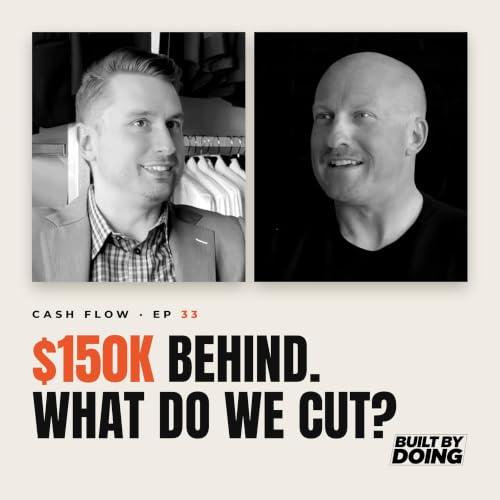
  • What to Cut First When Cash Flow Gets Tight
    2026/10/19
    Some months are great. Some months are tight. Ten years in, we still have this conversation, and right now we're having it again with our new Columbus location. In this episode of Built By Doing, Stan Kleja and I talk about how to navigate tight cash flow months as a business owner and what to cut first when money gets tight. Earlier this year we hit a stretch that should have been our best season. Slow holiday sales, a slow winter, thousands a month in snow plowing, about $10,000 stuck in tariff refunds, and software we were paying for but not using. We ended up roughly $150,000 behind where we planned to be. That kind of stretch tests your team, your patience and your decision making. We break down how to know your real monthly and annual spend, the expense "levers" you can pull when sales dip, why you cut long-term brand advertising before quick-return advertising, building a cash reserve vs. using a line of credit, and why so many owners say "I can't run the business without that" until they have to. I also get honest about my own early years. I traveled constantly to sell one $500 suit at a time, kept the nice house and the BMW to play the perception game, and had selling the house as my ejection seat button. Stan explains why cutting an expense rarely means losing it forever, how a client in insurance hired too fast and spent a year regrouping, and why a business that doesn't have to pay the owner can grow faster. We also talk about risk tolerance, ignoring competitors and social media highlight reels, cutting personal spending (yes, even holiday gifts), and why building something real takes 5 to 10 years minimum. If you're an entrepreneur, small business owner, startup founder or anyone dealing with cash flow problems right now, the tight months are part of the game. Cut what you can, run lean and keep building. http://www.builtbydoingpodcast.com
    続きを読む 一部表示
    27 分
  • How Much Should You Pay Yourself as a Business Owner?
    2026/10/12
    In 2017, my W-2 from my own business was $7,800. The next two years weren't much better. At one point I was seriously ready to sell my house and live in a van just to keep the business going. In this episode of Built By Doing, David Alan and Stan answer one of the most common questions in business: how much should you pay yourself as a business owner? We start with the number most people skip: what you actually need to live, not what you want. If you need $100,000 a year and the business only makes $100,000, the business can't grow. It can't hire, it can't advertise and it can't test anything new. Worse, if it only makes $80,000, you end up on loans and credit cards, hurting the business to fund your personal life. David shares the real numbers from his early years. Paying himself almost nothing. Running the math on giving up a $2,800 mortgage as a last resort. Digging out of $60,000 to $70,000 in credit card debt that was really business debt. Giving up nights out, trips and even some friendships to keep the business alive. Stan shares a client who lived on $2,000 a month for three years and passed $1 million this year. Then we get into how owner pay changes as the business grows. We cover W-2 salary vs. distributions, when an S corp election makes sense, what the IRS means by a reasonable salary, guaranteed payments in partnerships, the Profit First model, and why one client saved over $40,000 in taxes this year just by restructuring how he gets paid. We also talk about reinvesting in ad spend and hiring, paying off debt fast, and how the biggest players borrow against equity instead of paying themselves at all. The big lesson: every dollar you don't need personally can go back into the business and make more. But your story isn't anyone else's story. Know your number, know your goals, and get someone in your corner who understands the tax side. If you're an entrepreneur, small business owner, startup founder or side hustler trying to figure out what to pay yourself, start here. www.builtbydoingpodcast.com
    続きを読む 一部表示
    26 分
  • The Hardest Business Lesson: You Can’t Control Everything
    2026/10/05
    Nothing in business goes exactly according to plan. The longer I do this, the more I realize that's not the exception — that's entrepreneurship. In this episode of Built By Doing, we're reviewing our September business goals, what we accomplished, what we missed, what went completely sideways, and what we're carrying into October as we continue growing David Alan Clothing and our other businesses. September gave us one of our biggest wins ever: our annual David Alan Fashion Show raised more than $100,000 for Casey's Clubhouse in one night. But at the same time, other parts of the business were anything but smooth. Our new Columbus location was delayed by construction issues, an architect that didn't deliver, one sign company that stopped responding and another that turned out not to be licensed to install our sign in Columbus. Our Charleston expansion that we thought was nearly a done deal hit new obstacles during lease negotiations. Our original Nashville expansion plan fell apart, forcing us to pivot to a different—and potentially better—location. That's the reality of growing and scaling a business. You can create a business plan, set monthly goals, build timelines and prepare for every scenario you can think of. Then employees, vendors, landlords, contractors, permits, construction, cash flow and a hundred other variables enter the equation. We talk about why entrepreneurs consistently underestimate how long things will take, the difference between internal goals and goals dependent on outside parties, learning when to walk away from a bad business relationship, managing cash flow during expansion, evaluating commercial real estate opportunities, hiring the right people, and why mistakes are often simply the cost of your entrepreneurial education. One of the biggest lessons I've learned after more than a decade in business is that experience doesn't mean things stop going wrong. You just become better at handling them when they do. We also look ahead at our October business goals, including getting Columbus fully operational, moving Nashville and Charleston forward, growing Closets by David Alan, hiring another stylist and launching a new initiative designed to help other entrepreneurs and creators get exposure as they're building their own businesses. If you're an entrepreneur, small business owner, startup founder or anyone trying to grow and scale a business, remember this: the plan is going to change. Keep moving anyway.
    続きを読む 一部表示
    33 分
  • Employees, Pricing, Marketing: 5 Expensive Business Mistakes
    2026/09/21
    Your business can generate revenue and still have serious problems underneath the surface. In this episode of Built By Doing, we're answering real questions from business owners dealing with the kinds of problems that don't always have an obvious answer. One owner did $410,000 in revenue last year but only took home $38,000 — while two of his employees made more than he did. Is that normal when you're building a business, or a sign that something is seriously wrong? Another business owner is about to lose her top employee, who's leaving to start a competing company and already knows every client in the business. We talk about protecting client relationships, non-solicitation agreements, controlling the narrative and what to do when an employee becomes your competitor. We also break down what happens when you raise your prices 20% and immediately lose customers, whether you should keep funding a second location that's losing $6,000 every month, and one question I think a lot of business owners need to ask: If you're spending $5,000 a month on advertising, can you actually prove it's making you money? We get into marketing attribution, misleading ROAS numbers, tracking leads and sales, evaluating your marketing agency, understanding where problems exist in your sales funnel, and why business owners need visibility into where their revenue and profit are actually coming from. There isn't one universal answer to every business problem. Sometimes making less money today is part of building something bigger tomorrow. Sometimes losing customers after a price increase is actually a necessary reset. And sometimes that gut feeling that something isn't working is telling you it's time to dig into the numbers. We're not pretending we know every answer. We're sharing what we've learned from actually building businesses, making mistakes, losing money, hiring people, opening locations and figuring things out along the way. If you're an entrepreneur or small business owner dealing with profitability, employees, pricing, expansion, marketing or growth, this one's for you.
    続きを読む 一部表示
    19 分
  • 10 Years of Charity Fashion Shows
    2026/09/14
    Do you have to become successful before you can start giving back? I don't believe you do. In this episode of Built By Doing, I'm looking back at ten years of David Alan Fashion Shows and why giving back became part of our business long before David Alan Clothing became the company it is today. The first Fashion Show started in 2016 almost by accident. I was raising money for the American Cancer Society's Real Men Wear Pink campaign, had a young clothing brand, knew a few professional athletes and WWE wrestlers, and thought: Why don't we put on a fashion show? We had no idea whether 20 people or 500 people would show up. That first event had a budget of roughly $16,000. A decade later, we're producing a Fashion Show that costs more than $200,000 to put on — but the purpose behind it hasn't changed. I share some of the craziest stories from those ten years, including the year an event planner canceled our entire Fashion Show one hour before it was supposed to begin, leaving us scrambling to move the event to a completely different venue in about 60 minutes. We called every ticket holder, sponsor and celebrity, found a new location and somehow pulled it off. But this episode isn't really about fashion shows. It's about why I believe businesses and entrepreneurs have an obligation to positively impact the people around them. Stan shares a story I'd nearly forgotten: years ago, we were sitting at Panera discussing how broke I was and what would happen if I ran out of money. A veteran walked in, and I got up and bought his lunch. Then I sat back down and continued talking about how I might lose my house. That story hit me hard. Because I've always believed you don't have to wait until you have everything figured out to help somebody else. This year, the 10th Annual David Alan Fashion Show: Dreaming On benefits Casey's Clubhouse and its incredible athletes with special needs. We're taking over the heart of downtown Pittsburgh on September 19, 2026, and we've set our biggest charitable goal yet: Raise $100,000 in one night. Whether you're an entrepreneur, business owner or simply someone trying to build something meaningful, I hope this episode challenges you to think beyond revenue and growth. Build the business. Chase the dream. Become successful. But bring other people with you.
    続きを読む 一部表示
    31 分
  • Entrepreneurship Doesn’t Get Easier. The Problems Just Change.
    2026/09/07
    Does entrepreneurship ever actually get easier? Year one is hard. Year five is hard. Year ten is hard. The difference is why. In Episode 28 of Built By Doing, David Alan and Stan Kleja break down how the challenges of entrepreneurship change as a business grows — from fighting to survive in the early years to learning how to lead people, delegate responsibility, manage multiple companies and decide which opportunities are actually worth pursuing. David looks back at the earliest years of building David Alan Clothing, when every dollar mattered. He shares what it was like putting roughly $60,000–$70,000 in business expenses on personal credit cards, defaulting on debt, going months without paying himself, prioritizing employees and vendors before his own paycheck, and reaching points where the question wasn't how to fund the next year — it was how to find money by next week. Success eventually changes those problems, but it doesn't eliminate them. With more money, a larger team, multiple businesses, national expansion and more opportunities comes an entirely different challenge: Where should your time go? Who should you trust? What should you delegate? Which opportunity deserves a yes — and which needs a no? David and Stan discuss the transition from entrepreneur to CEO, why learning to trust other people with your business is essential for growth, what David looks for when hiring, and why time may be one of the best tests of whether someone truly belongs on your team. They also tackle one of the most consequential decisions a business owner can make: giving away equity. When does an employee deserve more compensation versus actual ownership? What level of value should a potential equity partner bring? And why can giving equity away too early become a mistake you can't easily undo? The conversation ultimately returns to a truth that applies whether you're in your first, fifth or tenth year of business: The challenges don't disappear. You become better equipped to handle them. If you're starting a business, scaling a company, building a team or trying to make the transition from entrepreneur to CEO, this episode offers a candid look at what changes — and what doesn't — as your business grows. Built By Doing is a business and entrepreneurship podcast about what it actually takes to build, lead and grow companies — told through the decisions, mistakes, lessons and experiences happening in real time.
    続きを読む 一部表示
    26 分
  • Our August Goals Didn’t Go to Plan. Now What?
    2026/08/31
    What happens when you set ambitious business goals and reality has other plans? In Episode 27 of Built By Doing, David Alan and Stan Kleja revisit the goals they publicly set for August and give an unfiltered assessment of what worked, what failed, what got delayed, and what those setbacks actually cost. The biggest miss? The new Columbus location still isn't open. Construction delays, permitting issues, architectural decisions and unexpected problems have pushed the timeline back, while rent, payroll, utilities and other expenses continue adding up. But August wasn't all losses. The team built a new sales dashboard that's changing how they coach and manage performance, added another key member to the Closets by David Alan team, hit the Fashion Show sponsorship goal ahead of the event, and continued making progress toward expansion into Charleston and Nashville. More importantly, the setbacks exposed weaknesses in their processes that can now be corrected before opening even more locations. David and Stan break down the lessons they're taking from August, including why entrepreneurs need to trust but verify, why spending money on the right expertise can actually save money, how seemingly small problems compound during expansion, and why missing a goal doesn't mean the goal was a failure. Then it's time to put themselves on the record again. They lay out their September business goals, including opening Columbus, advancing Charleston and Nashville expansion, growing the closet business, testing custom hardwood installations, launching a potential new custom blinds service, hitting company-wide sales targets, and an ambitious goal of raising $100,000 for Casey's Clubhouse through the David Alan Fashion Show. This is entrepreneurship while it's actually happening; the wins, the misses, the money, the mistakes and what happens next. If you're building, growing or scaling a business, this episode is a reminder that the plan rarely survives exactly as you wrote it. What matters is how quickly you learn, adjust and keep moving. Built By Doing follows the real-world process of entrepreneurship, business growth, leadership and building companies — without pretending everything goes according to plan. www.builtbydoingpodcast.com
    続きを読む 一部表示
    35 分