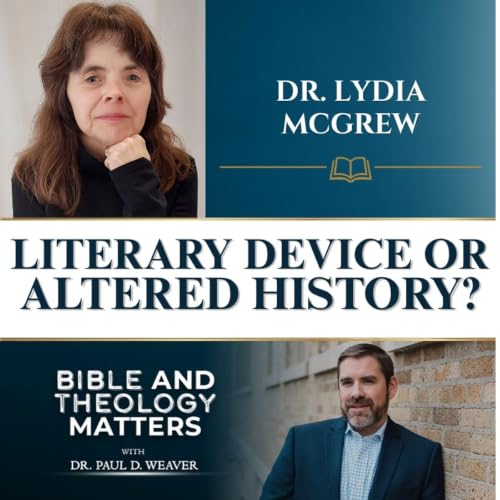
『Bible and Theology Matters: Insightful Conversations with Bible Scholars』のカバーアート

Bible and Theology Matters: Insightful Conversations with Bible Scholars

Bible and Theology Matters: Insightful Conversations with Bible Scholars

著者: Dr. Paul D. Weaver - DTS Professor and Biblical Scholar
無料で聴く

【Amazonプライム会員限定】今ならプレミアムプランが4か月 月額99円。

10月19日まで。※適用条件あり
The Bible and Theology Matters Podcast is a conversation with Biblical Scholars about all things Bible and Theology, including: challenging issues of Bible interpretation, important theological topics, essential Hermeneutical principles, Bible backgrounds and customs, Biblical ethics and worldview, apologetics, biblical archaeology, and much more. Dr. Paul D. Weaver, Professor and Biblical Scholar at Dallas Theological Seminary is the host.Copyright Paul D Weaver キリスト教 スピリチュアリティ 教育 聖職・福音主義
エピソード
  • BTM 212- How Richard Dawkins Led People to Christianity | Alister McGrath
    2026/10/01
    What if Richard Dawkins, one of the most prominent voices of New Atheism, actually led some people to investigate Christianity—and ultimately become Christians?

    In this re-released episode of Bible and Theology Matters, Dr. Paul Weaver speaks with Dr. Alister McGrath about Richard Dawkins, New Atheism, science and religion, and the surprising stories of people who moved from atheism toward faith in Jesus Christ.

    Drawing from Dr. McGrath’s book Coming to Faith Through Dawkins: 12 Essays on the Pathway from New Atheism to Christianity, this conversation explores why some people who were initially persuaded by Dawkins’ arguments against religion eventually began questioning his understanding of Christianity and investigating the Christian faith for themselves.

    Dr. McGrath discusses five characteristics of New Atheism that contributed to this unexpected response, including its aggressive attacks on religion, its understanding of the relationship between science and faith, its tone of certainty, and the way its leading voices approached disagreement and criticism.

    In this episode, we discuss:
    • Who Richard Dawkins is and his role in the New Atheism movement
    • The God Delusion and Dawkins’ arguments against Christianity
    • The difference between Richard Dawkins’ atheism and Anthony Flew’s philosophical atheism
    • Whether science and Christianity are really in conflict
    • The historical “warfare model” of science versus religion
    • Why some readers of Dawkins began investigating Christianity for themselves
    • Stories of people who moved from New Atheism to faith in Jesus Christ
    • The importance of understanding Christianity before criticizing it
    • The power of personal testimony and storytelling in Christian apologetics
    • How Christians can engage questions and objections to the Christian faith
    Dr. Alister McGrath is a theologian, scientist, and intellectual historian who has written extensively on the relationship between science and Christianity, atheism, theology, and Christian apologetics. His academic background includes doctorates in molecular biophysics, theology, and intellectual history, and he spent much of his career teaching at Oxford.

    Whether you're interested in Richard Dawkins, New Atheism, atheism and Christianity, science and religion, Christian apologetics, or the evidence for the Christian faith, this conversation offers an engaging look at how questions and objections can sometimes lead people to investigate Christianity more seriously.

    Watch the full conversation and consider the questions for yourself.Subscribe to Bible and Theology Matters for conversations about the Bible, theology, Christian apologetics, faith, and the historical foundations of Christianity.

    Because what you really believe determines how you really behave.

    Support: fim.org/give/weaver
    続きを読む 一部表示
    35 分
  • BTM 211- Genesis vs. Ancient Myths: Where Scholars Got It Wrong
    2026/09/24
    Did Moses borrow the creation and flood accounts in Genesis from ancient Near Eastern myths? What should Christians make of the similarities between Genesis 1–11 and texts such as Enuma Elish, the Atrahasis Epic, and the Epic of Gilgamesh?

    In this episode of Bible and Theology Matters, Dr. Paul D. Weaver sits down with Dr. Michael Grisanti, Professor of Old Testament at The Master's Seminary and a leading scholar of the Old Testament and ancient Near Eastern literature, to explore these important questions.

    Dr. Grisanti explains why understanding genre, historical context, and the ancient Near Eastern world can be valuable for interpreting Scripture—but also why those backgrounds should never become the controlling lens through which we interpret Genesis.

    Together, they discuss:
    What is genre criticism, and why does genre matter for biblical interpretation?
    What are the major ancient Near Eastern texts compared with Genesis 1–11?
    What are the actual similarities between Enuma Elish and Genesis 1?
    How does the Epic of Gilgamesh compare with the biblical flood account?
    Did Moses borrow from Babylonian or Sumerian creation accounts?
    How should Christians understand similarities between ancient texts?
    When does comparative ancient Near Eastern study become "parallelomania"?
    How can ancient Near Eastern customs and literature genuinely illuminate the biblical text?
    Does Genesis 1–11 present history or myth?
    Why does the historicity of Genesis 1–11 matter theologically?
    Do you need a PhD to understand the Old Testament?
    How should pastors and students respond when critics use ancient Near Eastern parallels to challenge confidence in Genesis?

    One of the central themes of the conversation is that ancient Near Eastern literature can help us understand the world of the Bible without becoming the ultimate authority for interpreting the Bible. As Dr. Grisanti emphasizes, the biblical text itself must remain primary.

    The conversation also explores the theological significance of creation, Adam and Eve, Noah, and the flood—and why our understanding of Genesis ultimately shapes how we understand the character, power, and purposes of God.

    ABOUT MICHAEL GRISANTI
    Dr. Michael A. Grisanti is a professor of Old Testament at The Master's Seminary and has spent decades studying the Old Testament, ancient Israel, and the ancient Near Eastern world. He has visited Israel more than forty times and has written extensively on Old Testament interpretation, biblical backgrounds, and ancient Near Eastern literature.
    続きを読む 一部表示
    56 分
  • BTM 210- Part 2: Literary Devices or Historical Revision?| Genre Criticism Examined
    2026/09/10
    Did the Gospel writers change historical events to make a theological point? Or can the differences between the Gospels be explained through normal historical reporting and paraphrase?

    In Part 2 of this discussion on genre criticism, Dr. Paul Weaver continues his conversation with Dr. Lydia McGrew about the growing debate over how Christians should understand the Gospel accounts—and particularly the claim that the Gospel writers used “literary devices” to reshape or relocate historical events.

    Dr. McGrew challenges approaches that explain Gospel differences by appealing to compositional techniques such as displacement, arguing that some proposed “literary devices” go beyond ordinary paraphrase. She also addresses questions surrounding Jesus’ “I am” sayings, the Gospel of John, harmonization, eyewitness differences, and the historical reliability of Scripture.

    In this episode, they discuss:
    • Whether Jesus’ “I am” sayings in John should be understood as historical
    • “Before Abraham was, I am” and “I and the Father are one”
    • The relationship between the Gospel of John and the Synoptic Gospels
    • What counts as legitimate paraphrase—and what goes beyond it
    • Whether Gospel differences require literary or compositional explanations
    • Why Christians should not be afraid of harmonizing the Gospels
    • How apparent contradictions can sometimes support rather than undermine eyewitness independence
    • Why Christians should critically engage with fellow Christian scholars
    • The danger of dismissing arguments through labels such as “hyper-conservative” or “fundamentalist”
    • What the early Church Fathers believed about the historical nature of the Gospels
    • How Christians can grow in confidence in the reliability and historicity of the Gospel accounts
    McGrew's central encouragement is not simply to take one scholar's word over another, but to read the arguments, examine the evidence, define terms carefully, and think critically.

    If the historical reliability of the Gospels matters to you, this is an important conversation about how we interpret Gospel differences—and what is at stake when we explain them.

    Watch Part 2 of this conversation and join the discussion.
    続きを読む 一部表示
    37 分
adbl_web_anon_alc_button_suppression_t1
まだレビューはありません