• How Limena Helps Recover Revenue Lost to Web Accessibility Barriers
    2026/09/18

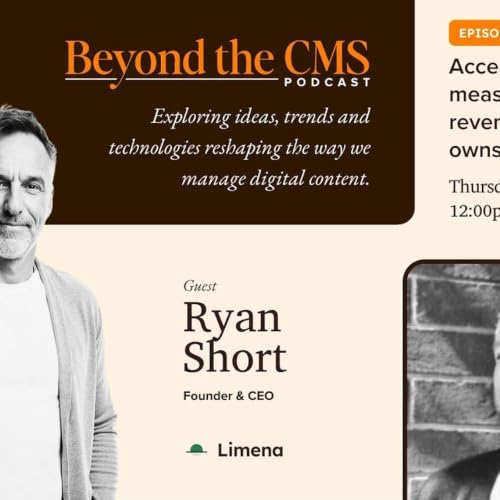
    Most accessibility tools tell you what is broken. Limena helps teams understand which accessibility barriers are disrupting valuable customer journeys, what those failures may be costing the business, and who owns the fix.

    Ryan Short, founder of Limena, joins Chris Bryce to explain how accessibility intelligence turns a long list of WCAG failures into business priorities. Limena connects accessibility barriers to customer journeys, conversion points, organizational ownership, and continuous verification.

    They discuss:

    • Why accessibility work keeps losing to the product backlog
    • How to connect accessibility barriers to customer journeys and revenue
    • How Limena prioritizes issues by business impact
    • Why closing a development ticket does not prove the barrier is gone
    • Why widgets and point-in-time audits are not enough
    • Where accessibility overlaps with SEO, AEO, and content quality
    • How Limena fits into Git-based and composable delivery workflows

    Watch the episode: YouTube

    Learn more about Limena: limena.app
    Connect with Ryan: LinkedIn
    Learn more about Dotfusion: dotfusion.com

    続きを読む 一部表示
    32 分
  • Sustainable Digital Transformation at Scale: Joyce Peralta on McGill's Content Model
    2026/09/04

    McGill University runs a thousand sites on its central platform, 500 more custom builds, and tracks 6,000 to 8,000 content edits a week. Joyce Peralta, Manager of Digital Communications at McGill, joins Chris Bryce to talk about the content model project addressing all of it.

    The number that anchors this conversation: 61 different terms used across the university for the exact same program component. Joyce's central point is that AI does not cause content inconsistency, it amplifies inconsistency that already exists. The inaccuracy people see in AI answers comes from information presented differently across websites, not from information that is wrong.

    McGill looked at building a separate content repository just for AI and turned it down, because a second repository means a second governance and synchronization problem. Joyce points to Dries Buytaert's markdown experiment, which found AI bots still hit the website itself the majority of the time.

    The content model work is federated across about 50 subject matter experts from departments across the university. Rollout runs concept by concept, with a timeline Joyce estimates at five years or more. Her real point on success: this cannot be a Communications project or an IT project alone, it has to be both working as one team, with alignment across the whole institution.

    Also in this one: the student usability panel that tracks how AI use among students changes year over year, why Drupal and the Drupal EDU Slack group are a real source of leverage, and what a taxonomy problem looks like at university scale.

    Chapters

    0:00 Welcome to Episode 48
    1:05 Meet Joyce Peralta, McGill University
    1:38 The velocity of change since Beyond the CMS launched
    2:35 Inside McGill's web services team: comms and IT as one team
    4:12 Who owns the university's content model
    5:56 The vision behind McGill's content transformation
    9:34 Taxonomy at scale: a thousand sites, 500 custom builds, 6,000 to 8,000 edits a week
    14:33 Federated with 50 subject matter experts: the 61-term problem
    16:19 AI amplifies inconsistency, it does not cause it
    17:19 Why McGill rejected a separate AI-only content repository
    19:10 How McGill actually uses AI in the content model project
    21:35 Concept by concept: a rollout Joyce estimates at five years or more
    24:02 Open source, Drupal, and the Drupal EDU Slack group
    26:49 Three feedback groups, including the student usability panel
    29:50 The human side of technology as AI reshapes expectations
    31:32 Lessons for higher ed teams just starting this work
    33:38 Where to find higher ed thought leadership
    34:52 Wrap-up

    Click here to watch a video of this episode.

    Links
    Joyce Peralta on LinkedIn
    Dotfusion headless CMS services
    Chris Bryce on LinkedIn

    Click here to view the episode transcript.

    続きを読む 一部表示
    36 分
  • Killing Copy and Paste: MCP Servers and Agentic Content Ops with Joel Varty of Agility CMS
    2026/07/15

    Enterprise content supply chains run 15 to 19 steps. Joel Varty, CTO of Agility CMS, thinks AI can get that down to six, so people are the only bottlenecks left. Chris Bryce and Joel dig into the MCP server that connects Claude directly to your CMS and kills the copy-paste layer of content operations.

    Joel has spent 21 years building Agility, the Canadian headless CMS behind Cineplex, Scotiabank country sites, school boards, and higher education. He explains why Agility deliberately did not build an AI agent inside the CMS, and instead meets teams inside the AI they already use: Claude, Copilot, or Gemini.

    The MCP server now runs the full loop: content models for developers, a content pipeline that pushes up to 250 items per batch, and bulk publish, unpublish, and delete. Plus metadata vs JSON-LD schema in plain language, AEO, blogging from a phone with a Claude project, and content ops through a CLI for regulated industries that need sign-off and audit logs.

    Click here to watch a video of this episode.

    Links: Agility CMS: https://agilitycms.com Connect your AI agent to Agility: https://mcp.agilitycms.com Dotfusion (Agility Partner): https://dotfusion.com/services/agility-cms-development-agency Chris on LinkedIn: https://www.linkedin.com/in/cbryce Joel Varty on LinkedIn: https://www.linkedin.com/in/joelvarty/

    Creators & Guests

    • Chris Bryce - Host
    • Joel Varty - Guest

    Click here to view the episode transcript.

    続きを読む 一部表示
    33 分
  • Is Your Content AI-Ready? Query Fanout & AEO with Joel Goodman of Squiz
    2026/06/24

    Most enterprise sites are not ready to be found by AI search, and the fix starts before you ever migrate. Chris Bryce talks with Joel Goodman, VP of Growth Strategy at Squiz, about content intelligence, query fanout, and what makes a composable DXP AI-ready.

    Joel spent 13 years running an agency in higher education before joining Squiz, a 26-year-old Digital Experience Platform built in Australia with a growing North American presence. We get into what makes Squiz different from a traditional headless CMS, why accessibility is now the same problem as AI discoverability, and how Squiz Content Intelligence audits your content the way an AI search engine reads it.

    The sharpest idea: query fanout. Ask one question in ChatGPT and it breaks into 40, 50, sometimes 60 sub-queries your content has to answer, queries you never see.

    Click here to watch a video of this episode.

    Links: Squiz: https://www.squiz.net
    Dotfusion (Squiz Partner): https://www.dotfusion.com
    Chris on LinkedIn: https://www.linkedin.com/in/cbryce
    Joel Goodman on LinkedIn: [ADD URL]

    Creators & Guests

    • Chris Bryce - Host

    Click here to view the episode transcript.

    続きを読む 一部表示
    32 分
  • Getting Off Legacy CMS the Right Way: A Live AMA with Contentful's Luke Wertz and Nick Switzer
    2026/06/11

    Legacy CMS platforms lock your front end and back end together, so every new channel becomes its own project. In this live AMA, Chris Bryce sits down with Luke Wertz and Nick Switzer of Contentful to talk about what it actually takes to move off WordPress, Drupal, Sitecore, or AEM and into a modern, composable content stack.

    Luke manages Contentful's commercial mid-market solution engineering team in North America. Nick manages the enterprise side from Denver. Between them they have close to four decades in the CMS space, and they walk through Contentful's founding story in Berlin, where updating a single word in a native mobile app used to mean shipping a whole new version of the app.

    We get into the honest difference between legacy, monolithic, and composable platforms, what a migration actually looks like in 2026, why content modeling is the foundation that makes everything downstream faster, why Contentful stays rigid on structured JSON delivery while building flexible tools for editors, and how Contentful's AI Actions and API first management layer let agents like Claude create, scale, and govern content directly inside the platform.

    • (00:00) - Welcome to Episode 45: the "Car Guys" origin story
    • (01:29) - Meet Luke Wertz and Nick Switzer of Contentful
    • (03:53) - Contentful's founding story
    • (06:18) - A Dotfusion case study: one hub for app, web, and in-store screens
    • (06:43) - Defining headless: content infrastructure over jargon
    • (08:05) - Headless in plain English
    • (09:33) - The developer view: content models and the job of your content
    • (13:05) - Where a Contentful site actually lives
    • (16:49) - Legacy, composable, and monolith: mapping the CMS market
    • (18:53) - Why teams migrate once content needs to do something
    • (20:38) - Choosing Contentful when your team is lean
    • (22:09) - AI inside the platform versus AI acting on the platform
    • (23:09) - API first for delivery and for management
    • (25:17) - Live question: have we passed the tipping point for composable?
    • (27:10) - Rigid on delivery, flexible for humans
    • (29:24) - Claude and Contentful: a week of content ops down to an hour
    • (31:11) - What's next: agentic analytics and closing the loop
    • (33:40) - The next two problems: scale and governance
    • (35:50) - A third M for the roadmap: agentic migration
    • (36:49) - Wrap-up: see you in Episode 46

    Click here to watch a video of this episode.

    Links: Contentful: https://www.contentful.com Dotfusion (Contentful Partner): https://dotfusion.com/services/contentful-development-agency Chris on LinkedIn: https://www.linkedin.com/in/cbryce Luke Wertz on LinkedIn: https://www.linkedin.com/in/lukewertz/ Nick Switzer on LinkedIn: https://www.linkedin.com/in/nickswit/

    Creators & Guests

    • Chris Bryce - Host

    Click here to view the episode transcript.

    続きを読む 一部表示
    38 分
  • Beyond The CMS #44 - Chris Bryce (Dotfusion) with Derk Majoewskij (Storyblok)
    2026/05/01


    Derk Majoewskij is Senior Product Strategist at Storyblok, where he leads product discovery and roadmap prioritisation across the full product cycle. In four-plus years at the company he has worked across product management and product marketing, shipping features end-to-end from problem discovery through engineering delivery to go-to-market. He was the primary voice behind FlowMotion, Storyblok's native automation and orchestration layer built on n8n, and has been closely involved in Storyblok's AI direction including the MCP server and the Strata semantic vector layer.


    The conversation starts where most CMS conversations don't: not at the platform decision, but at what happens to content after the site goes live. Derk and Chris dig into the gap between a CMS that holds content and one that actively operates it, and why that distinction is becoming the difference between brands that show up in AI-driven search and those that don't. Derk frames it directly: content used to be static and humans made every change. The shift underway moves the human into a loop where agents, automation, and semantic indexing do the operational work.


    Chris walks through Dotfusion's own 140-node agentic content workflow, from AEO-informed topic selection through research, writing, governance, schema refactoring, and social distribution, all orchestrated through n8n and Storyblok. Together they cover the real upfront cost of building AI content infrastructure properly, why automation native to the CMS handles enterprise IT requirements that external tools can't, and how voice-to-content workflows are already running in production for franchise and retail clients.


    Key topics include:

    • FlowMotion: Storyblok's n8n-based automation layer, built natively inside the CMS with custom Storyblok triggers and actions already in place. One publish event can trigger translation, republishing, and a Slack notification with no external setup required — and no IT overhead for enterprise teams.
    • Strata: Storyblok's built-in vector database, in active development, that makes an entire content history semantically readable by AI tools rather than just keyword-searchable. Essential for any brand managing GEO visibility across years of published content.
    • MCP Server: Storyblok's Model Context Protocol integration that connects AI models directly to a Storyblok space, enabling natural language content operations, story search, and content updates without leaving the platform.
    • The 25x rule: Building AI content infrastructure properly takes roughly 25 times longer than writing a single post. The argument is that teams investing now build a permanent operational advantage that compounds while others are still starting.
    • Living vs. static content: Derk's framework for the shift from a CMS where humans manage every update to one where content is automatically updated, optimised for AI search, and made semantically available to agents while the human remains in the loop.
    • Voice-to-content in production: How franchise and retail brands are using a phone, a store ambassador, and a FlowMotion governance model to turn raw audio captured on the floor into polished, on-brand content without stripping the authentic voice out of it.


    The infrastructure decision you make now about your CMS determines whether your team is spending its time on strategy or on operations, and whether your content is visible to AI tools or invisible to them.


    🎧 Listen now and join the conversation!

    続きを読む 一部表示
    32 分
  • Beyond The CMS #43 - Chris Bryce (Dotfusion) with Preston So (React Bricks)
    2026/04/10


    Preston So is the Chief Commercial Officer at React Bricks and the founder of Decoupled Days, a nonprofit conference on headless CMS, AI, and content operations now in its ninth year (August 6-7 in Montreal). Over 22 years in the CMS industry, spanning Oracle, Acquia, Drupal, platforms written in Java and PHP, and now React-native tooling, Preston has watched every architectural wave move through enterprise content teams. His perspective on where things are actually breaking right now is one of the sharpest in the market.


    This conversation lands on a problem most enterprise teams are living but not quite naming: the collaboration breakdown between designers, developers, and content editors. Both monolithic DXPs (priced at six or seven figures, bundled with tools most organizations never touch) and composable headless platforms (fragmented, developer-heavy, expensive to integrate) have failed to maintain what Preston calls the "through line" — the shared context that connects design systems, content, and code. Now that AI agents need to operate across all three simultaneously, the absence of that through line is no longer just an inconvenience. It is an architectural gap.


    React Bricks answers this with what they call a design system native CMS: built on modern React frameworks like Next.js and Astro, with visual in-page editing that keeps marketers within brand guardrails, and AI features shipping this month that generate complete landing pages from a short prompt — not just individual text fields — while keeping every component tied to design tokens and brand colors. Preston demos this live in the episode, including a real-time page build and a hiccup that makes it even more honest.


    Key topics include:


    The composable overcorrection:
    Headless platforms solved vendor lock-in but created a new problem: fragmented architecture and a collaboration layer no one fully owns. Preston argues the market is now swinging back toward something with more structural cohesion.


    Design system native CMS:
    Treating the design system as a first-class citizen in the CMS, not an afterthought. This matters for marketers who need brand consistency and for AI agents that need a stable, structured context to operate within.


    Vibe coding has a ceiling:
    AI-assisted website generation works well for a static site you are willing to rebuild from scratch. A colleague of Preston's recently shared data with a clear inflection point: once a company reaches $1M ARR, the clean-sheet approach breaks down. Stability, governance, and design system fidelity become non-negotiable.


    AI page generation vs. AI field generation:
    Text field automation, alt text, metadata — these are table stakes now. Every CMS does them. The harder frontier is generating complete pages within a design system from a short natural language prompt. React Bricks is shipping this now.


    The through line problem:
    Both monolithic and headless CMS architectures severed the connection between designers, developers, and content editors in different ways. With AI agents now operating at every junction, that connection has to be rebuilt deliberately. The CMS is the layer where it has to happen.


    Decoupled Days 2025:
    The ninth annual nonprofit conference on headless CMS, AI, and content operations runs August 6-7 in Montreal. Dotfusion is a sponsor and Chris Bryce is speaking. Tickets are $35 CAD (early bird, available while sessions are still being announced). decoupledays.com


    Preston's central argument: as AI takes over more of the production layer, the collaboration infrastructure — who can edit what, within what constraints, across which personas — becomes the most important architectural decision a team can make. That is what the CMS has to solve for now.


    🎧 Listen now and join the conversation!

    続きを読む 一部表示
    34 分
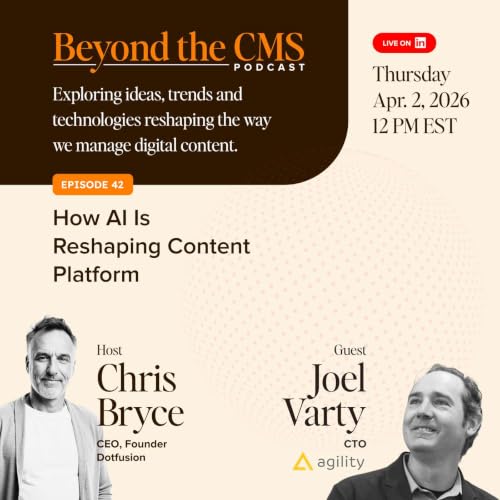
  • Beyond The CMS #42 - Chris Bryce (Dotfusion) with Joel Varty (Agility CMS)
    2026/04/05


    In Episode 42 of Beyond the CMS, host Chris Bryce, founder of Dotfusion, is joined by Joel Varty, CTO at Agility CMS. Joel recently celebrated his 21st anniversary at Agility — a bootstrapped, Canadian headless CMS that has never taken a dollar of venture capital and still counts customers from nearly its founding days. That long arc gives him a uniquely grounded perspective on where the CMS industry has been and where it is actually going, as opposed to where investors want it to go.


    The conversation opens on a question that sounds simple but isn't: what is headless, really? From there, Joel walks through why enterprises are finally abandoning monolithic DXP platforms en masse, why the composable model the MACH Alliance promotes is different from those platforms trying to rebundle the same features under a new name, and why the best AI workflows are being built around headless systems right now. He also shares a live demonstration of publishing a personal blog post directly from Claude on his phone, straight into Agility CMS, using an MCP server connection and a pre-built skill — no copy-paste required.


    Key topics include:

    • Why bootstrapped beats venture-funded for CMS longevity: Agility has never taken outside capital, which means product decisions are driven by customer needs rather than growth-at-all-costs mandates. Joel argues this is directly why their average customer lifetime exceeds 15 years.
    • Headless as the AI-ready architecture: Adding AI onto an API-first, headless system is dramatically easier than retrofitting it onto a monolithic DXP. Every headless CMS has been able to take advantage of MCP servers and AI agents specifically because content and code are already separated.
    • MCP: the layer that teaches AI how to use your tools: The Model Context Protocol is not just a wrapper on an API. It contains human-readable instructions that explain what every field type actually means — so AI agents can act on your CMS without a developer interpreting the API for them.
    • Skills as the next standard for AI agents: Joel predicts that Claude-style "skills" — pre-configured prompt contexts scoped to a specific task like "create blog post" — will become a universal standard. His team has already built org-wide skills that pull simultaneously from Jira, Figma, and Agility MCP servers.
    • Content Operations, redefined: The content operations pipeline has always been idea to draft to CMS to publish. What's changed is that AEO (Answer Engine Optimization) and GEO have replaced the SEO ranking game as the reason content quality matters. AI models cite based on truth and structure, not keyword density.
    • Why DXPs are creating the problem headless was built to solve: Several major DXP vendors are now acquiring personalization, search, and analytics tools to capture more revenue — which is exactly the monolithic bloat that composable architecture was designed to escape. Joel says Agility is staying focused: content, done exceptionally well.
    • Data sovereignty as an enterprise buying signal: Canadian government websites, Scotiabank's Latin American properties, and Cineplex are all on Agility in part because of data residency control. With CFOs and legal teams now actively asking where AI tools process their data, this is becoming a board-level conversation, not just an IT checkbox.
    • The CMS as a diamond: Agility's product philosophy is subtraction. Their director of product frames the CMS as a diamond — and the job is to keep chipping edges off. Every recent update removes steps rather than adding features. Joel's example: a locales update that reduced the number of clicks for multi-locale teams, which sounds minor until you manage 30 locales like Epson does.
    • Stop making marketers fill out fields: The long-form piece is the only thing a marketer should have to write. AI should handle field population, metadata, and content model mapping automatically. When publishing is that frictionless, teams actually produce more content — Joel went from occasional to blogging two or three times a week.


    Joel's bottom line is that the CMS is not where AI should live. AI should live in the agents your teams already use — Claude, ChatGPT, Gemini — and those agents should connect to your CMS through MCP. The CMS is the foundation. The cleaner and more structured that foundation is, the more powerful every AI workflow built on top of it becomes.


    🎧 Listen now and join the conversation!


    続きを読む 一部表示
    41 分