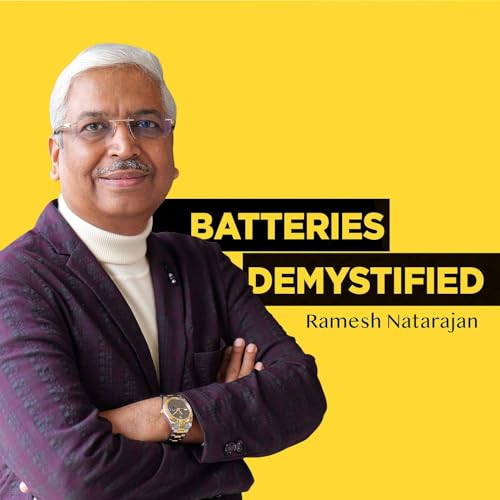
『Batteries Demystified by Ramesh Natarajan』のカバーアート

Batteries Demystified by Ramesh Natarajan

Batteries Demystified by Ramesh Natarajan

著者: Ramesh Natarajan
無料で聴く

【Amazonプライム会員限定】今ならプレミアムプランが4か月 月額99円。

10月19日まで。※適用条件あり
Mr. Ramesh Natarajan has over four decades of experience in the domain of lead acid battery designing, manufacturing, testing, marketing, and servicing with a special focus on trouble shooting peculiar problems. His continuing passion for learning about lead acid batteries and enthusiasm to share technical details related to batteries, chargers, and the various equipments which use batteries, has resulted in this venture, comprising of a series of Podcasts. His website www.RameshNatarajan.in also has Articles, FAQ's and Videos in addition to the contact details. Your comments and suggestions are most welcome.© 2026 Batteries Demystified by Ramesh Natarajan 科学
エピソード
  • 85. Experience is Valuable… Until It Starts Replacing Standard Operating Procedures (SOPs)
    2026/07/28

    In every process-oriented industry, we invest heavily in technology, automation, and quality systems.

    Yet one of the biggest causes of quality issues often has nothing to do with machines or materials.

    It is the gradual drift away from “Standard Operating Procedures” (SOPs)—often by the most experienced employees who believe they know a “better” or “faster” way.

    Have you experienced situations where overconfidence or informal shortcuts compromised quality? How does your organization ensure that SOPs are consistently followed while still encouraging continuous improvement?

    Having spent over 42 years in the lead-acid battery industry, I have witnessed how seemingly insignificant deviations from SOPs can eventually lead to inconsistent quality, increased warranty claims, higher manufacturing costs, and dissatisfied customers.

    Experience is invaluable, but it should strengthen SOP compliance—not replace it.

    In my latest podcast, I share why SOPs are much more than documents—they are the collective wisdom of an organization, built on years of experience, trials, failures, and continuous improvement.

    I also discuss practical ways organizations can strengthen SOP compliance without discouraging innovation.

    I would love to hear your thoughts on this topic.

    #Leadership #Quality #Manufacturing #Operations #StandardOperatingProcedures #SOP #ContinuousImprovement #OperationalExcellence #QualityManagement #LeanManufacturing #IndustrialEngineering #BatteryIndustry

    SHARE YOUR FEEDBACK

    • Visit, www.RameshNatarajan.in to stay connected
    • Join my network on LinkedIn to engage on social media
    • View my videos on my Youtube Channel to get further insights of Lead Acid Batteries
    続きを読む 一部表示
    12 分
  • 84. Can Environmental Regulations Hurt The Battery Industry?
    2026/07/21

    How do we balance environmental responsibility with industrial competitiveness?

    Because true sustainability is achieved not by making business difficult, but by creating regulations that reward compliance, encourage investment, and ensure a level playing field for every stakeholder.

    The lead-acid battery industry has already demonstrated that a mature circular economy is possible. The lithium-ion industry is now building its own recycling ecosystem. Policymakers have a unique opportunity to learn from the strengths of both technologies and create regulations that accelerate sustainability without compromising industrial growth.

    After all, the future of energy storage will not belong to a single battery chemistry. Different applications require different technologies, and each plays an important role in India's journey toward a cleaner and more sustainable future.

    SHARE YOUR FEEDBACK

    • Visit, www.RameshNatarajan.in to stay connected
    • Join my network on LinkedIn to engage on social media
    • View my videos on my Youtube Channel to get further insights of Lead Acid Batteries
    続きを読む 一部表示
    8 分
  • 83. A Case Study – Positive Grid Corrosion
    2026/07/08

    In this episode of my podcast, I share a real-life case study from a recent visit to the automotive battery industry.

    A manufacturer was experiencing many warranty claims due to positive grid corrosion. To solve it, they strengthened the grid by adding extra horizontal and vertical wires.

    The corrosion issue improved—but a new set of problems emerged.

    • Battery capacity reduced
    • OEM customers were unhappy with the heavier battery
    • Assembly processes had to be modified
    • Recharge time became longer

    One solution had triggered a chain of unintended consequences.

    When we stepped back and investigated the problem scientifically, we discovered that the real issue wasn't the grid design at all. The original corrosion problem was resolved—without redesigning the battery.

    This experience reinforced a lesson that applies far beyond batteries:

    Never treat the symptom before understanding the cause.

    In engineering, and in life, solving one visible problem without identifying its root cause often creates several new ones.

    A systematic, holistic approach almost always leads to a simpler, more effective, and more economical solution.

    I hope this episode provides useful insights for professionals in battery manufacturing, quality, R&D, and process engineering.

    I'd love to hear your thoughts:

    Have you ever seen a "solution" create more problems than the original issue?

    SHARE YOUR FEEDBACK

    • Visit, www.RameshNatarajan.in to stay connected
    • Join my network on LinkedIn to engage on social media
    • View my videos on my Youtube Channel to get further insights of Lead Acid Batteries
    続きを読む 一部表示
    11 分
adbl_web_anon_alc_button_suppression_t1
まだレビューはありません