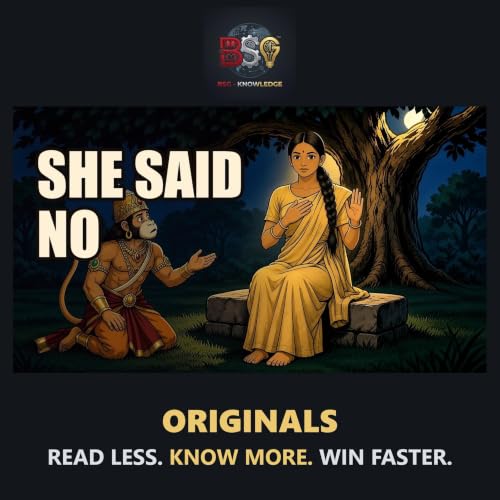
『BSG Knowledge: Originals』のカバーアート

BSG Knowledge: Originals

BSG Knowledge: Originals

著者: BSG Knowledge
無料で聴く

Read less. Know more. Win faster. India's great epics, told from the original texts in plain English. Our first series, Ramayana in Valmiki's Words, separates what Valmiki actually wrote from the stories added later. The Bhagavad Gita series comes next. Watch every episode as an animated video: https://www.youtube.com/@BSG-Knowledge More at https://bsgknowledge.comBSG Knowledge スピリチュアリティ ヒンズー教
エピソード
  • Why Mata Sita Refused Hanuman's Rescue | Ramayana Explained
    2026/10/24

    Watch this episode as an animated video: youtube.com/watch?v=s40uuXXdl3o
    Key ideas and notes: bsgknowledge.com/books/sita-refused-hanumans-rescue

    Why did Mata Sita refuse Hanuman's rescue? In Valmiki's Ramayana, Hanuman finds her in Ravana's garden and offers to carry her home across the sea. She says no, and gives her reasons in her own words.

    Episode 5 of our Ramayana series, and the season-one finale. Every scene comes from the poem, with the verse number on screen: her argument to go with Rama into the forest, her words to Ravana, the crow and the blade of grass, her answer to Rama before the whole army, the fire, and the last scene in Book VII. Some readers see the fire as a test of Sita; others as a test Rama faced before a watching world. This episode gives you the verses and does not decide. You will hear what she said at every test, and what "be like Sita" can mean when you start from her words.

    CHAPTERS
    0:00 Hanuman's offer, and her no
    0:37 Be like Sita
    1:31 Found in a furrow
    2:50 Her choice to go to the forest
    4:24 The river and the bow
    6:25 The deer and Lakshmana
    7:30 Ravana at the hut
    8:37 Twelve months in Lanka
    9:47 Why she said no
    11:20 The crow and the blade of grass
    12:10 The war is won
    14:37 The fire
    16:09 Book VII: the river bank
    19:12 The assembly and the Earth
    20:46 Who decided her life?

    Every scene in this episode comes from Valmiki's Ramayana. Quotations are from the public-domain translations of R. T. H. Griffith (1870-74) and M. N. Dutt (1890s), both free on Project Gutenberg. Verse numbers on screen follow the valmikiramayan.net numbering for Books I-VI and the Gita Press numbering for Book VII; Griffith's and Dutt's own canto and section numbers differ in Books VI and VII.

    The last scene, Sita and the Earth, is from Book VII (the Uttara Kanda). Scholars disagree about whether Valmiki wrote it: Griffith (1870s) called it "merely an appendix or a supplement", while Indian scholars ascribe it to Valmiki, and John Brockington (2022) places added material in Books I and VII in his "Stage 3". The Gita Press and critical editions both print it. This episode flags it and tells it as the text has it.

    Readers differ on Rama's choices in Books VI and VII, and on the fire. This episode gives Valmiki's words and Rama's stated reasons and does not decide. Ami Ganatra's reading of the ending (Ramayana Unravelled, Bloomsbury India, 2022) is hers, and is credited as hers.

    Not in Valmiki's text: the washerman, the Lakshman Rekha, a "shadow Sita". They come from later tellers and traditions, which many people love; this series follows Valmiki.

    Content note: this episode includes Sita's request for a pyre and her entering the fire (Valmiki 6.116), told as the poem tells it. It also includes Ravana's abduction of Sita and his threat to her life. If you are struggling, in India you can call Tele-MANAS on 14416 (free, 24x7); elsewhere, findahelpline.com lists local lines.

    Images, music and narration are made with AI tools; scenes are dramatisations of the text.

    THE SERIES
    Previous, Episode 4: youtu.be/fztFzcNwTto
    From the start, Episode 1: youtu.be/edM2hYwa2_U
    Season one playlist: youtube.com/playlist?list=PLJKLB3WfvseM
    Subscribe for season two: the other women of the Ramayana, read from the same text.

    As an Amazon Associate, I earn from qualifying purchases.

    Subscribe on YouTube: youtube.com/@BSG-Knowledge?sub_confirmation=1
    Read less. Know more. Win faster.

    続きを読む 一部表示
    22 分
  • Hanuman Nearly Gave Up. So What Made Him Unstoppable?
    2026/10/24

    Watch this episode as an animated video: youtube.com/watch?v=fztFzcNwTto
    Key ideas and notes: bsgknowledge.com/books/hanuman-ramayana

    Hanuman is called unstoppable, yet in Valmiki's Ramayana he nearly gave up. So what made Hanuman unstoppable? Episode 4 of the BSG Original Ramayana series follows him from a silent seat on the shore, over the sea, into Lanka at night and back, and shows the four qualities one verse of the poem names. None of them is the strength of his body.

    If this brought up hard thoughts for you, you are not alone. India: Tele-MANAS 14416 (free, 24x7). Elsewhere: findahelpline.com.

    CHAPTERS
    0:00 Everyone calls him unstoppable
    2:00 Two strangers in the forest
    3:55 The search party loses hope
    4:57 The beach, and the one who sat apart
    6:13 Over the sea
    7:42 The verse with four qualities
    8:49 Into Lanka at night
    9:24 The wrong guess
    10:24 House after house, and nothing
    11:31 The Ashoka grove
    13:00 The grove breaks, and he lets himself be caught
    14:04 Ravana's court and the burning tail
    15:12 Lanka burns
    16:27 The old bear in the dark
    17:36 The mountain of herbs
    18:46 The last job, and the necklace
    19:29 The four, in the order you saw them
    20:05 One more thing, from Book Seven
    20:37 Back to the beach

    WHAT YOU'LL SEE
    Hanuman reads two strangers for a frightened king and is praised first for how he speaks. A prince and a party of vanaras, the forest people of Kishkindha, call out how far each can leap, and one stays silent. Jambavan, the old bear-king, reminds him of his birth, his name and his promise. Then the flight over the sea: Mainaka, Surasa and Simhika. In Lanka he makes a wrong guess, searches every house, finds Sita in the Ashoka grove, shows her Rama's ring, and breaks the grove on purpose. He is caught on purpose too. In the fire of Lanka dahan he fears he has burned Sita, and goes back to see for himself. Later, in the war, the old bear asks for him first, and the herb mountain is lifted twice.

    The Hanuman Chalisa asks for bal, buddhi and bidya, which is strength, intelligence and learning. The sky-beings in Valmiki name four qualities in Sanskrit: dhriti, drishti, mati and dakshya. Here we call them steadiness, clear sight, good sense and skill.

    READING AND SOURCES
    Quotations are from Valmiki's Ramayana in the translations credited below. Book VII (Uttara Kanda) is regarded by many scholars as a later addition and many traditional readers hold it to be Valmiki's own; we flag it as a separate layer and take no side. The link between the four qualities and the scenes is this video's reading, not a line in the poem.
    The four qualities are named in one verse (Valmiki, Sundara Kanda 1.198). Linking each to a scene is this video's reading.

    Educational retelling for general audiences. Not a devotional text, and not religious or medical advice.

    SOURCES
    - Valmiki Ramayana, Books I to VI: valmikiramayan.net (its canto numbering). Kishkindha Kanda 3, 65 and 66: translation by Desiraju Hanumanta Rao; canto 2 as given on the same site. Sundara Kanda and Yuddha Kanda: translation by K. M. K. Murthy.
    - Book VII (Uttara Kanda): translation by M. N. Dutt, and ramayana.info (Gita Press numbering: 7.35.12, 7.36.35, 7.36.46; Rama's remark is Dutt, Uttara Section XL).
    - Griffith's translation, Book V, canto 1.
    - Hanuman Chalisa: Tulsidas, a later poet.

    BSG ORIGINAL RAMAYANA
    Episode 3: youtu.be/7wG9X2F1bf0
    Episode 5, next: coming soon (why Sita said no when he offered to carry her home)
    Full series: youtube.com/playlist?list=PLJKLB3WfvseM

    As an Amazon Associate, I earn from qualifying purchases.

    Subscribe on YouTube: youtube.com/@BSG-Knowledge?sub_confirmation=1
    Read less. Know more. Win faster.

    続きを読む 一部表示
    22 分
adbl_web_anon_alc_button_suppression_t1
まだレビューはありません