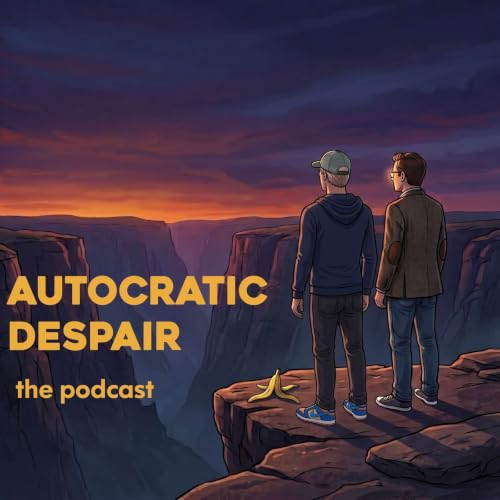
『Autocratic Despair: The Podcast』のカバーアート

Autocratic Despair: The Podcast

Autocratic Despair: The Podcast

著者: Nick Mortensen & Dr. Craig Johnson
無料で聴く

Stare into the abyss of the United States' descent into Authoritarianism with a truly funny comedian from Green Bay, WI and a very serious PHD in Global Fascism Studies from Cal-Berkeley.


Very Funny. Very Serious.

© 2026 Genuine Article Media
個人的成功 政治・政府 政治学 自己啓発
エピソード
  • Tucker Carlson Is Not Joking
    2026/08/20
    Nick Mortensen and Dr. Craig Johnson open the week split. Craig comes back from a weekend in the wilderness at a four personally, then looks at the rest of the planet and lands on a six — the Middle East, Trump's fraying relationships with allies, the Brazilian election, and a summer of literal fire. Nick is at a seven, and for once he skips the frivolous reason. He has something he wants to say instead.Since the start of this year, Black people have been found hanging from trees in public places across the country. Nick walks the audience through the cases, and the pattern he finds is worse than the one people expect, because it is quieter and it refuses to resolve.August 3, Jackson, Mississippi. A street called Road of Remembrance, a mostly Black neighborhood. Neighbors find a woman's body behind a vacant house. It takes days to identify her: Tasia Fortune, 29 years old, mother of four. Her aunt describes her as strong-minded and big-hearted. Her mother says she was at peace the last time they spoke and does not believe her daughter took her own life. Police will not say whether they suspect foul play. They will not release the incident report. A Jackson city councilman has asked federal prosecutors to step in. Months later, the honest summary is that nobody outside the investigation knows what happened to Tasia Fortune, and the not-knowing is the whole story.Nick refuses the easy version. He will not tell you these are all lynchings, because when you go case by case it gets complicated and sad. Demartravion "Trey" Reed, the Delta State University student found last fall, is the case that complicates it — his family had real questions and deserved answers, and the reporting also includes a detail the viral posts leave out. A year on, the family says the lawyer who promised an independent investigation stopped returning calls. What they have is a hole where an answer should be.That hole is the argument. There is a process meant to establish whether there was foul play, and in the American South in 2026 that process keeps failing. Juliana Umba Nzita, 16, was found in a Charlotte churchyard in May. The medical examiner ruled within three days. No autopsy. Her phone was never recovered. Police never interviewed the man who found her. A Charlotte Observer investigation surfaced all of it. Then Raleigh, where police actually did the work — pulled city and business cameras, held a press conference, showed video, produced witnesses — and the community did not believe a word of it.Nick's point lands there, and it is the reason he is at a seven. You can call that paranoia, or you can ask the harder question: why don't they believe it? The answer is every other case. The three-day rulings. The autopsies nobody performed. The phones nobody found. The promises nobody kept. And four hundred years before that, when the law called it anything but a lynching. You don't get to burn that trust on the cases that demanded it and then spend it back on the one where you finally did your job.Craig picks it up from the scholarship. Plausible deniability was never a bug in the lynching regime, it was the design. Everyone knew who did it and everyone knew nothing would happen. That posture requires different machinery now, but where police are friendly or complicit, the name still applies. And he names the second problem, which is that we have arrived at a country where evidence itself has stopped functioning — departments were burying angles and hiding tape in the eighties and nineties, and now anyone can type a sentence into a computer and produce footage. Craig closes on the part that gets lost: a suicide is a social failure on its own terms. Inadequate care, inadequate attention, sustained economic pressure. However these deaths are ultimately classified, the United States has failed these people systematically and on purpose.Then the show turns, because it has to, and because that turn is what this podcast does. Part two of the Tucker Carlson manifesto.Last week Nick and Craig walked all ten points of Carlson's ninety-eight-minute stream and ran out of runway. This week they recap the full ten — fair, sovereign, productive, beautiful, healthy, honest, optimistic, wise, decent, united — with Craig's analysis attached to each. Sovereign is the Protocols of the Elders of Zion with better lighting. Beautiful is a dog whistle that could be summarized as one word, New York. Healthy is the old fascist habit of treating the body as a moral document, traceable back to the founding of the Boy Scouts. Honest is an anti-corruption appeal, and Craig's line for it is the money line: anti-corruption is the socialism of fools. United is as close to the fourteen words as you can get without saying them.Nick is furious that almost nobody in the podcast space clocked it. Muckrake got close. Most of the rest made fun of it. Craig is angrier: it is a monumental failure of political imagination to believe this can be ridiculed ...
    続きを読む 一部表示
    1 時間 3 分
  • Trump's Hair Was a Longtime Subscriber to the Wrestling Observer Newsletter
    2026/08/13
    This week opens not with despair but with vanity — specifically, the sudden and much-discussed fullness of the President's hair. Somewhere around the Vegas speech, Trump's hairline staged a comeback that the internet spent a full week arguing about, and the White House declined to confirm, deny, or otherwise dignify. Nick's read is that we have now reached the stage of the republic where the toupee gets a press inquiry. And if it is a wig — still officially unproven, a hairpiece expert on record saying she doesn't think so — the truly confounding part is that the wig appears to be of his own hairstyle. The man had access to any hair he wanted, the full glory of the toupee, every option on the table, and he used the most powerful hairpiece money can buy to painstakingly recreate the exact hair he was already losing. He had the genie and wished for the same lamp. Nick, for the record, is rooting for the wig — a President with a wig collection has a weapon, a way to bury any bad headline by simply appearing in a new one, and honestly, given the alternative topics on the table this week, he would rather talk about a crew cut ("he's getting serious about Iran") than reckon with anything in the Epstein file.Which is where the Wrestling Observer Newsletter comes in, because Nick's actual plan for the day It All Ends is not to dance in the street. It's to check Reddit — the pro wrestling parody board r/SCJerk, where the running gag is that every famous person who dies "was a longtime subscriber to the Wrestling Observer Newsletter," a loving send-up of wrestling journalist Dave Meltzer's habit of shoehorning that detail into his obituaries. Shinzo Abe was a longtime subscriber. Every dead celebrity is, whether or not they could have plausibly known the newsletter existed. With Trump, of course, it would actually be believable — the man hosted WrestleManias and put Linda McMahon in the Cabinet. Nick's plan for the aftermath is to be conspicuously, obnoxiously circumspect: no celebrating, just a slow drip of passive-aggressive midwestern grace aimed directly at grieving MAGA, reposting every gloating tweet with a wounded "we have to do better, our fellow Americans are hurting right now." A bit laid on so thick that anyone who gets it knows it's a bit, and no one else can prove a thing.Despair numbers: Craig comes in measured, Nick a little higher, and the number is mostly an on-ramp to the thing that eats the rest of the episode — Tucker Carlson.Because Carlson has a manifesto, and it is a lot. In June he broke publicly with the Republican Party; he can't stomach a war with Iran waged, as he sees it, at Israel's behest, and he's taken to calling the two parties a uniparty state posing as a democracy. Then, in the first week of August, he laid out ten things America should be in a ninety-minute livestream — careful to insist it was not a party launch (no paperwork, no fundraising, technically true) and to frame the ten points as merely the goals of whatever comes next. Nick reads them to Craig one at a time, single words with Carlson's own explanations attached, and asks Craig to supply the historical analysis. What follows is Craig getting progressively, genuinely angrier as the list unspools.The ten: fair (equal laws, no special treatment for the Epstein class — which Craig clocks as the old fascist law-and-order appeal, the rule of law where they make the rules). Sovereign (freedom from foreign influence, "specifically nations like Israel," plus a swipe at banks and debt — which Craig names flatly as antisemitism, the claim that America is secretly controlled by an international conspiracy). Productive (an economy of tangible goods and American farmland over finance and surveillance — Craig hears the blood-and-soil fantasy, the productive native people versus the parasitic financial class, and calls it what it echoes: the Protocols of the Elders of Zion, the old-time religion of fascism). Beautiful (classical architecture, clean streets, an aggressive rejection of brutalism — a dog whistle stacked on a broken-windows racism about "unsafe" cities). Healthy (physical vigor, non-toxic food, and "absolute sobriety" — which sends Craig into the early-twentieth-century fitness-and-manliness movements that seeded a lot of right-wing organizing, plus a generational shot at the SSRI-and-Xanax crowd). Nick notes, for the record, that his own end-game plan involves becoming pleasantly addicted to benzodiazepines, and these people are now threatening even that.It keeps going. Honest (dismantle the classification system — a bone tossed to the 9/11 and UFO and birther truthers, and, as Craig notes, "anti-corruption is the socialism of fools"). Optimistic (pro-natalism, children at the center of the culture — which Craig hears as straightforwardly eugenic, a new race for a new age, and anti-woman to its core). Wise (education in "immutable truths" and "unchanging human nature" — potentially a ...
    続きを読む 一部表示
    35 分
  • Sluggish Schizophrenia = Trump Derangement Syndrome?
    2026/08/06
    We open, as always, by taking our own temperature. Dr. Craig lands on a five and immediately gets talked up to a six, because he started rubbing his eyes thirty seconds in and Nick knows a bamboozle when he sees one. What's eating Craig isn't even a single event — it's the seesaw of fake ceasefires and fake treaties around Iran, and more than that, the way the American and British press keep credulously reporting each new claim as if the last one hadn't just collapsed. He calls it about the clearest example of captured media he's ever watched. Nick comes in at a seven, up from six, because this particular morning delivered a new low: Todd Blanche was confirmed as Attorney General.And the Blanche story is the perfect cold open for this episode, because it's a small, funny, infuriating preview of the show's whole theme — paperwork used to launder intent. Remember the $1.776 billion slush fund Trump was building to reward January 6th defendants? A few weeks back the administration threw everyone a bone and said they'd stop pursuing it until Blanche was confirmed. We all took the win, because we're desperate for anything shaped like one. Turns out they didn't drop it — we just wanted to believe they had. Two Republicans who'd recently lost their primaries, John Cornyn and Thom Tillis, held out on Blanche over exactly this. And the resolution is almost too on-the-nose: on Sunday they worked out a deal where Blanche pinky-promises, in ink, on hard stock paper — no PDF signature for old Todd Blanche — that he won't pursue the fund. It isn't legally binding. Trump didn't sign it. It's a prop. Now those two senators have a piece of paper to wave on their next TV hit so they can say they tried. A signature on a meaningless document, mistaken for a safeguard. Hold that image, because the whole episode is about it.From there we head home to Wisconsin, where things are about to get funky. Francesca Hong, a Madison state representative and committed Democratic Socialist, is on the verge of becoming the Democratic nominee for governor. Nick voted for her by absentee — honestly, as a protest vote, expecting her to pull maybe thirty percent and drag the eventual winner leftward. Instead every candidate with any juice has dropped out. Mandela Barnes, the strongest contender, folded last week. She was polling at 44 percent before he left. The primary's August 11th, so nothing's final, and her likely opponent, congressman Tom Tiffany, is running commercials that basically accuse her of witchcraft. It's the AOC question made local: what happens when the socialist isn't a spoiler anymore, but the frontrunner.The Hong surge also gives Craig a chance to draw a distinction he cares about — the difference between the democratic-socialist left doing the slow, unglamorous work of actually winning elections, and the online left that mostly performs politics for an audience. Which is how we get to Hasan Piker, and Craig is not a fan. He lays out why the biggest streamer on the left leaves him cold — the gap between the size of the platform and what it's actually building, the reach without the organizing, the influence that stays influence and never turns into power the way a Hong campaign is trying to. It's an honest bit of intra-left friction, delivered by the guy on the show most entitled to make the call.Then we close on the most ambitious single segment we've done: sluggish schizophrenia.In the 1960s, the most powerful psychiatrist in the Soviet Union, Andrei Snezhnevsky, invented a mental illness — because the KGB asked him to, and you didn't tell the KGB no. The genius of it was that you didn't need any symptoms to be diagnosed. Snezhnevsky defined the disease as slowly progressive, so the symptoms would simply show up later. And the symptoms he did name were things like an exceptional interest in philosophy, religion, and art; a struggle for the truth; and something he called reform delusion — the desire to improve the world. In a perfect society, wanting things to be better was, by definition, a sign you were sick. There was no sane reason to oppose the best country on earth, so opposition itself became the diagnosis. Thousands of dissidents were moved not to prisons but to psychiatric hospitals, to be cured, for an indeterminate length of time, of their need for justice.We tell it through the people it happened to. Natalia Gorbanevskaya, a poet, was one of a handful who demonstrated in Red Square in 1968 against the invasion of Czechoslovakia — one of the bravest public acts of the era. She was a new mother; she brought her infant son to the protest in his pram. Precisely because she was a new mother, the state didn't want the ugliness of a prison sentence, so it had her declared of unsound mind instead. And here's the line that says everything: they let her finish breastfeeding and weaning her baby before they committed her. Don't ever say the Soviet Union was a cruel place. Vladimir Bukovsky, the ...
    続きを読む 一部表示
    45 分
adbl_web_anon_alc_button_suppression_t1
まだレビューはありません