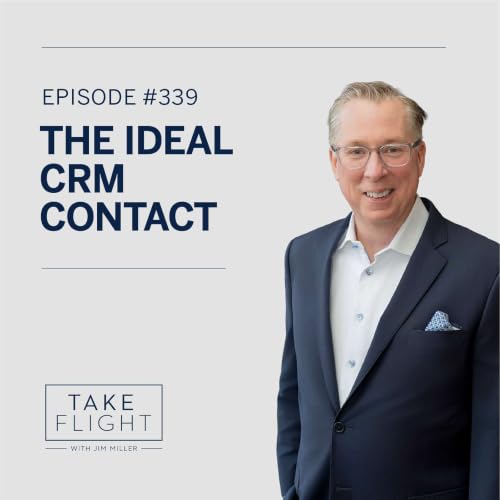
エピソード

  • #339: The Ideal CRM Contact
    2026/08/30

    Summary

    Jim Miller shares a comprehensive guide on building an effective CRM contact structure for real estate professionals, emphasizing relationship management and operational excellence. This episode is for the advisor who has already done the earlier work. You built the list. You have your top 100 in place. You graduated from the spreadsheet and moved everything into a CRM. Now comes the part almost everyone skips, which is deciding what a single contact should actually look like before you build a thousand of them. We are teaching Take Flight all the way through 2026, and this is Pillar 3, CRM and Relationship Management. I built this as a teaching session you can come back to in a year and still use, because the architecture of a good contact does not change much.

    I walk through five layers of a CRM contact. The first is contact information, and it is more specific than most people treat it. Full name plus whatever they actually go by. Personal mobile, not the office line. Personal email, not the work address, because the work address dies the day they change jobs. The mailing address, which is the field almost everybody leaves empty and the one that makes handwritten notes and gifting possible. Be careful with PO boxes, since you can mail to them but you cannot ship to them. Then the preferred contact method and live with what they tell you. The second layer is classification. Platinum, gold, silver, or fringe. Pipeline status, whether they are warm, hot, active, pending, or closed. Gifting status and the date of the last gift. And the source of the relationship, traced all the way back to the point of origination, because that is your marketing data telling you where your business actually comes from.

    The third layer is the relationship itself. Birthday, home purchase anniversary, spouse or life partner, children, pets, schools, where they went to college, what they care about. A top 100 counts households, so combine the household into one contact. The fourth layer is property. Current address, purchase date, purchase price, second homes, rentals, land, where they vacation, and what they have told you about the next move. The fifth layer is activity. Last reach out, what was discussed, and the next touch scheduled in advance, so the CRM tells you who to call instead of you trying to remember. Then come the tags. Keep them lowercase and keep the working list between 15 and 25. Tag interests, life stage, property type, work type, and how they like to be reached.

    The list of names is the only thing in your business that carries value other than you, and it stays fresh only if you prune it weekly during your planning session. The system holds the information so you can be present for the person, because you cannot automate thoughtfulness. Start with 25 names. Build one contact out completely, exactly the way you want every contact to look, and use it as the reference for every name after it. Chapter five of The Go-Giver says it plainly. Your compensation is tied to how many people you serve and how well you serve them.


    Chapters

    00:00 Introduction to CRM and Relationship Management
    01:57 Why a CRM is Essential for Real Estate Success
    03:51 Building the Architecture of a Client Contact
    06:13 Key Information to Collect for Each Contact
    08:11 Classifying and Tagging Your Contacts
    10:02 Tracking Engagement and Follow-Ups
    12:01 Using Tags for Marketing and Personalization
    14:00 Maintaining and Updating Your CRM
    15:59 The Power of Consistency and Regular Pruning
    17:55 Building Business Through Relationship Excellence
    19:54 Final Tips and Resources for CRM Success

    Follow me on Instagram at @askjimmiller or receive my weekly email by requesting it at Jim@AskJimMiller.com

    続きを読む 一部表示
    21 分
  • #338: The Suggested Annual Touch Plan for Your Top 100
    2026/08/23

    Summary

    Jim Miller shares practical strategies for managing client relationships through effective CRM practices, focusing on top-tier clients and maintaining consistent communication to foster trust and referrals. This episode came straight out of your questions. Who are my Platinum clients? I have too many people on my lists, so where do I start? I do not have a hundred people, so does this even apply to me? How often should I be reaching out, and at what point am I annoying them? I have been getting these same questions for years, so I took this episode to answer them one at a time. It also picks up right where last week left off, with the client care fund, where you set aside 10% of the commissions that come from your network and hold that money as an investment back into those relationships instead of letting it disappear into an operations account.

    Platinum is the top 20% of your top 100. These are the people who do business with you regularly. Developers, investors, connectors, the ones who saw your value immediately and say your name when you are not in the room. The standard is roughly ten touches a year, four to five of them phone calls if you are not seeing that person in person, and you cannot go more than 90 days without reaching out. Gold is the next 30% down. They love you and they refer to you, sometimes without ever having transacted with you. Same 90 day cadence, same anchored dates, the spend is just a little different.

    Two dates anchor the entire year. The birthday and the home purchase anniversary. My biggest return on investment when I was selling was my birthday card program, and the people highest up the food chain are the ones getting the least attention on that day. The home anniversary is your natural window for the annual property review. Silver is the bottom 50%, good relationships with low engagement, worth an occasional touch and your marketing but never at the expense of platinum and gold. Fringe lives on your email and your social media. Platinum and Gold are also on your holiday list, and the ideal drop is the Monday or Tuesday right after Thanksgiving, which means that project starts in September, not in November.

    Then you hold it with a system. One person I work with runs the whole thing on a printed spreadsheet. Name, category, quarterly columns, birthday, home anniversary, notes, last contact date. Their director of operations prints it every quarter and they mark it off by hand. Their production has doubled and is on its way to tripling. Your clients do not care what CRM you use. They care that you remember them. If a hundred names feels like too much, start with 25, run them the right way, then add five at a time. And when you make the call, understand what the call is. You are not selling and you are not pursuing. You are asking how they are doing as a person. That is the whole job, and it is almost not fair how well it works.

    Chapters

    00:00 Introduction and episode overview
    00:29 Jim's purpose and approach to teaching
    01:27 Client fund and relationship investment
    02:23 Managing different client types and communication
    05:21 Defining platinum clients and their importance
    07:11 Frequency of contact with top clients
    08:39 Recognizing clients on special days
    10:37 Home anniversary and annual reviews
    13:29 Gold clients and their management
    14:29 Silver clients and low-engagement strategies
    16:24 Holiday gifting and client appreciation
    17:52 Focusing on top clients and managing overwhelm
    20:14 Cadence and management systems
    22:09 Simplifying processes for consistency
    23:06 Relationship building over selling
    24:09 Final thoughts and call to action

    Visit my Instagram profile at @askjimmiller and request my weekly newsletter by emailing me at Jim@AskJimMiller.com

    続きを読む 一部表示
    25 分
  • #337: Do You Have a Strategy for Client Gifting and Entertainment?
    2026/08/16

    Summary

    This week I did something I have not done on this show before. I brought real research with me. I have been archiving my own thinking and my own data for eight or nine months now, building what people call a second brain, and this is the first time I merged that archive with outside data and pulled it up to the microphone. The subject is client gifting and entertainment. The real question underneath it is whether you have a strategy for it at all. Most advisors do not. They have a habit, a holiday, and a credit card.

    I went back to 2013, my last official year selling. By then I had doubled my business four times in five years and finished around thirty-seven million in volume with an average sale price north of a million. The number that actually built that year was not the volume. It was sixty-eight. Sixty-eight people sat in my platinum and gold, and from 2013 forward I made a deliberate decision to put more effort into fewer people. When I totaled what I deployed across that whole network, my top 100, my referral partners, my warm and hot lists, and my collaborative brokers, the number came out just over fifty-one thousand dollars. Roughly seven hundred and fifty dollars a relationship.

    Then I ran that number as an investment instead of an expense, which is the whole point of the episode. I walk through what a warm, top-of-mind network returns on that kind of deployment, and I hold it up against what the same money does sitting in a broad index fund over the same stretch of years. I also answer the question every advisor asks the second they hear the number, which is how you possibly fund fifty-one thousand dollars of client care. That answer is new. I have been working on it for about a month and this is the first time I have said it out loud. When a broker in another market refers your business, you pay a fee, you are thrilled to pay it, and it never touches your account. When somebody in your own top 100 refers your business, there is no fee at all. So pay yourself on it. Ten percent off the top, into a separate account, before it ever hits operations and before it ever hits personal.

    I want to be clear that I am not a financial advisor, and this is not investment advice. What I am giving you is my own data, my own experience, and the mindset shift I want you to make before next Sunday. Money spent on the people who already trust you is not a line item to defend at the end of the year. It is the investment that produces the business. Next week I take the other half of this and show you how to deploy it, which is where the strategy actually lives. It takes time and it takes effort, because you cannot automate thoughtfulness.


    Chapters

    00:00 Introduction to the concept of client gifting as an investment
    01:57 Jim's background and the importance of relationship management
    03:56 Analyzing business data and the value of a network
    05:50 Funding client care through referral-based investment
    07:55 The math behind ROI on relationship investments
    09:49 The power of trust and influence in client relationships
    12:11 Separating investment funds from operational expenses
    14:02 Long-term benefits of strategic gifting and relationship building
    15:02 Practical strategies for deploying relationship investments
    15:59 Encouragement to view client spending as a long-term investment


    Follow me at @AskJimMiller on Instagram

    続きを読む 一部表示
    17 分
  • #336: The Art of Communication
    2026/08/09

    Summary

    Not every touch carries the same weight. A text and a lunch both get filed under staying in touch in most advisors’ heads, and they are not the same thing. Not to the client, and not to the business. This one lays the ways you communicate out as a ladder, ten rungs, and makes the case that the art is not picking the most convenient rung. It is picking the right one for the person in front of you. This continues the 2026 teaching series inside Pillar 3, CRM and Relationship Management, and it is the practical half of the work. The database tells you who. The ladder tells you how.

    It starts with an email from someone in the ecosystem, and the question is a fair one. He built his top 100 and came up light. Five names, maybe ten, maybe thirty-five that felt real. That is normal and it is not a problem. A healthy Top 100 runs roughly 20 percent platinum, 30 percent gold, and 50 percent silver, meaning prospects and the people who have not fully gelled with you yet. Most advisors who have been at this a while land between 35 and 75 and build toward 100 from there. I had 11 in 2009. His second question was whether ten reach outs a week would burn through the list too fast. It will not, because the next 10 was never only the top 100. Prospects, referral partners, vendors, transaction partners, and the rest of your sphere all live in that rotation.

    The ladder itself runs from most human to most automated. Rung one is the one on one in person meeting. Two ears, one mouth, and no business talk unless they bring it up. Rung two is a phone call. Five minutes, no agenda, they simply crossed your mind. Rung three is FaceTime or Zoom, which costs you a scheduling step. Rung four is the handwritten note, and it lands the way it does because almost nobody receives more than a couple in a year. One shows up on a counter and stays there. Rungs five and six are the video note and the voice note. Rung seven is the text, which we all use constantly and which is exactly why it is not special. Rung eight is an email you actually wrote yourself. One human, one recipient, one reason. Rung nine is a segmented and tagged newsletter. Rung ten is the broadcast. Direct mail, the mass email, the social post to everybody. The middle rungs move around depending on the person, and social media DMs sit right in that range.

    Here is the line to carry into your week. You cannot automate thoughtfulness. A newsletter is not a touch. A social post is not a touch. Neither one counts toward your next 10, no matter how good it looked going out the door. The work is to know how each person wants to hear from you, note it in the CRM so you stop guessing, and then get on the rung that matches. Your Platinum's should see your face in person once or twice a year. Everything else follows from that.

    Listen for more. This is your coaching session.


    Chapters

    00:00 Introduction to the hierarchy of communication
    01:58 Building your top 100 client list
    05:49 The communication ladder explained
    07:43 First rung: In-person one-on-one meetings
    08:43 Second rung: Phone calls and personal check-ins
    09:42 Using FaceTime, Zoom, and scheduled meetings
    10:40 The power of handwritten notes and video messages
    12:06 Text messages, voice notes, and social media interactions
    14:02 Email, newsletters, and segmented communication
    15:57 Broadcasting via direct mail, email, and social media
    17:50 The art of personalized communication and CRM notes
    19:48 Summary: Matching communication methods to individuals


    Follow me at @askjimmiller on Instagram

    続きを読む 一部表示
    23 分
  • #335: Are You Networking or Observing?
    2026/08/02

    Summary

    There are two types of real estate advisors and entrepreneurs. One of them builds a network on purpose. The other waits for the phone to ring. Episode 335 puts those two side by side and makes the case that the distance between them has almost nothing to do with talent, market, or timing. It comes down to intention. This episode continues the 2026 teaching series inside Pillar 3, CRM and Relationship Management, and it goes underneath the technology to the thing the technology is supposed to serve. The tool is not the point. Cloud-based system, spreadsheet, index cards on a desk. Your clients do not care which one you use. They care whether you follow up, and whether the follow up feels authentic to them.

    The parable in this episode is a map. There is a map of North America on the wall of Jim’s office, and it has been there for ten years covered in pins. Blue where there is a relationship he trusts. Light blue where a relationship still needed to be built. There are not many light blue pins left, because filling that map became a deliberate practice rather than a hope. The same practice shows up in how he walks into a large industry event. Research the room in advance. Identify seven to ten people who operate the way you operate and who serve markets that feed yours. Reach out before you arrive. Set the coffee. Follow up after. Walking out of a room of three thousand people with ten names you will actually nurture beats walking out with a stack of handouts and nobody to call.

    Then the math. Roughly 85 to 90 percent of an elite advisor’s business comes from the network. Attraction marketing is real, it matters, and plenty of people do very well with it, but on average it accounts for 10 to 15 percent. Effort should follow those numbers, and for most of the industry it does not. The episode also makes a harder point about ownership. When you eventually step back, the only thing in your business that still holds value is the network of names and people who trust you. Everything else is activity. This is also where the referral bench earns its keep. The plumber who takes your call, the contractor who moves your client to the front of the line, the vendor who owes you thirty introductions and is glad to return one. Robert Cialdini named that dynamic decades ago in Influence. You open a door, they open a door, and the client is the one who wins.

    Two books anchor the episode. Influence by Robert Cialdini, and Rich Relationships by Selena Soo, where the research puts one true connector who believes in you on par with a thousand to ten thousand social followers. Sit with that before you post again. The close is the question worth carrying into the week. Am I networking, or am I observing? A network does not get built in a year. It gets built across a career, and the only day to start is the one you are in.


    Chapters

    00:00 Introduction to Networking vs Observing
    00:29 The importance of active networking
    00:59 Networking as an active, intentional process
    01:27 Content layers in the Take Flight ecosystem
    02:24 Purpose of relationship management
    02:54 Building operational excellence in business
    03:23 Technology vs relationship-based client follow-up
    04:20 Passive observers vs active networkers
    05:21 Long-term value of your network
    06:17 Networking at industry events
    08:19 Building a strategic referral network
    11:51 The influence of relationships and the book Influence
    15:10 Rich Relationships book and connection rings
    17:36 The law of compensation and network value
    18:36 Summary and key takeaways on networking
    19:01 Call to action: Be intentional in networking
    20:00 Closing remarks and next steps

    resources

    "Influence" by Robert Cialdini
    "Rich Relationships" by Selena Soo
    Jim Miller on Instagram: @askjimmiller

    続きを読む 一部表示
    20 分
  • #334: Use Social Media to Nurture Your Network
    2026/07/26

    Summary

    Most advisors treat social media as a broadcast channel, and that is exactly why it is not working for them. In this episode Jim reframes Instagram, Facebook, and LinkedIn as one enormous cocktail party. Your Top 100 is in that room. Your referral partners are in that room. Your competition is in that room, shaking hands and remembering names. If you have decided the room is too loud, too vain, or too far outside your comfort, you have not opted out of the comparison. You have only opted out of the relationships. This is Pillar 3 work, CRM and relationship Management, with a thread of Pillar 5 - Marketing, Lead Generation and Personal Branding, running through it, and it starts with a decision about which kind of person you are going to be when you walk in.

    There are two kinds of people at that party. The first walks in and says look at me. Look at my listing, look at my numbers, look at my video. They post and they leave. The second walks in and asks how they can be useful. Jim gives the practical build for becoming the second kind on Instagram. Use the favorites and close friends settings so your top 100 has its own feed instead of the algorithm's. Comment on five posts a day and five stories a day, with twenty or thirty seconds of real thought behind each one, because a comment on a story puts you in the direct messages where an actual conversation can start.

    Facebook gets the same treatment with a different tool. Friends lists, built from the desktop, let you sort three or four thousand connections into the groups that matter and read only those. LinkedIn earns fifteen or twenty minutes a week if your clients work in industries that live there. Google Alerts do the quiet work in the background, telling you when a client is promoted, honored, or written about. All four of these do the same job. They convert scrolling into intelligence, and intelligence is what lets you act before someone has to tell you anything.

    The heart of the episode is a story about a loss in Jim's own family and the note and book that arrived from someone in his network who simply noticed a post and did something about it. That book still sits out in the house years later. It is the cleanest illustration of the definition Jim gives here: thoughtfulness is taking the time, putting real thought into something, and then acting on it. Awareness without action is not thoughtfulness. Tools can surface the moment. They cannot supply the care. Next Sunday takes this into a live room, where the same principle has an entirely different set of do's and don'ts.


    Chapters

    00:00 Introduction and overview of social media as a networking tool
    01:58 The importance of being present at the social media 'cocktail party'
    03:53 Two types of social media users: broadcasters vs. value-adders
    05:51 Using Instagram for relationship intelligence and engagement
    09:13 Managing your Instagram feed with favorites and close friends
    12:08 Commenting on posts and stories to build relationships
    14:11 Managing Facebook with friends lists for targeted feed viewing
    16:02 Using LinkedIn and Google Alerts for professional networking
    17:55 The power of thoughtful actions and recognizing major life events
    20:03 The mindset shift: adding value vs. broadcasting
    21:03 Engaging actively and responding to comments for better visibility
    21:57 Final tips and next steps for social media networking

    Resources

    Instagram: @askjimmiller

    Website: askjimmiller.com


    続きを読む 一部表示
    24 分
  • #333: When the Ideal Client Finds You First
    2026/07/19

    Summary

    Most real estate advisors were taught the wrong job. The industry says we sell homes. That framing screwed me up for years, because the product is a home but the work is people. What we actually do is put buyers with sellers and sellers with buyers, and that only happens through relationships. Episode 333 continues our Pillar 3 journey on CRM and relationship management, and this week the focus is the best call you can get in this business, the one where your ideal client finds you first.

    There is a term for this. Return on Network (RON). Just like a return on time or a return on investment, your network pays a dividend when you have put yourself in the right rooms and maintained the relationships you built there. For elite level producers, 85 to 90 percent of business comes from network. Once you do that math, the conclusion is not complicated. The area of your business that deserves the most intention is the one most advisors treat as an afterthought. This ties straight to the law of compensation from chapter five of The Go-Giver by Bob Berg. Your income equals the number of people you serve and the way in which you serve them. Notice what is not in that sentence. It says nothing about houses.

    I walk through four situations from my own network to make it real. An advisor gets a call from a parent at her school who needs a private, confidential move, and she already has the buyer, so the seller shows the home to one person and everyone wins. An advisor fields a request from another broker, works his own database, and finds a client sitting on a property who names a move-me number. A couple relocating to Chicago in 2011 call me because a past client told them I was the only option, and I close a $1.6 million sale in thirty days when I need it most. An advisor drags himself across a restaurant to greet a past client, meets two more empty-nester couples at the table, and that one walk turns into $25 million in production. None of these are lucky. Every one of them traces back to a relationship that was built and then maintained.

    Here is the hard part. This is not Instagrammable. It does not go viral. Nobody talks about it but it is the foundational principle of a successful brokerage business, and it is the only real equity you have. The industry keeps telling us to go find new people. In reality the new people are already connected to the clients in your top 100. The work is two to three hours a week, maintaining your network one brick at a time, and once you lay a brick in that foundation you never remove it. It does not matter whether your CRM is analog, a spreadsheet, or something sophisticated. What your top 100 cares about is that you are invested in them and that you are their person. Build the systems and the rhythms to hold those relationships, and the business gets easier, more predictable, and more enjoyable. That is the business we all want. This is your coaching session.


    Chapters

    00:00 Introduction and overview of relationship management
    00:30 The value of the network and return on relationships
    01:28 The professional purpose: helping you win in real estate
    02:10 What is a broker? Beyond selling homes, creating relationships
    05:02 The true role of a real estate advisor: putting people together
    07:10 The law of compensation and serving more people
    08:19 Examples of relationship-driven transactions
    16:23 Creating momentum through relationship systems
    18:18 The importance of maintaining your network
    20:40 Building a foundation brick by brick
    22:37 The joy of your ideal client finding you
    23:11 Closing remarks and next steps


    Find me on Instagram at @askjimmiller and online at askjimmiller.com.

    続きを読む 一部表示
    23 分
  • #332: The Price of a Client Relationship You Let Go Cold
    2026/07/12

    Summary

    In 2013, I made a decision that on paper looked like career suicide. I moved into leadership at Jameson Sotheby's and agreed to wind down my personal real estate business. My strategy was to cut my Top 150 in half, push the bottom 50% down to fringe, and go all in on the 68 people who mattered most. I was concerned my production would suffer. The opposite happened. 2014, 2015, and 2016 were some of the best brokerage years I ever had. This episode is about why, and it is the real start of Pillar 3, CRM and Relationship Management.

    The heart of this episode is the referral tree. Your platinum clients are the seed and the trunk. They introduce you to the person, who introduces you to the next person, who becomes three more branches. Picture ten or fifteen of those trees, nurtured over years, and you start to see why I still know I had exactly 68 clients. I know that number the way you know your own kids' birthdays, because I looked at it every single day. That daily attention is the entire reason my business doubled four times in five years. A CRM organizes the relationship. It does not make the call. You cannot automate thoughtfulness.

    Listen for more details.


    Chapters

    00:00 Introduction to the importance of CRM and relationship management
    01:00 The value of CRM in generating millions in revenue
    01:59 Categories of clients: platinum, gold, silver, fringe
    02:57 Jim's personal story and business growth through CRM
    03:59 The law of compensation and serving more clients
    04:56 Creating a top 100 client list for business success
    05:59 The importance of staying top of mind with clients
    06:58 The referral tree concept and its significance
    08:06 The impact of relationship nurturing on business growth
    09:04 Starting with platinum clients and personalized communication
    10:03 Practical steps to build and maintain your CRM
    11:14 The cost of neglecting CRM and relationship strategies
    12:14 Creating momentum through consistent client engagement
    12:54 Expanding your client base through relationship management
    14:09 The importance of regular CRM audits and pruning
    15:08 Jim's final advice and encouragement for listeners
    16:11 Closing remarks and next steps for building your CRM

    Resources

    The Go-Giver by Bob Burg
    Jim Miller - Instagram - @askjimmiller


    続きを読む 一部表示
    23 分