エピソード

  • Can Multilateralism Be Re-Invented? With Elizabeth N. Saunders, Jean-Marie Guéhenno, Tim Heinkelmann-Wild
    2026/09/29

    A panel discussion presented by the Marc Bloch Center, the Alliance Program, and Deutsches Haus, Columbia University.


    Recorded on 16 September 2026 at the Deutsches Haus at Columbia University


    With Elizabeth N. Saunders (Columbia University), Jean-Marie Guéhenno (SIPA, Columbia University), Tim Heinkelmann-Wild (LMU Munich, EUI)

    Moderator: Emmanuel Kattan (Columbia University)


    The world order that emerged out of World War II helped affirm the power of diplomacy and the need to uphold international law. But it wasn’t perfect. Countries in the Global South did not always reap the benefits of the multilateral system, which often favored the most powerful countries. Today, the post-World War II order is cracking at the seams and we are experiencing a return to power politics and a „might is right“ ideology. While many support some of the achievements of the past decades—international collaboration that led to advances in science, health, human rights, gender equality, and socio-economic development—trust in the institutions and the global architecture behind this progress is waning.

    What is left of multilateralism, and can it be reinvented? Is the current geopolitical and economic fragmentation inevitable? Will international cooperation give way to a patchwork of regional coalitions and issue-specific alliances, or can new forms of global governance emerge? Could coalitions of middle powers help shape a more stable and more equitable international order?

    In order to examine these questions and to cast not only the future of multilateralism but also the historical foundations upon which it still rests, the Alliance Program and the Centre Marc Bloch are bringing together a transatlantic panel of experts.


    Hébergé par Ausha. Visitez ausha.co/politique-de-confidentialite pour plus d'informations.

    続きを読む 一部表示
    1 時間 36 分
  • Mediation and Ethics of War in the Israeli-Palestinian Conflict
    2025/01/21

    For the last conference of our cycle Israel, Palestine and European Societies, we wanted to address what may at first glance sound as a counterintuitive perspective on the israeli-palestinian conflict namely the question of ethics (and the role. of international humanitarian law and international courts) and mediation in times of war. By mediation we referred not only to political mediation (hostages, cease fire, humanitarian aid) but also social mediation at different levels including civil society actors involved in peace and dialogue initiatives.

    The panel gathered three internationally recognized experts from different disciplinary horizons, with both an academic and practitioner perspective in the practice of international negotiation and mediation:

    Valérie Rosoux is a political scientist and IR specialist, Director of Research at the National Fund for Scientific Research and Professor at the University of Louvain in Belgium. She is the author of "How to Not Mediate Conflict", International Affairs 98: 5 (2022) 1717–1735 and "Israeli and Palestinian Stories. Can Mediators Reconfigure Incompatible Narratives?", Global Policy, 10:2 (2019)

    Rudolf Schüßler is a professor in moral philosophy at the University of Bayreuth in Germany. He is the author of Focal Points in Negotiation, Palgrave Macmillan, 2019, co-ed. with Jan-Willem van der Rijt,

    Charles Tenenbaum, is an associate professor in political science and IR at Sciences Po Lille in France. He is the author of "Mediation by Intergovernmental Organizations" in Guillaume Devin (ed.), Making Peace, Palgrave MacMillan, 2012 and "Mapping the engagement of religious actors with international organizations" in Bob Reinalda and Marieke Louis (eds.), Routledge Handbook of International Organization, Routledge, 2024.


    Hébergé par Ausha. Visitez ausha.co/politique-de-confidentialite pour plus d'informations.

    続きを読む 一部表示
    2 時間 3 分
  • Why does Israel need a Constitution? A comparative perspective. Hanna Lerner (Tel Aviv University)
    2024/11/22

    At its foundation, Israel adopted permissive constitutional arrangements that avoided controversial decisions on contentious identity-related issues. Over the decades, the permissive approach was partly replaced by more decisive formal constitutional principles. What lessons can be drawn from Israel's experience regarding the long-term consequences and durability of permissive constitutions, particularly in the context of the country's current social, constitutional, and geopolitical conflicts?

    Hanna Lerner is Professor of Political Science and head of the School of Political Science, Government and International Affairs at Tel Aviv University and Visiting Researcher at the Centre Marc Bloch in October 2024.

    Her research focuses on comparative constitution making, on religion and democracy, and on global justice and global governance especially around the issue of international labor rights in transnational supply chains. She is the author of Making Constitutions in Deeply Divided Societies (Cambridge University Press, 2011) and editor of Global Justice and International Labour rights (with Yossi Dahan and Faina Milman-Sivan, Cambridge University Press, 2016), Constitution Writing, Religion and Democracy (with Asli Bali, Cambridge University Press, 2017) and Comparative Constitution Making (with David Landau, Edward Elgar 2019). In 2014 she co-convened a research group on constitutionalism, religion and human rights at the Center for Interdisciplinary Research (ZiF), Bielefeld University, Germany.


    This Conference was held at the Centre Marc Bloch on October 14th 2024, as part of our cycle: Israel, Palestine and European Societies


    Hébergé par Ausha. Visitez ausha.co/politique-de-confidentialite pour plus d'informations.

    続きを読む 一部表示
    1 時間 2 分
  • La société israélienne en temps de guerre: Alain Dieckhoff (Sciences Po Paris)
    2024/11/22

    Le 7 octobre 2023 a été un événement tournant pour Israël et pour tout le Proche-Orient. Passé l’effet de surprise et sidération, l’attaque du Hamas a créé en Israël un réflexe compréhensible de solidarité et un élan en faveur de la libération des otages. Toutefois, pour l’heure, les équilibres politiques internes n’ont guère été modifié. Ce sont ces dynamiques contrastées qu’il s’agira de saisir.

    Alain Dieckhoff est directeur de recherche au CNRS, au Centre d'études internationales de Sciences Po, dont il a été le directeur de 2014 à 2023. Il a travaillé sur divers aspects de la construction de la nation en Israël et a également entrepris d'importants projets comparatifs sur le nationalisme contemporain, le populisme et les relations entre la politique et la religion.

    Il est notament l'auteur de Zionist Thought and the Making of Modern Israel, Columbia University Press, New York, NY, 2003; Revisiting Nationalism : Theories and Processes (ed., avec Christophe Jaffrelot), Hurst, London, 2005 et de : Israël-Palestine. Une guerre sans fin ? Dunod, 2024.


    Cette conférence a eu lieu au Centre Marc Bloch le 6 novembre 2024 dans le cadre de notre cycle Israël, Palestine et les sociétés européennes


    Hébergé par Ausha. Visitez ausha.co/politique-de-confidentialite pour plus d'informations.

    続きを読む 一部表示
    1 時間 2 分
  • Anti-Antisemitismus als Staatsräson : Elad Lapidot, Université de Lille
    2024/11/12

    Drittes Panel: Gesellschaft

    Moderatorin: Susan Neiman, Philosophie, Einstein

    Moshe Zuckermann, Soziologie, Universität Tel Aviv (per zoom)

    Elad Lapidot, Philosophie, Université de Lille


    Elad Lapidot ist Professor für Jüdische Studien an der Universität Lille, Frankreich. Seine Forschung wird von Fragen nach dem Verhältnis von Wissen und Politik geleitet.


    "My talk reflects on how anti-anti-Semitism has become state ideology (Staaträson) for the State of Israel and what it means that this ideology is driving the deployment of state violence against Gaza. This reflection refers to more general question of the use of ideology and "reason" for the modern use of sovereign power."


    Zum weiterlesen:


    https://www.tandfonline.com/doi/pdf/10.1080/14623528.2024.2387898


    https://www.mdpi.com/2077-1444/15/2/250


    https://www.matthes-seitz-berlin.de/buch/anti-anti-semitismus.html


    Hébergé par Ausha. Visitez ausha.co/politique-de-confidentialite pour plus d'informations.

    続きを読む 一部表示
    19 分
  • Anti-Antisemitismus als Waffe? Moshe Zuckermann, Universität Tel Aviv
    2024/11/12

    Drittes Panel: Gesellschaft

    Moderatorin: Susan Neiman, Philosophie, Einstein

    Moshe Zuckermann, Soziologie, Universität Tel Aviv (per zoom)

    Elad Lapidot, Philosophie, Université de Lille


    Moshe Zuckermann ist emeritierter Professor an der Universität Tel Aviv. Seine Lehr- und Forschungsschwerpunkte waren Geschichte und Philosophie der Geistes-, Sozial- und Kulturwissenschaften; Frankfurter Schule; Ästhetische Theorie und Kunstsoziologie; der Einfluß der Shoah auf die politischen Kulturen Israels und Deutschlands.


    Hébergé par Ausha. Visitez ausha.co/politique-de-confidentialite pour plus d'informations.

    続きを読む 一部表示
    22 分
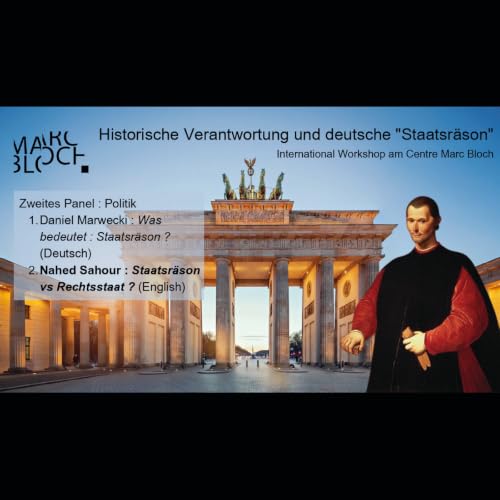
  • "Staatsräson vs Rechtsstaat?" Nahed Samour, Radboud University, Nijmegen
    2024/11/12

    Zweites Panel : Politik

    Moderatorin : EstherMöller, Geschichtswissenschaft, CMB

    Daniel Marwecki, Politikwissenschaft, Hong Kong University

    Nahed Samour, Rechtswissenschaft und Islamwissenschaft, Radboud University, Nijmegen


    This contribution takes a legal approach to the term Staatsräson, investigating how the term does (not) fit the liberal rule of law state that Germany purports to be. The term "Staatsräson" is neither used in the German Basic Law nor in any statutory provisions of German law. It is therefore not to be understood as a legal or doctrinal term. And yet, while Staatsräson is not a legal term, it has wide- ranging legal effects nevertheless. In fact, my argument is that precisely because it is not a legal term and because it is not enshrined in a legal norm and remains opaque in its meaning, interpretation and application, it creates uncertainty and "chilling effects", so that it is unclear for citizens and residents in Germany what is and is not legal, causing a hinderance for excerting fundamental and human rights.


    Dr. Nahed Samour ist Research Associate an der Radboud University, Nijmegen und arbeitet im Forschungsprojket "race-religion-constellations". Sie hat Rechtswissenschaften und Islamwissenschaften an den Universitäten Bonn, Birzeit/Ramallah, London (SOAS), Berlin (HU), Harvard und Damaskus studiert. Sie war Doktorandin am Max-Planck-Institut für Europäische Rechtsgeschichte in Frankfurt a. M. und Rechtsreferendarin am Kammergericht in Berlin. Ihre wissenschaftliche Laufbahn führte sie zudem an das Eric Castrén-Institut für Völkerrecht und Menschenrechte der Universität Helsinki, an das Lichtenberg-Kolleg des Göttingen Institute for Advance Study. Sie hat an der Harvard Law School Institute for Global Law and Policy gelehrt und war co-emerging PI am Law & Society Institute der Humboldt Universität zu Berlin, Juristische Fakultät.


    Zum weiterlesen:


    Nahed Samour, The Arab in the Law of Berlin, or: „How does it feel to be a problem?“, in: Badr, Hanan/Samour, Nahed (eds.): Arab Berlin. Bielefeld: transcript Verlag 2023, p. 103–120.Arab Berlin | transcript.open - Open Access Co-Publishing Network (transcript-open.de)

    Nahed Samour, Ntina Tzouvala, Self-defence in Israel and Palestine: Unsuspending Disbelief (rsilpak.org), Research Society of International Law, 27.11.2023.

    Pary El-Qalqili, Nahed Samour, Das Scheitern von Kunst – und Kulturbetrieb – Die Straße als Ort für Dissens, Pary El-Qalqili & Nahed Samour - The Words of the Arty Class, 10.02.2024.


    Hébergé par Ausha. Visitez ausha.co/politique-de-confidentialite pour plus d'informations.

    続きを読む 一部表示
    27 分
  • Was bedeutet: Staatsräson? Daniel Marwecki, Hong Kong University
    2024/11/12

    Zweites Panel : Politik

    Moderatorin : EstherMöller, Geschichtswissenschaft, CMB

    Daniel Marwecki, Politikwissenschaft, Hong Kong University

    Nahed Samour, Rechtswissenschaft und Islamwissenschaft, Radboud University, Nijmegen


    Daniel Marwecki, Lecturer in International Relations, University of Hong Kong, hält einen Vortrag über die Geschichte der deutsch-israelischen Beziehungen und die ihr spezifische Tauschstruktur: Rehabilitation für die Bundesrepublik, Waffen und Wirtschaftshilfe für Israel. Er stellt dabei die Frage, was uns diese Geschichte über die Gegenwart sagen kann.


    Zum Weiterlesen:

    https://blnreview.de/en/ausgaben/2024-06/marwecki-calculated-reconciliation-germany-israel-reason-of-state


    https://www.wallstein-verlag.de/9783835355910-absolution.html


    Hébergé par Ausha. Visitez ausha.co/politique-de-confidentialite pour plus d'informations.

    続きを読む 一部表示
    27 分