エピソード

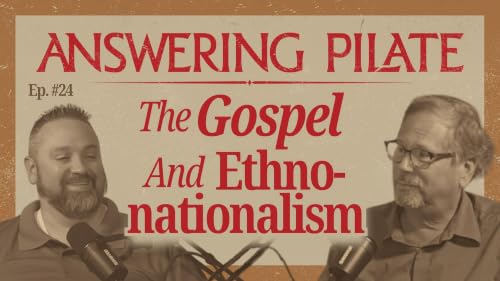
  • The Gospel And Ethno-Nationalism (Ep. 24)
    2026/10/12

    Is ethnonationalism compatible with the Christian faith? In this episode, we look past the usual prooftexts and test ethnonationalism against the whole story of Scripture. We explain why ancient Israel, the church and the modern nation-state are not the same thing. We also ask what should define a nation: ethnicity, or shared moral and civic commitments.

    From there we talk about Christ's reign and postmillennial hope, and the limits of political power. Government can restrain evil, but only the gospel creates the people a Christian social order needs. We cover civil government after Noah, natural law and justice, and how the Great Commission undoes ethnic fatalism. We also discuss the order of loves, love of neighbor, and why Christian identity outranks ethnic identity. We close on the beauty of unity in Christ across cultures, and on the church gathered from every nation as the clearest sign of Christ's present reign.

    続きを読む 一部表示
    1 時間 9 分
  • Is Ethno-Nationalism Biblical?
    2026/10/05
    Is ethno-nationalism a biblical framework for Christian political engagement, or does it contradict the gospel's multiethnic vision? In this episode we revisit Christian nationalism through the lens of ethno-nationalism — defining our terms, weighing the role of rhetoric, and asking what Scripture actually teaches about ethnic and national distinction. We work through Genesis 11's dispersion at Babel alongside Acts 2's reversal at Pentecost, consider how Deuteronomy 32 and Acts 17 speak to borders and the boundaries of the nations, and examine the church's multiethnic witness in relation to culture and civil order. Finally, we press into the order of loves: should Christians love their unsaved ethnic or national neighbors more than fellow believers from other nations? We close with a preview of future theological and political topics.
    続きを読む 一部表示
    49 分
  • A History Of Baptism
    2026/09/28
    In this episode we trace the history of baptism from the earliest days of the church through the Reformation, weighing what Scripture and church history each contribute to the debate. We look at early Christian practice and the case for believers' baptism, how and why infant baptism appeared and spread in the early church, and what baptism actually does — does it save, or is salvation only through the blood of Christ by faith? Along the way we follow believers' baptism through the Middle Ages and Reformation, and close by asking whether Christians can disagree well on baptism without hostility.
    続きを読む 一部表示
    45 分
  • Christ, Conscience, and the Public Square: A Christian Political Theology
    2026/09/21
    In this episode we explore why Christians should engage the public square and why moral neutrality in government is a myth. We work through Christ's lordship, human sin, and the purpose of civil government — asking whether modern states are bound to the Mosaic Law, and why political theology should begin at Creation rather than Sinai. Along the way we consider natural law and the need for Scripture, what civil law should enforce, the Noahic covenant and general equity, progressive revelation, the church and the state, religious liberty without liberal neutrality, and borders, migration, and the state's duty to protect. We close by rejecting both theonomy and liberalism as adequate frameworks for Christian political witness.
    続きを読む 一部表示
    1 時間 2 分
  • Lindsay Clancy and the Culture of Death
    2026/09/14
    The Lindsay Clancy case has been reframed by much of the culture as a tragedy of mental illness — but what happens when compassion overrides accountability, and the victims disappear from the story? In this episode we work through the case with a biblical lens on justice, guilt, and moral agency: the facts and defenses being offered, the limits of psychiatric and chemical explanations for evil, and the way media and social platforms shape public judgment through emotional narratives. We take up 'toxic empathy,' premeditation and the insanity defense, and what justice should require even in cases of severe mental disturbance. From there we make a theological case for accountability rooted in the image of God, address why altered faculties (whether from medication or intoxication) do not erase guilt, and contrast medical solutions to suffering and depression with the biblical care of souls. Finally we trace the wider worldview — from abortion to feminism — that underwrites selective sympathy and diminished responsibility, and close on why naming sin honestly is necessary for both justice and the hope of the gospel.
    続きを読む 一部表示
    1 時間 42 分
  • Episode 19 — Covenant, Civil Government, and the Limits of Theonomy
    2026/09/07
    In this episode, we dig into how covenant theology shapes our view of civil government, Christian nationalism, and public ethics. Starting from a Baptist and Reformed foundation, we work through the fulfillment of the old covenant in Christ, the law of Christ, and the place of imprecatory prayer. From there we unpack theonomy — what it is, how it differs from historic Reformed and Baptist thought, and why we're only partially persuaded by general equity theonomy. We wrestle with the hard question of God's severe Old Testament judgments in light of sin, justice, and redemption, then offer a broader biblical-covenantal alternative that grounds civil government in the creation order from Adam and Noah rather than Moses. We close by considering church, state, and public morality under the new covenant, and preview where the conversation goes next.
    続きを読む 一部表示
    1 時間 3 分
  • Why Do I Believe The Bible?
    2026/08/31
    Why should anyone believe the Bible in the first place? In this episode we start where every worldview must — with the question of ultimate authority — and work through the difference between general and special revelation, the limits of inherited faith, and why evidence alone can't produce belief without the Spirit. From there we look at how the biblical worldview actually makes reality intelligible: logic, reason, and science all rest on the sustaining order of a rational Creator. We close on what makes human beings unique — dignity, morality, and meaning grounded in the image of God — and how to help the next generation move past a borrowed faith into one that's genuinely their own.
    続きを読む 一部表示
    48 分
  • The Resurgence Of Sacramentalism - Part 2
    2026/08/24
    A growing number of young evangelicals are leaving their tradition for Roman Catholicism, Anglicanism, and other liturgical churches. What's driving the shift — and is it as deep as it appears? In this episode we trace the appeal of apostolic roots and the Church Fathers, look at Matthew Barrett's move to Anglicanism as a case study, and ask hard questions about whether sacred aesthetics really produce spiritual depth. We examine claims about apostolic succession and doctrinal certainty in Rome, make the case that Scripture — not tradition — must govern the church, and unpack the rise of sacramentalism and competing views of the Lord's Supper. Along the way we discuss why visible rituals feel so powerful, why faith must rise above them, and how churches can answer the real hunger for serious theology and intellectual depth without abandoning the gospel.
    続きを読む 一部表示
    1 時間 4 分