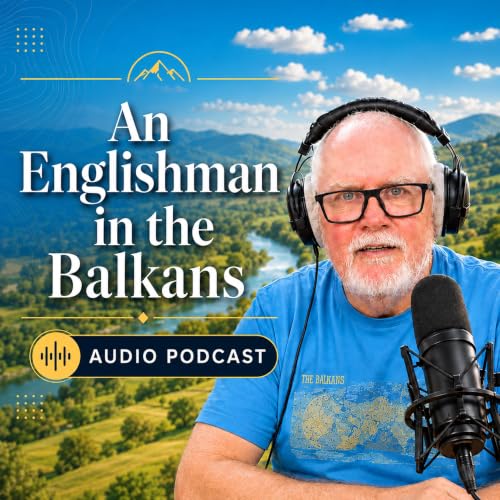
『An Englishman in the Balkans』のカバーアート

An Englishman in the Balkans

An Englishman in the Balkans

著者: David Pejčinović-Bailey MBE
無料で聴く

An Englishman in the Balkans is a personal storytelling podcast from David Pejčinović-Bailey, a British broadcaster and former soldier who has made his home in Bosnia and Herzegovina. , From village walks and quiet reflections to conversations about culture, history, travel, retirement abroad, and life after 70, this podcast offers a warm, honest and often thoughtful look at Bosnia and the wider Balkans through British eyes. This is not a glossy travel brochure, and it is not a relocation manual. It is a slower, more personal journey through everyday life in a country that is still too often misunderstood. Each episode brings you stories, observations and reflections from rural Bosnia, exploring what it means to start again later in life, live between cultures, and find meaning in small places, quiet roads, shared coffee, changing seasons and unexpected conversations. If you are interested in Bosnia and Herzegovina, the Balkans, retired life abroad, expat stories, slow travel, or simply thoughtful audio storytelling from a British voice in Southeast Europe, you are very welcome here. An Englishman in the Balkans, a British voice from Bosnia, telling stories from life beyond the usual headlines.David Pejčinović-Bailey MBE 2026 旅行記・解説 社会科学
エピソード
  • The Blue Blanket | A Bosnian Refugee’s Journey to Australia
    2026/08/16
    An Englishman in the Balkans is a personal podcast about life, travel, culture, and storytelling in Bosnia and Herzegovina, told from the perspective of a British-born creator who has made this country home.Expect gentle reflections, real places, local voices, field recordings, and stories that go beyond the usual headlines.What does home mean when you were forced to leave it as a child?In this deeply personal episode, I speak with Ivana Strbac Alfonso, who was six years old when conflict reached her village of Stranjani, near Zenica in central Bosnia and Herzegovina.Before the war, Ivana remembers a simple but loving rural childhood: a multigenerational family home, grandparents drinking coffee with sugar cubes, flower crowns, home-cooked meals and a community in which people helped one another.Then everything changed.Ivana remembers wooden boards covering the windows, being told to stay inside and the morning her mother woke the children so that they could flee. She remembers the smell of freshly baked bread and desperately trying to take her large blue comfort blanket with her as the family escaped through the forest.What followed was a long and painful journey through displacement, refugee accommodation and a difficult new life in Germany. Although the family had reached safety, Ivana experienced bullying, poverty, language barriers and the feeling of being regarded as an outsider.After four and a half years in Germany, the family was told they could no longer remain. With very little waiting for them in Bosnia, they eventually received permission to begin another new life on Australia’s Gold Coast.Ivana speaks openly about arriving in Australia without English, trying to become a cultural “chameleon” and growing up between several different worlds. Inside the family home were Balkan language, food and traditions. Outside, she tried to sound and behave like an Australian child.We also talk about:The difference between choosing to migrate and being forced to fleeHer complicated relationship with AustraliaReturning to Bosnia as an adultFeeling both connected to and separated from the country of her birthPreserving language and culture for the next generationThe creation of her Balkan Sis podcastWhy sharing difficult stories can make their burden easier to carryThis is an emotional conversation, but also one filled with humour, honesty and resilience.Ivana’s story reminds us that reaching a safe country does not necessarily bring a refugee’s journey to an end. The questions of identity, belonging and home can remain for a lifetime.Content note: This episode includes discussion of war, forced displacement, childhood trauma, bullying and the long-term effects of becoming a refugee.You can follow Ivana here 👇Instagram (Balkan Sis) https://www.instagram.com/balkansispodcastFacebook 1 https://www.facebook.com/share/192a6DyTHo/Facebook 2 https://www.facebook.com/share/19UrPbcj7f/LinkedIn https://www.linkedin.com/in/ivanaalfonsoLinktree https://linktr.ee/ivanaalfonsoEmail ivana.alfonso@hotmail.comBefore I go, I'd love to hear from you.If this episode brought back a memory, made you curious about Bosnia and Herzegovina, or simply gave you something to think about, why not send me an Email or WhatsApp voice note?You might have a question, a story of your own, or just want to say hello.With your permission, I may even feature your message in a future episode.LEAVE A VOICE NOTE ON WHATSAPPThe Email address is: david@anenglishmaninthebalkans.comYou'll also find ways to support the podcast, become a member, and follow the journey over at:Website:Substack:Support the Podcast:Interested in starting your own podcast later in life?My self-paced course, Start With Your Voice, is designed for late creators who want a calm and simple way to begin: FIND OUT MORE:
    続きを読む 一部表示
    1 時間 16 分
  • How Pirate Radio Changed My Life | From Radio Caroline to Bosnia
    2026/08/15

    An Englishman in the Balkans is a personal podcast about life, travel, culture, and storytelling in Bosnia and Herzegovina, told from the perspective of a British-born creator who has made this country home.

    Expect gentle reflections, real places, local voices, field recordings, and stories that go beyond the usual headlines.

    Pirate radio, Radio Caroline and the offshore stations of the 1960s changed British broadcasting, and quietly shaped the direction of my own life.

    On 14 August 1967, the Marine Broadcasting Offences Act came into force in Britain. Most offshore radio stations closed, although Radio Caroline famously continued. As a young teenager listening in London, I couldn’t have known that the excitement of finding those voices on the radio dial would remain with me for almost sixty years.

    In this personal episode, I trace my journey from listening to offshore radio and becoming involved with the land-based pirate station Radio Jackie in 1968, through volunteering with BFBS in Germany and launching Punch FM under a Restricted Service Licence in 1993.

    That journey also took me to BBC Radio Surrey, 2-TEN FM and back to BFBS as a contract presenter. Eventually, I brought those accumulated experiences to Bosnia and Herzegovina, where I helped create Oksigen FM, an independent station offering young people a musical window into the wider world during the difficult postwar years.

    Today, the ships, transmitters and crackling medium-wave signals have largely given way to microphones, digital editing and podcast feeds. Yet the essential idea remains: one person speaking in one place can reach another person somewhere far away.

    Now I continue that journey from a village near Laktaši through An Englishman in the Balkans, sharing the people, places and everyday life of the country I call home.

    Almost sixty years after first discovering offshore radio, I am still following that signal.

    Before I go, I'd love to hear from you.

    If this episode brought back a memory, made you curious about Bosnia and Herzegovina, or simply gave you something to think about, why not send me an Email or WhatsApp voice note?

    You might have a question, a story of your own, or just want to say hello.

    With your permission, I may even feature your message in a future episode.

    LEAVE A VOICE NOTE ON WHATSAPP

    The Email address is: david@anenglishmaninthebalkans.com

    You'll also find ways to support the podcast, become a member, and follow the journey over at:

    Website:

    Substack:

    Support the Podcast:

    Interested in starting your own podcast later in life?

    My self-paced course, Start With Your Voice, is designed for late creators who want a calm and simple way to begin: FIND OUT MORE:

    続きを読む 一部表示
    30 分
  • When Language Becomes Identity
    2026/08/09
    An Englishman in the Balkans is a personal podcast about life, travel, culture, and storytelling in Bosnia and Herzegovina, told from the perspective of a British-born creator who has made this country home.Expect gentle reflections, real places, local voices, field recordings, and stories that go beyond the usual headlines.Language is never simply a collection of words. It carries memories, family stories, humour, history and a sense of where we belong.In this episode, I speak with Nick Nasev, an Australian-born chartered linguist, translator, writer and editor with Macedonian roots. Nick has spent almost 25 years working professionally with several Balkan languages, including Bosnian, Serbian, Croatian, Montenegrin, Macedonian and Bulgarian.Nick grew up surrounded by different languages in Australia. As a child, however, his family was advised to stop speaking Macedonian to him because it was believed that using more than one language would confuse him.That experience almost caused him to lose his mother tongue.We talk about what happens when a language gradually disappears within a family. Nick explains that the loss goes far beyond vocabulary. When younger generations can no longer fully understand their parents or grandparents, they may also lose access to the stories, cultural references and meanings carried within everyday expressions.Our conversation then turns to the Balkans, where the question of whether someone speaks Bosnian, Serbian, Croatian or Montenegrin can become surprisingly sensitive.After more than 25 years of living in Bosnia and Herzegovina, I still occasionally find myself stepping carefully through that linguistic minefield. Nick explains why relatively small differences in words, accents and pronunciation can become powerful markers of identity and belonging.We also discuss Australian English, accents as badges of identity, the languages of the former Yugoslavia, and whether younger generations in the Balkan diaspora will continue speaking the languages of their parents and grandparents.This is a thoughtful, personal and occasionally amusing conversation about migration, family, language and the complicated question of where we truly belong.Guest: Nick NasevTopics: Balkan languages, language and identity, mother-tongue loss, diaspora, multilingual families, Bosnian, Serbian, Croatian, Macedonian, accents and belonging.You can find out More about Nick at:Substack: https://nicknasev.substack.com/ for my writing about Balkan things.For Australian English: https://australianenglishwithnick.substack.com/My website: www.nicknasev.comInterested in more of the translation side of things?: https://www.linkedin.com/in/nick-nasev/and depending on what language, I have Facebook profiles:Macedonian: https://www.facebook.com/NickNasevMacedonianToEnglishTranslator/Bulgarian: https://www.facebook.com/NickNasevBulgarianToEnglishTranslator/Bosnian/Croatian/Serbian/Montenegrin: https://www.facebook.com/NickNasevBosnianCroatianSerbianToEnglishTranslator/Before I go, I'd love to hear from you.If this episode brought back a memory, made you curious about Bosnia and Herzegovina, or simply gave you something to think about, why not send me an Email or WhatsApp voice note?You might have a question, a story of your own, or just want to say hello.With your permission, I may even feature your message in a future episode.LEAVE A VOICE NOTE ON WHATSAPPThe Email address is: david@anenglishmaninthebalkans.comYou'll also find ways to support the podcast, become a member, and follow the journey over at:Website:Substack:Support the Podcast:Interested in starting your own podcast later in life?My self-paced course, Start With Your Voice, is designed for late creators who want a calm and simple way to begin: FIND OUT MORE:
    続きを読む 一部表示
    29 分
adbl_web_anon_alc_button_suppression_t1
まだレビューはありません