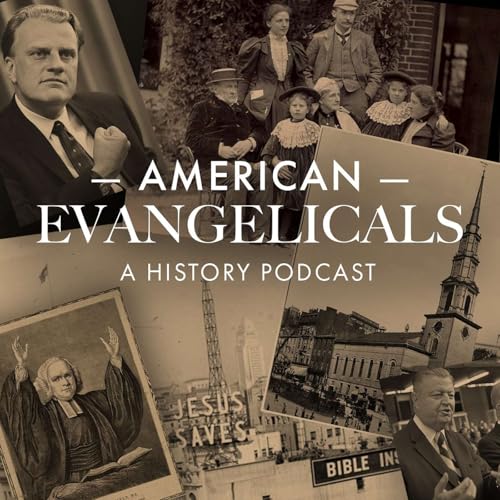
『American Evangelicals - A History Podcast』のカバーアート

American Evangelicals - A History Podcast

American Evangelicals - A History Podcast

著者: SL Brown Foundation
無料で聴く

American Evangelicals blends storytelling and free-flowing conversation to explore the varieties, similarities, and significance of evangelical Christians in American history.


Spanning the religious revivals of the 18th century to the cultural and political conflicts of the 21st, each episode is a conversation based on the historical research of its hosts, the deep scholarship on American evangelicals, and the lives of real figures who shaped the movement.


Hosted by three historians of American evangelicalism, discover how evangelicals have shaped and been shaped by the challenges of not just theology and belief, but by the same forces that have contributed to American society, from immigration to war, race, and economics.

© 2026 American Evangelicals - A History Podcast
キリスト教 スピリチュアリティ 世界 聖職・福音主義
エピソード
  • BONUS: Evangelicals, Science, & Ted Davis
    2026/07/23

    Episode 8 of American Evangelicals only had room for excerpts of our conversation with historian of science Ted Davis. This bonus episode gives you the entire, unedited interview. Davis, a leading historian of science and religion, traces the relationship between American Christianity and scientific thought from the early republic through the Scopes trial and into the twenty-first century — challenging some common assumptions about evangelicals and science along the way. If you've already heard our episode on evangelicals and science, think of this as the director's cut: every story, historical detail, and insight that didn't make the final cut. Host John Fea conducted the full interview with Ted Davis.

    ABOUT OUR GUEST

    Edward B. “Ted” Davis is Professor Emeritus of the History of Science at Messiah University, where he was a longtime colleague of host John Fea, and a Fellow of the International Society for Science & Religion. He is co-editor, with Michael Hunter, of The Works of Robert Boyle. His most recent book, Protestant Modernist Pamphlets: Science and Religion in the Scopes Era (Johns Hopkins University Press, 2024), is a critical edition of ten rare pamphlets on science and religion published around the 1925 Scopes trial.

    PEOPLE, BOOKS & TERMS MENTIONED

    • Francis Bacon — English philosopher; The Advancement of Learning (1605) articulated the “two books” framework of scripture and nature.
    • Robert Boyle — 17th-century chemist; his The Christian Virtuoso (1690/91) argued science strengthens rather than threatens Christian faith.
    • Cotton Mather — brought Enlightenment science to America; author of The Christian Philosopher (1721), modeled on Boyle.
    • Samuel Miller — New York Presbyterian minister and later Princeton Seminary professor; A Brief Retrospect of the Eighteenth Century (c. 1803) attacked “infidel philosophy.”
    • Asa Gray — Harvard botanist, correspondent of Charles Darwin, and traditional Christian who reviewed On the Origin of Species favorably in 1860.
    • William Jennings Bryan — prosecutor in the 1925 Scopes trial; opposed evolution and, especially, theistic evolution.
    • Vernon Kellogg — Stanford biologist and pacifist; Headquarters Nights (1917) linked evolution to German militarism and influenced Bryan.
    • Bernard Ramm — Baptist theologian; The Christian View of Science and Scripture (1954) urged evangelicals to be open to science.
    • John C. Whitcomb Jr. and Henry Morris — The Genesis Flood (1961), written partly in response to Ramm, launched the modern young-earth creationist movement.
    • Francis Collins — geneticist who led the Human Genome Project to completion; prominent evangelical voice on faith and science.
    • American Scientific Affiliation — an organization of evangelical scientists founded just before Pearl Harbor, which grew rapidly after World War II.
    • Society of Catholic Scientists — founded by astrophysicist Stephen Barr as a Catholic counterpart to the American Scientific Affiliation.

    🔗 LINK to episode 8

    https://www.buzzsprout.com/2610661/episodes/19367017

    Send us Fan Mail

    Hosts:

    JOHN FEA - Visiting Fellow in History, Lumen Center; Distinguished Professor of History, Messiah University

    MAGGIE CAPRA - Visiting Instructor in American History, Beloit College

    DAN HUMMEL - Director of the Lumen Center; Honorary Research Fellow, University of Wisconsin-Madison

    This podcast is brought to you by the Lumen Center and STUDIO, both initiatives of the SL Brown Foundation.

    Find out more about our work:

    • slbf.org/lumen-center
    • slbf.org/studio

    Produced by Daniel Johnson and Dave Conour

    Edited by Dave Conour

    続きを読む 一部表示
    39 分
  • Looking Back, Looking Ahead: Evangelicalism, History, and What Comes Next (Episode 12)
    2026/07/16

    In the finale of Season One, John Fea, Dan Hummel, and Maggie Capra step out of their usual narrative format to reflect directly on the series and on the state of the field they study. They open by sharing what listener feedback has taught them about the value of a historian's “dispassionate” approach to a subject most people experience personally rather than academically.

    From there, the conversation turns to future casting — always, they admit, a risky exercise for historians. The hosts trace the demographic rise of religious “nones” and “nonverts,” debate whether “evangelical” and “evangelicalism” remain useful words, and revisit the Bebbington Quadrilateral, Timothy Smith's kaleidoscope theory, and the historiographical legacy of David Bebbington, George Marsden, Joel Carpenter, and Mark Noll.

    The back half of the episode moves through evangelicals and political power, the rise of dominionism and reconstructionist thought, the uncertain future of Christian higher education, and the migration of evangelical debate onto podcasts, Substack, and YouTube. They close with a shared case for why a historical — rather than theological or political — lens on evangelicalism still matters, closing out the season with thanks to listeners and a tribute to historian Gordon Wood, who died the week of recording.

    PEOPLE & BOOKS MENTIONED

    • Stephen Bullivant, Nonverts: The Making of Ex-Christian America (Oxford University Press, 2022)
    • Molly Worthen, Apostles of Reason: The Crisis of Authority in American Evangelicalism (Oxford University Press, 2013)
    • Mark Noll, The Scandal of the Evangelical Mind (Eerdmans, 1994)
    • A.J.A. Woods, The Cultural Marxism Conspiracy: Why the Right Blames the Frankfurt School for the Decline of the West (Verso, 2026)
    • Henry F. May, “The Recovery of American Religious History,” American Historical Review 70 (October 1964)
    • David Bebbington — historian; the “Bebbington Quadrilateral” framework for defining evangelicalism
    • George Marsden and Joel Carpenter — historians discussed their role in establishing evangelicalism as a coherent historiographical category
    • Nathan Hatch — historian referenced on the “democratization” of American Christianity
    • Timothy L. Smith — historian referenced for his “kaleidoscope theory” of evangelicalism
    • Vincent Bacote — theologian, Wheaton College, cited as an example of evangelical political-theology scholarship; the hosts recall him as a guest earlier in the season (Episode 4)
    • R.J. Rushdoony — referenced in the discussion of Christian reconstructionism
    • Paul Weyrich — referenced as a Christian-right organizer connected to the New Congress Foundation
    • Lyndon LaRouche — referenced in the discussion of the “cultural Marxism” conspiracy theory's origins
    • Tim Mackie — co-founder of The Bible Project, referenced on patron-funded models of Christian content
    • Gavin Ortlund — pastor and YouTube creator, cited as an example of digital-first evangelical ministry
    • Gordon Wood — historian of the American Revolution, was remembered by the hosts following his death at 92 in June 2026

    🔗 LINK to our button form

    https://www.surveymonkey.com/r/AmerEvanPodButtons

    Send us Fan Mail

    Hosts:

    JOHN FEA - Visiting Fellow in History, Lumen Center; Distinguished Professor of History, Messiah University

    MAGGIE CAPRA - Visiting Instructor in American History, Beloit College

    DAN HUMMEL - Director of the Lumen Center; Honorary Research Fellow, University of Wisconsin-Madison

    This podcast is brought to you by the Lumen Center and STUDIO, both initiatives of the SL Brown Foundation.

    Find out more about our work:

    • slbf.org/lumen-center
    • slbf.org/studio

    Produced by Daniel Johnson and Dave Conour

    Edited by Dave Conour

    続きを読む 一部表示
    1 時間 5 分
  • Accidental Diplomats: Missionaries, Money, and the World (Episode 11)
    2026/07/09
    It's easy to imagine American evangelicalism as a story that happens entirely inside the United States. In this episode, John Fea, Dan Hummel, and Maggie Capra push past that bubble to explore evangelicals' long, tangled relationship with the rest of the world.The episode opens with two stories drawn from recent scholarship. The first, from David Swartz's Facing West, complicates the founding myth of World Vision: American evangelist Bob Pierce is remembered as the organization's sole founder, but the humanitarian network he built on was already running under Korean pastor Kyung Chik Han. The second, from Philip Dow's Accidental Diplomats, follows Daniel Arap Moi from a ten-year-old convert at a Kenyan mission station to Kenya's second president, guided for decades by his missionary mentor and confidant, Earl Anderson.From there, the hosts trace how American evangelicals have understood missions, humanitarianism, and their own place in the world across two centuries: the shift from cultural superiority to contextualized missiology, the 1974 Lausanne Congress and its Global South critiques of Western evangelicalism, the astonishing 20th-century demographic shift of Christianity from the global North to the global South, and the increasingly contested question of what — if anything — the word "white" is still doing in front of "evangelical." They close by reckoning honestly with the missionary movement's mixed legacy: real colonial entanglements alongside real cross-cultural courage, and a complicated set of missionary heroes evangelicals still look to for inspiration.PEOPLE & TERMS MENTIONEDBob Pierce: Evangelist and founder of World Vision (1950), following a 1947 trip to China that inspired his humanitarian ministry.Kyung Chik Han: Korean pastor and refugee relief leader who built the orphanage and humanitarian network in Seoul that became the operational core of World Vision.Daniel Arap Moi: Kenya's second president (1978–2002), mentored in his youth by American missionary Earl Anderson.Earl Anderson: American missionary and government school inspector in colonial Kenya; longtime mentor and confidant to Daniel Arap Moi.René Padilla & Samuel Escobar: Latin American evangelical theologians whose critiques of Western missions at the 1974 Lausanne Congress challenged American evangelical assumptions.John Stott: British evangelical leader who helped mediate the global-north/global-south tensions at the Lausanne Congress.William Ernest Hocking: Harvard philosopher who chaired the 1932 “Re-Thinking Missions” laymen's inquiry, questioning the traditional conversion-focused model of missions.Bebbington's Quadrilateral: Historian David Bebbington's four-part definition of evangelicalism: conversionism, biblicism, crucicentrism, and activism.1040 Window: Cold War-era missions term for the band of the globe (10° to 40° north latitude) considered least reached by Christianity.Carl McIntire: Fundamentalist radio preacher associated with balloon-borne Bible airdrops into communist territory during the Cold War.Paul Hiebert: Missiologist (Fuller Theological Seminary, later Trinity Evangelical Divinity School) known for bringing anthropological method into evangelical missions training.Walter Kim: President of the National Association of Evangelicals, cited as an example of the organization's non-white leadership.New Apostolic Reformation: Term used to describe an influential, loosely organized network of independent charismatic and Pentecostal leaders.BOOKS MENTIONEDDavid R. Swartz, Facing West: American Evangelicals in an Age of World Christianity (Oxford University Press, 2020).Philip Dow, Accidental Diplomats: American Missionaries and the Cold War in Africa (William Carey Publishing, 2024).David P. King, God's Internationalists: World Vision and the Age of Evangelical Humanitarianism (University of Pennsylvania Press, 2019).David A. Hollinger, Protestants Abroad: How Missionaries Tried to Change the World but Changed America (Princeton University Press, 2017).Gina A. Zurlo, How Many Evangelicals in the World? A New Assessment from the World Christian Database, Review of Religious Research (open access).Send us Fan MailHosts:JOHN FEA - Visiting Fellow in History, Lumen Center; Distinguished Professor of History, Messiah UniversityMAGGIE CAPRA - Visiting Instructor in American History, Beloit CollegeDAN HUMMEL - Director of the Lumen Center; Honorary Research Fellow, University of Wisconsin-MadisonThis podcast is brought to you by the Lumen Center and STUDIO, both initiatives of the SL Brown Foundation. Find out more about our work:slbf.org/lumen-centerslbf.org/studioProduced by Daniel Johnson and Dave ConourEdited by Dave Conour
    続きを読む 一部表示
    1 時間 4 分
adbl_web_anon_alc_button_suppression_t1
まだレビューはありません