

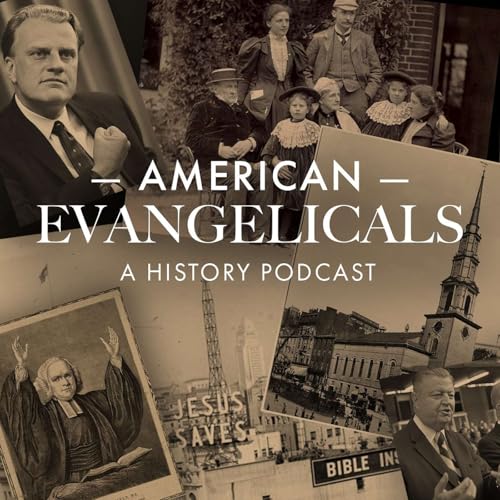
Defining the American Evangelical Movement: Born Again
カートのアイテムが多すぎます
カートに追加できませんでした。
ウィッシュリストに追加できませんでした。
ほしい物リストの削除に失敗しました。
ポッドキャストのフォローに失敗しました
ポッドキャストのフォロー解除に失敗しました

Defining the American Evangelical Movement: Born Again
-
ナレーター:
-
著者:
概要
We begin where history often does — with a story. It’s October 23, 1740, and Connecticut farmer Nathan Cole has just heard urgent news: the famous preacher George Whitefield will be in Middletown in a matter of hours. Cole drops his tools, saddles his horse, and races twelve miles through a cloud of dust kicked up by thousands of others doing the same. What he experiences that day — and over the two years that follow — opens a window into one of the most important and contested movements in American history: evangelicalism.
Hosts John Fea, Dan Hummel, and Maggie Capra use Cole’s diary as a launching point for exploring the deceptively simple question at the heart of this series: What is an evangelical?
Topics Covered
- The story of Nathan Cole and his encounter with George Whitefield at Middletown, CT (1740)
- George Whitefield as the first true celebrity of British America
- The Bebbington Quadrilateral — the four theological markers historians use to define evangelicalism: Conversionism, Biblicism, Crucicentrism, and Activism
- Why the “New Birth” is the most distinctive feature of evangelical identity
- The 1976 Gallup poll and Jimmy Carter’s influence on how “born again” entered mainstream American vocabulary
- The trans-denominational character of early evangelicalism — and why Whitefield crossed church lines freely
- The First Great Awakening as a largely Reformed/Calvinist phenomenon, and the difference between “New Lights” and “Old Lights”
- Whitefield’s theatrical preaching style and the role of celebrity in evangelicalism, then and now
- The “parachurch” dimension of evangelicalism — how much of the action happens outside formal church structures
- The question of whether the First Great Awakening contributed to the American Revolution (Alan Heimert’s 1966 thesis and its critics)
- Nathan Hatch’s The Democratization of American Christianity and evangelicalism’s relationship to popular democracy
- How historians have debated whether evangelicalism is the “center” of American religious history
Key People & Works Mentioned
- Nathan Cole — Connecticut farmer; his diary is held at the Connecticut Historical Society in Hartford
- George Whitefield — Anglican itinerant preacher; subject of Harry Stout’s biography The Divine Dramatist
- Jonathan Edwards — Theologian, pastor at Northampton, MA
- Gilbert Tennant — New Jersey revivalist preacher, trained at the Log College
- David Bebbington — Evangelicalism in Modern Britain: A History from the 1730s to the 1980s (Taylor & Francis, 1988)
- D. Bruce Hindmarsh — The Evangelical Conversion Narrative: Spiritual Autobiography in Early Modern England (Oxford University Press, 2005)
- Mark Noll — The Rise of Evangelicalism: The Age of Edwards, Whitefield and the Wesleys (IVP Academic, 2003)
- Nathan Hatch — The Democratization of American Christianity (Yale University Press, 1989)
- Alan Heimert — Religion and the American Mind: From the Great Awakening to the Revolution (Harvard University Press, 1966)
- Harry Stout — The Divine Dramatist: George Whitefield and the Rise of Modern Evangelicalism (Wm. B. Eerdmans, 1991)
- Frank Lambert — Pedlar in Divinity: George Whitefield and the Transatlantic Revivals, 1737–1770 (Princeton University Press, 1993)
- John Butler — His
Send us Fan Mail
This podcast is brought to you by the Lumen Center and STUDIO, both initiatives of the SL Brown Foundation.
Find out more about our work:
- slbf.org/lumen-center
- slbf.org/studio
Produced by Daniel Johnson and Dave Conour
Edited by Dave Conour