エピソード

  • Ernest Bai Koroma and Maada Bio's Reconciliation of Corruption
    2026/11/02

    Julius Maada Bio was elected President of Sierra Leone in April 2018 on a platform to fight corruption and introduce fiscal discipline in government. A governance transition committee Bio established to investigate his predecessor, Ernest Bai Koroma, reported that the Koroma administration left Sierra Leone in serious economic difficulty, citing a large external and domestic debt burden driven mostly by an “expanded payroll” of US$263 million, or 14.4% of GDP.

    Bio’s multiple audits into the Koroma regime's past activities uncovered egregious political and financial corruption, nepotism, and widespread economic graft that permeated governance during the ten years of the All Peoples Congress (APC). Bio imposed travel bans on Koroma and several of his former ministers.

    Then in late November 2023, shortly after the disputed June 2023 elections, Bio accused Koroma of plotting to overthrow the controversial government created by a tripartite agreement between the APC and Bio’s SLPP. Koroma was then exiled to Nigeria, where he stayed for two consecutive years before returning to Sierra Leone in early September 2026. Yet, in a two-day conference held in Freetown last week, Koroma and Bio publicly announced they had reconciled their differences, calling for peace and national cohesion across the country.

    In this episode, we ask what became of Maada Bio’s anti-corruption campaign and the findings of the commissions of inquiry against Koroma and his APC ministers. We examine how Koroma and Bio’s reconciliation and peace efforts affect accountability for human rights violations, transparency in governance, and Sierra Leone’s fight against corruption.

    続きを読む 一部表示
    36 分
  • Sierra Leone's Judicial and Constitutional Crisis
    2026/10/26

    In recent years, Sierra Leonean politicians have amended key provisions of the country's constitution and public-election laws to consolidate a de facto one-party state and entrench the SLPP and APC’s power-rotation politics.

    This chain of anti-democratic laws and regulations began with the 2021 cybersecurity legislation, followed by the 2022 Public Elections Act and the 2025 counter-terrorism law, and has now culminated in the current Constitutional Amendment Bill at the center of a so-called litigation in the Freetown courts.

    In this episode, we examine the implications of the constitutional and judicial crisis created by these disingenuous and illegitimate amendments to the country's multiparty constitution and public election laws, highlighting that the current tripartite regime, which resulted from the rigged elections of June 2023, lacks the legal and constitutional mandate to pursue any legal reform in Sierra Leone.

    続きを読む 一部表示
    31 分
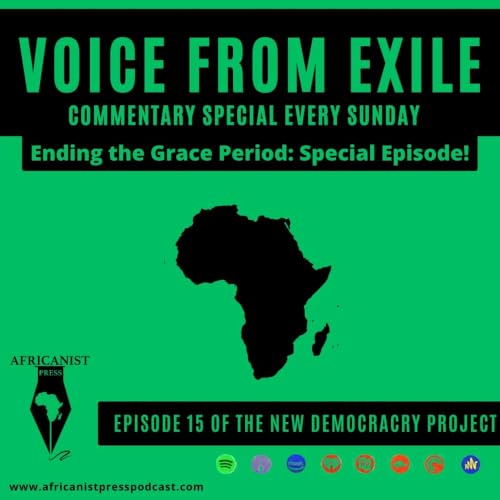
  • Ending the Grace Period: Announcing a Special Investigative Project on Sierra Leone!
    2026/10/04

    In this special episode, Africanist Press editor-in-chief, Dr. Chernoh Alpha M. Bah, briefly reviews the Africanist Press Podcast since its launch in December 2023, announces the return of the weekly Voice From Exile audio series, and outlines plans to introduce a new investigative journalism project on Sierra Leone as the country prepares for the 2028 elections.

    続きを読む 一部表示
    19 分
  • A Legacy of Resistance: Music, Memory, and Self-Determination in Africa
    2026/09/07

    In this episode, we feature Masauko Chipembere discussing his music, his family’s role in the decolonization movement in Malawi, and how his parents’ exile shaped his current work in Africa and around the world.


    続きを読む 一部表示
    1 時間 23 分
  • Arts and Entrepreneurship: Mobilizing Africa's Diaspora Capital
    2026/08/28

    This episode features a discussion with Bloom Afrique’s Toni Blackman and Kennedy Rance about how they use art and emerging technologies to mobilize Africa’s diaspora capital and foster entrepreneurship across the continent.

    続きを読む 一部表示
    1 時間 10 分
  • The Future of Creative Writing and Literature in Sierra Leone: A Conversation with Arthur Onipede Hollist
    2026/08/18
    Arthur Pede Hollist is an award-winning Sierra Leonean writer and Professor of English at the University of Tampa. He teaches courses in African literature and creative writing. His publications include So the Path Does Not Die, which was named the 2014 African Literature Association Creative Book of the Year; “Foreign Aid,” which was shortlisted for the 2013 Caine Prize and published in A Memory This Size and Other Stories; and “The Tale of the Three Water Carriers,” which was longlisted for the 2015 Short Story Day competition and anthologized in Water: New Short Fiction From Africa. His research interests and scholarly publications encompass African trauma fiction, Afrodiasporic literatures, and Sierra Leonean literature. He was a 2017 Fulbright scholar and received the Louise Loy Hunter Award in 2014-2015.This episode features an interview with Professor Hollist, focusing on his writing inspirations, teaching philosophy, and perspectives on the future of the Sierra Leonean literary scene, informed by his extensive experience as both a writer and professor.
    続きを読む 一部表示
    1 時間 19 分
  • Art for Development and Self-Reliance in Africa
    2026/07/27

    The ART27 Group is a Gambian-based non-profit initiative that offers financial assistance for essential expenses such as materials, transportation, and exhibitions. ART27 was founded in December 2024 by Ferenc Donderer, an arts promoter and advocate, to support and advance contemporary visual artists in the Gambia.

    Originally from Cologne, Germany, Donderer has resided in the Gambia since 2016. He manages one of the largest art studios in Sanyang, where he produces his own artwork and provides residency opportunities for artists engaged in training, workshops, and exhibitions.

    With over 40 years of experience as a visual artist exhibiting in cities across Europe and the Americas, including Cologne, Berlin, Antwerp, Salvador de Bahia, New York, and the Canary Islands, Donderer aims to establish a lasting legacy for West African art through the construction of a modern art gallery in the Gambia. The proposed gallery is designed to serve as a dedicated venue for local and African artists to exhibit their work and engage with international audiences.

    In this episode, Osman Kargbo interviews Ferenc Donderer regarding ART27 and his vision for advancing Gambian and African artists.

    続きを読む 一部表示
    38 分
  • The Work of the National Center for Arts and Culture in the Gambia
    2026/07/21

    Politicians and policymakers in Africa are increasingly incorporating historical tourism into national development agendas. They are renewing efforts to make museums and archives central to preserving collective memory, fostering cultural identity, and promoting social cohesion, while also seeking to boost economic growth through heritage tourism.

    Yet, museums and heritage institutions in Africa face hurdles, including underfunding, inadequate climate control, and postcolonial identity crises. These challenges are compounded by urbanization, community disputes over ownership of artifacts, and the struggle to repatriate historical treasures from Europe and elsewhere.

    However, the main challenges limiting the growth and sustainability of African heritage institutions include reduced government funding, low visitor numbers, and a lack of both public and private patronage.

    In the Gambia, the National Center for Arts and Culture (NCAC) is leading efforts to advance the country’s history and cultural heritage as part of the national development agenda.

    Established by an Act of Parliament in 1989, the NCAC serves as the primary government body responsible for the preservation, promotion, and development of Gambian arts and culture. Its strategic role involves protecting cultural assets, bridging cultural heritage with national development, and fostering economic growth through tourism.

    In this episode, our colleague in The Gambia, Osman Kargo, speaks with Hassoum Ceesay, historian and Director General of the NCAC, about the institution's significance and the role of history and culture in The Gambia’s national development agenda.

    続きを読む 一部表示
    43 分