エピソード

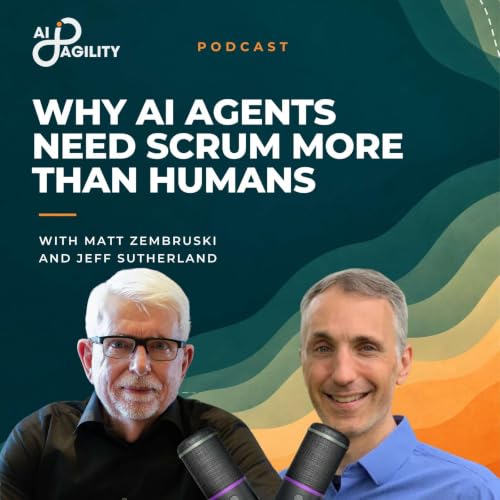
  • AI, Scrum & the Future of AI-Augmented Teams | Dr. Jeff Sutherland | AI Accelerator Podcast
    2026/09/22
    What happens when you combine Scrum, artificial intelligence, and autonomous AI agents?In this episode of the AI Accelerator Podcast, Matt Zembruski sits down with Dr. Jeff Sutherland, co-creator of Scrum and Scrum@Scale and a signatory of the Agile Manifesto, to explore how Scrum is evolving for an AI-powered world.Jeff's background in AI goes back decades, including his work at the Stanford AI Lab with John McCarthy and his involvement with the MIT AI Lab, where he provided development space for Rodney Brooks as he worked on autonomous robotics.Today, Jeff is applying those lessons to AI-native teams through ScrumAI.org, exploring how humans and AI agents can work together through disciplined protocols, autonomous teams, and AI-augmented workflows.The conversation covers everything from the origins of Scrum to AI agents running software development work, AI-powered infrastructure management, and what business leaders need to consider as AI changes the way organizations operate.In This Episode, Dr. Jeff Sutherland Discusses:His early work at the Stanford AI Lab and connection to John McCarthyHis experience with Rodney Brooks and the development of autonomous roboticsHow lessons from robotics influenced the creation of ScrumWhy Jeff describes Scrum as a protocolWhy AI agents need structured processes and protocolsHow Scrum can be adapted for AI-augmented teamsThe role of AI agents in software developmentUsing AI to manage servers and technology infrastructureThe emerging model of AI-augmented Scrum teamsHow AI can amplify the capacity of a teamMeasuring AI contribution alongside human workThe changing roles of Product Owners and Scrum MastersWhat CEOs and executives need to do to adapt to AIHow organizations can begin building AI capabilitiesThe future of AI-native organizationsChapters00:00 - Welcome to the AI Accelerator Podcast01:01 - Meet Dr. Jeff Sutherland, Co-Creator of Scrum02:22 - Jeff's Early AI Journey at Stanford04:37 - From AI Databases to Autonomous Robotics06:27 - How Robotics Inspired Scrum07:27 - Scrum as a Protocol for AI Agents09:33 - Jeff's OpenClaw Project and AI Stack10:15 - Building AI-Powered Infrastructure Operations13:43 - ScrumAI and Scrum@Scale for AI Agents15:20 - Using AI to Amplify Teams16:23 - Measuring AI Contribution in Scrum17:41 - What Business Leaders Need to Know About AI19:45 - What Jeff Is Building at ScrumAI.org20:50 - How CEOs Can Start Adapting to AI22:12 - The AI Adoption Gap23:16 - How to Connect With Jeff24:12 - Closing ThoughtsThe transcript traces Jeff's AI background from Stanford and MIT through robotics and into his current work applying Scrum to AI agents.Key Learnings1. AI Doesn't Eliminate the Need for ProcessJeff argues that AI agents can make the same kinds of mistakes humans make, but they can make them much faster. His approach is to build the Scrum protocol directly into AI-driven workflows so that agents operate within defined structures.2. Scrum Can Be Applied to AI AgentsJeff describes Scrum as a protocol for creating autonomous, self-organizing teams that collaborate toward a goal. In his current work, he is exploring how that protocol can be applied to teams that include AI agents.3. AI Can Amplify Existing TeamsRather than simply replacing people, Jeff discusses using AI to augment teams and increase their capacity. He describes a goal of making a single team capable of producing the value of multiple traditional teams.4. AI Work Can Be Measured Within Existing Scrum PracticesJeff explains how his web team is tracking AI-generated work alongside human work on the Jira board, including measuring the story points completed by AI and humans during a sprint.5. Leaders Need to Build AI Capability NowJeff's advice to executives is centered on education and organizational adaptation. He describes the need for companies to identify people who understand AI deeply and begin building structured programs to help the organization adapt.6. AI Requires Continuous AdaptationA major theme of the conversation is the pace of change. Jeff argues that leaders need to continuously educate their teams and learn how to use new tools rather than treating AI as a temporary technology trend.💬 Jeff Sutherland's Key Insights“Simple rules generate really smart behavior really fast.”“Scrum is really a protocol.”“They really need Scrum more than the humans, because they screw up faster than humans.”“The goal is to augment the team and make the single team worth 10 teams.”About Dr. Jeff SutherlandDr. Jeff Sutherland is the co-creator of Scrum and Scrum@Scale and a signatory of the Agile Manifesto. His career in technology and AI spans decades, including early work at the Stanford AI Lab under John McCarthy and work connected to the MIT AI Lab and Rodney Brooks.Today, Jeff focuses on writing, consulting, and applying Scrum principles to AI through ScrumAI.org. His current work explores how humans and autonomous AI agents can operate together through ...
    続きを読む 一部表示
    25 分
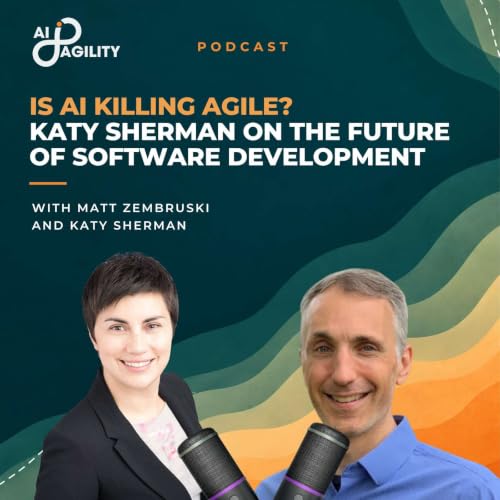
  • Is AI Killing Agile? AI, Product & the Future of Software Development with Katy Sherman
    2026/09/15

    AI is changing how software is built, tested, managed, and delivered. But are we building better systems, or just building them faster?

    In this episode of the AI Accelerator Podcast, Matt Zembruski talks with Katy Sherman, VP of Technology at BeSmartee, about how AI is reshaping Agile, product management, engineering, and technology leadership. With more than 30 years in technology, from software engineer to leading Product, Engineering, Support, and Information Security for a SaaS lending platform, Katy explains why AI is transforming Agile rather than killing it, why documenting intent is now a core engineering discipline, and how leaders can use AI to improve both speed and decision quality.

    At the center of the conversation are two questions every software organization should be asking: What is the system supposed to be doing? And what is it actually doing?

    In this episode:

    • Is AI killing Agile, or transforming it into something better?

    • Why the Agile Manifesto may need a second look in the age of AI

    • Why humans struggle to keep context across large amounts of documentation

    • Documenting intent before AI writes the code

    • Why faster development isn't automatically better development

    • Using AI to connect goals, KPIs, requirements, acceptance criteria, tests, and code

    • Why Product and Engineering are converging, and why Product Operations matters

    • How BeSmartee adopts AI while balancing security, quality, and customer expectations

    Key quote: "What is the system supposed to be doing and what is it really doing?" – Katy Sherman

    Timestamps:

    00:00 Welcome to the AI Accelerator Podcast

    00:14 Meet Katy Sherman, VP of Technology at BeSmartee

    01:27 Katy's journey from software engineer to technology and product leader

    03:36 Why combining Product and Engineering creates better business outcomes

    04:32 AI adoption in fintech: security and managing risk

    05:25 Is AI killing Agile?

    06:30 The massive transformation happening in software development

    07:40 Reexamining the Agile Manifesto in the age of AI

    08:38 Why humans struggle with massive amounts of documentation

    09:43 From comprehensive documentation to code as the durable record

    10:49 What AI changes about comprehension, context, and software development

    12:05 AI-generated code and the need to document intent

    13:09 Why successful organizations will need stronger statements of intent

    14:38 How BeSmartee is adapting its operating model

    15:07 Balancing speed, quality, and customer expectations

    16:05 The two questions at the heart of software quality

    17:40 Why knowing what a system will actually do is difficult

    18:34 The danger of simply accelerating code production

    19:28 Using AI to document and validate intent

    20:52 What is the system supposed to do, and what is it actually doing?

    21:25 Separating code generation from context and decision-making

    22:01 Using AI to connect goals, KPIs, requirements, tests, and code

    22:48 Getting the benefits of AI without losing control

    23:19 Final thoughts with Katy Sherman

    Connect with Katy Sherman:

    Website: https://www.besmartee.com/

    LinkedIn: https://www.linkedin.com/in/katy-sherman/

    Connect with Matt Zembruski:

    Website: https://leadingaiagility.com

    LinkedIn: https://www.linkedin.com/in/mattzembruski/

    Email: matt@leadingaiagility.com

    Phone / Text / WhatsApp: +1 978-618-5778

    About the AI Accelerator Podcast: Hosted by Matt Zembruski, the AI Accelerator Podcast explores how leaders are moving beyond AI hype and putting artificial intelligence to work in real organizations, with practical perspectives on AI adoption, digital transformation, leadership, innovation, and the future of work.

    続きを読む 一部表示
    24 分
  • AI, Clean Data & the Future of Product Development | Johanna Rothman | AI Accelerator Podcast
    2026/09/09
    AI is everywhere, but more AI does not automatically mean better results.In this episode of the AI Accelerator Podcast, host Matt Zembruski sits down with Johanna Rothman, known as the Pragmatic Manager, to explore what practical AI adoption really looks like inside product development organizations.Johanna Rothman has worked in software and product development since 1977 and has written 21 books covering management, leadership, project management, and product development. Her approach is straightforward: understand your current reality, focus on what actually works, and avoid adopting technology simply because everyone else is doing it.The conversation explores why clean organizational data may matter more than massive datasets, how AI can improve the flow of information across teams, and why organizations need to rethink how they make decisions in an increasingly AI-enabled workplace.Johanna also explains why teams should use AI together, rather than treating AI as an individual productivity tool. Effective collaboration, better information flow, shorter feedback loops, and faster decision-making can all play a role in creating more adaptable organizations.In This Episode, Johanna Rothman Discusses:◼️ Why AI hype makes pragmatic thinking more important than ever◼️ Why clean data can be more valuable than enormous datasets◼️ How organizations can use AI to uncover insights from their existing data◼️ The difference between cost accounting and measuring organizational flow◼️ Why value stream mapping can help companies understand how work actually moves◼️ How AI can improve the flow of information and features across an organization◼️ Why product development teams need to use AI collaboratively◼️ The concept of flow debt and how accelerating one piece of work can affect everything else◼️ Why organizations often need fewer features delivered faster rather than more features◼️ How AI can support better decision-making without removing human judgment◼️ Why important business decisions should be treated as experiments◼️ How shorter roadmaps and faster iterations can make organizations more adaptable◼️ Why finance, HR, sales, and marketing also need to become more adaptable◼️ How leaders can think differently about AI adoption and organizational change◼️ The importance of protecting sensitive and proprietary company data when using AIChapters00:00 Welcome to the AI Accelerator Podcast00:30 Introducing Johanna Rothman, the Pragmatic Manager01:30 Johanna's journey through product development and management03:00 Cutting through the AI hype05:00 Clean data, small models, and practical AI07:50 What does dirty organizational data look like?08:20 Cost accounting vs. flow and throughput09:00 Using AI with value stream mapping10:00 Measuring work, wait time, WIP, throughput, and cycle time11:00 AI readiness and organizational assessments12:00 Why organizations need to understand their current reality14:20 Data quality and using AI for better business insights15:15 Understanding flow debt15:40 Why collaborative teams should use AI together17:00 Improving information flow across organizations18:30 AI, decision-making, and organizational effectiveness19:50 Why valuable decisions should be treated as experiments21:00 Johanna's writing, books, and pragmatic management philosophy23:50 Building adaptable organizations with shorter roadmaps25:00 Why organizations need to experiment and pivot26:00 The future of AI and organizational adaptabilityKey Learnings✔ AI adoption should begin with understanding the organization's real problems✔ Clean, useful data can be more valuable than simply having more data✔ AI can help organizations analyze flow, throughput, cycle time, and work-in-progress✔ Product development is fundamentally collaborative work✔ Teams can get more value from AI when they use it together✔ Faster information flow can lead to better and faster decisions✔ Organizations often need fewer features delivered more effectively✔ Important decisions should remain flexible and be treated as experiments✔ Shorter roadmaps allow organizations to respond to changing conditions✔ AI should strengthen human decision-making rather than eliminate it✔ Organizations need to build a culture of experimentation and adaptability💬 Johanna's Key Insights“The hype cycle is unbelievable.”“What we need is effective flow of information and flow of features.”“The faster you can make that flow of information move, the faster people can then make better decisions.”“The most valuable decisions need to be able to be thought of as experiments.”About Johanna RothmanJohanna Rothman, known as the Pragmatic Manager, is an author, consultant, and expert in product development, project management, program management, portfolio management, leadership, and modern management. She has written 21 books along with hundreds of articles and thousands of blog posts....
    続きを読む 一部表示
    26 分
  • AI-Powered Service Operations: Driving ROI and Adoption in the Service Lifecycle | Ashok Kartham
    2026/08/31
    AI is transforming service operations, but the real opportunity is not simply adding AI to existing systems. It is using AI to improve service outcomes, empower the workforce, and create measurable business value.In this episode of the AI Accelerator Podcast, Matt Zembruski sits down with Ashok Kartham, CEO of Circuitry.ai, a serial entrepreneur with more than 25 years of experience building technology and enterprise software companies.Ashok shares how Circuitry.ai is using AI to support field technicians, contact center agents, manufacturers, and dealer networks. He explains why proprietary service data is so important, how organizations can approach AI adoption, and why AI solutions should be connected to tangible business outcomes.In this episode, Ashok reveals:◼️ How AI can empower field service technicians and service workforces◼️ Why proprietary product and service data is critical for enterprise AI◼️ How AI can improve service outcomes across complex industries◼️ Why AI adoption requires customization and integration◼️ How companies can connect AI investments to measurable ROI◼️ Why Circuitry.ai ties pricing to tangible service decisions◼️ How manufacturers and dealer networks can approach AI adoption◼️ Why companies should start with specific business processes◼️ How AI can transform warranty, repair, and service workflows◼️ What business leaders should consider before deploying AIChapters00:00 Welcome to the AI Accelerator Podcast00:13 Introducing Ashok Kartham & Circuitry.ai00:45 Ashok’s 25+ years in service and enterprise software07:47 Using AI with proprietary service and product data14:23 What AI adoption and implementation really look like17:18 Connecting AI pricing to service outcomes22:47 Advice for business leaders adopting AI23:00 Protecting proprietary data in AI implementations24:00 Building the right AI architecture for your business25:00 Starting small with AI and improving business processes26:00 Using AI to reduce friction in service operations27:00 Final thoughts on AI adoption and ROIKey Learnings✔ AI can empower service professionals rather than simply automate their jobs✔ Proprietary product knowledge can create significant value for specialized AI applications✔ Service manuals, diagnostic information, parts catalogs, and other specialized data can be critical AI inputs✔ AI adoption requires thoughtful implementation, customization, and integration✔ AI investments should connect to measurable business outcomes✔ Pricing AI around tangible business transactions can make its value easier to understand✔ Manufacturers and dealer networks need practical strategies for AI adoption✔ Companies should identify specific processes where AI can reduce cost or friction✔ Starting with a smaller, manageable use case can help organizations build momentum✔ Successful AI adoption requires focusing on the business problem, not simply the technology💬 Ashok’s Most Powerful Quotes“AI can really have a very beneficial impact on the service outcomes.”“We wanted to tie our pricing to the service decisions that we are augmenting or automating.”“AI is really about how do we train AI on very specific, unique and proprietary data.”“Just isolate that process and then try to deconstruct it with AI in mind.”“Start small and pick a process that if you break it, it's not going to be the end of the world.”Follow Ashok KarthamWebsite: https://circuitry.aiLinkedIn: https://www.linkedin.com/in/ashokkartham/About Ashok KarthamAshok Kartham is a successful serial entrepreneur with more than 25 years of experience as CEO of technology and enterprise software companies. He is the CEO of Circuitry.ai, where he focuses on using AI to empower service workforces and improve service outcomes.Ashok previously founded Mize, which merged with Syncron in 2021 to create a global leader in Connected Service Experience. He also founded 4CS, a leading warranty and service lifecycle management company that was acquired by Parametric Technology Corporation (PTC) in 2011.With a degree in Computer Science and extensive experience building technology companies, Ashok brings deep expertise in enterprise software, service operations, AI adoption, and business transformation.Follow Circuitry.aiWebsite: https://circuitry.aiLinkedIn: https://www.linkedin.com/in/ashokkartham/Follow Matt ZembruskiWebsite: https://leadingaiagility.comLinkedIn: https://www.linkedin.com/in/mattzembruski/Email: matt@leadingaiagility.comPhone / Text / WhatsApp: +1 978-618-5778
    続きを読む 一部表示
    25 分
  • AI Adoption in China vs. the United States | Erick Watson | AI Accelerator Podcast
    2026/08/24

    AI adoption isn't happening the same way everywhere. In this episode of the AI Accelerator Podcast, Matt Zembruski sits down with Erick Watson, fractional CPO at SproutVest, to explore the differences between AI adoption in China and the United States.

    Erick shares his perspective on how cultural, economic, and business differences influence AI adoption, where the U.S.-China AI conversation gets misunderstood, and how companies should think about building AI systems that create a real competitive advantage.

    The conversation also explores open-source AI models, proprietary data, AI strategy, and a practical approach for companies looking to begin their AI transformation.

    In this episode, we discuss:
    ◼️ AI adoption patterns in China vs. the United States
    ◼️ Why AI adoption looks different across markets
    ◼️ The most overhyped and underreported stories in U.S.-China AI
    ◼️ When companies should build proprietary AI solutions
    ◼️ When businesses should simply use existing AI models
    ◼️ Open-source AI and the changing global AI landscape
    ◼️ Data, security, and AI implementation
    ◼️ How companies can start small with AI
    ◼️ Reinventing business processes with AI
    ◼️ Turning frontier AI research into products people actually use

    Chapters
    00:00 Welcome to the AI Accelerator Podcast
    01:17 Erick’s journey into computer science and technology
    07:36 AI adoption in China vs. the United States
    14:37 Build proprietary AI or use existing models?
    22:40 The most overhyped and underreported U.S.-China AI stories
    25:53 How businesses should start their AI journey

    Key Learnings
    ✔ AI adoption needs to be understood within its cultural and economic context.
    ✔ Companies should determine whether AI can create a genuine competitive advantage before building proprietary systems.

    ✔ Existing AI models can be the better choice for common business problems.
    ✔ Open-source models are becoming increasingly important in the AI landscape.
    ✔ Businesses should start AI adoption with a manageable process rather than trying to transform everything at once.
    ✔ The best AI opportunities often come from eliminating friction in existing business processes.

    💬 Erick’s Key Insights
    “There's two decisions you have to make right up front.”
    “Is that solution going to be unique to my business?”
    “Start small.”
    “Reinvent it from the ground up.”

    About Erick Watson
    Erick Watson helps AI labs, Web3 protocols, and venture studios turn frontier research into products people use. Through SproutVest, he works as a fractional CPO, embedding with founding teams for 6–12 months to define product lines, build go-to-market strategies, and ship products.

    Follow Erick Watson
    Website: https://sproutvest.com
    LinkedIn: https://www.linkedin.com/company/sproutvest
    X: https://x.com/sproutvest
    Bluesky: https://bsky.app/profile/sproutvest.bsky.social
    Telegram: https://t.me/ErickWa
    GitHub: https://github.com/ErickWa

    Follow Matt Zembruski
    Website: https://leadingaiagility.com
    LinkedIn: https://www.linkedin.com/in/mattzembruski/
    Email: matt@leadingaiagility.com
    Phone / Text / WhatsApp: +1 978-618-5778


    続きを読む 一部表示
    28 分
  • AI Agents, Subscription Growth & The Future of Product | Priya
    2026/08/18

    AI is changing how businesses operate, and according to Priya Lakshminarayanan, the biggest opportunity isn't simply using AI to analyze information. It’s using AI to take action.

    In this episode of the AI Accelerator Podcast, host Matt Zembruski sits down with Priya Lakshminarayanan, Chief Product Officer at Recurly, to explore AI-powered product development, agentic workflows, subscription growth, and the future of business automation.

    Priya shares lessons from her career across Microsoft, PayPal, Meta, Brex, and Recurly, along with how her team is using AI to help subscription businesses optimize revenue and automate growth.
    She also explains why businesses need to balance AI automation with customer trust, transparency, and strong controls.

    In this episode, we discuss:
    ◼️ Priya’s career journey from engineering to product leadership
    ◼️ How AI is transforming subscription management and recurring billing
    ◼️ Recurly Compass and AI-powered agentic workflows
    ◼️ How businesses can use AI for revenue optimization
    ◼️ Using AI to build and prototype products faster
    ◼️ How natural language is making technology more accessible
    ◼️ AI-powered personalization and content optimization
    ◼️ Why businesses should focus on data they already have
    ◼️ Balancing AI automation with customer trust and control
    ◼️ The future of AI in product development and business growth

    Chapters
    00:00 Welcome to the AI Accelerator Podcast
    00:20 Introducing Priya Lakshminarayanan & Recurly
    01:23 Priya’s journey from Microsoft to Recurly
    03:40 AI experimentation at Brex
    05:00 AI and subscription growth at Recurly
    08:00 Building AI-powered agentic workflows
    11:00 AI, product development, and customer outcomes
    15:00 AI-powered personalization and content creation
    17:00 Building with AI and natural language
    19:00 The future of AI and business innovation
    21:30 Finding opportunities in your business data
    22:00 AI, automation, trust, and control

    Key Learnings
    ✔ AI should solve real business problems, not be adopted simply for the sake of using AI.
    ✔ Agentic workflows can move AI from analysis to action.
    ✔ Businesses should look closely at the data they already have.
    ✔ AI can dramatically accelerate product development and experimentation.
    ✔ Natural language is making advanced technology accessible to more people.
    ✔ Customer trust, auditability, and control are essential for responsible AI adoption.
    ✔ AI can help subscription businesses improve revenue and customer experiences.

    💬 Priya’s Key Insights
    “Set subscription growth on autopilot.”
    “Not doing AI for AI’s sake.”
    “Trust in all of this is a big thing.”
    “Look deep into what data you have access to.”

    Follow Priya Lakshminarayanan
    Website: https://www.recurly.com
    LinkedIn: https://www.linkedin.com/in/prial

    Follow Matt Zembruski
    Website: https://leadingaiagility.com
    LinkedIn: https://www.linkedin.com/in/mattzembruski/
    Email: matt@leadingaiagility.com
    Phone / Text / WhatsApp: +1 978-618-5778

    続きを読む 一部表示
    23 分
  • Teaching, Teamwork & AI Leadership | Scott Andersen | AI Accelerator Podcast
    2026/08/07
    Artificial intelligence is changing the way organizations work, but according to Scott Andersen, technology alone isn't enough. The organizations that thrive will be the ones that build strong teams, create meaningful learning environments, and empower every individual to contribute.In this episode of the AI Accelerator Podcast, host Matt Zembruski sits down with Scott Andersen, architect, author, speaker, longtime Microsoft technology leader, and former elementary school teacher. Drawing on more than 25 years of experience spanning education, engineering, enterprise architecture, consulting, and leadership, Scott shares why the best AI strategies begin with people—not technology.From leading global engineering teams and advising CIOs around the world to helping organizations embrace AI responsibly, Scott explains how his years in the classroom continue to shape the way he approaches innovation, collaboration, and leadership.At the heart of Scott's philosophy is one simple belief:"Everyone has something to say, and everyone has something to contribute."In this episode, Scott reveals:◼️ Why great AI adoption starts with great leadership◼️ How teaching shaped his approach to technology and innovation◼️ Why customer engagement is the foundation of successful architecture◼️ The four leadership lessons that have guided his entire career◼️ Why strong teams consistently outperform individual brilliance◼️ How architects help organizations solve business problems—not just technical ones◼️ The importance of designing AI around people instead of processes◼️ Why curiosity and lifelong learning are essential in the AI era◼️ Lessons from working with CIOs and enterprise leaders around the world◼️ How organizations can successfully lead digital transformation◼️ Why everyone on a team deserves a voice◼️ The future of AI, leadership, and enterprise architecture◼️ How leaders can create cultures where innovation naturally thrives◼️ Why business success begins with listening before building◼️ Scott's advice for navigating the next generation of AI transformationChapters00:00 Welcome to the AI Accelerator Podcast00:30 Introducing Scott Andersen02:00 From Elementary School Teacher to Technology Leader05:30 The Four Lessons That Shaped Scott's Career09:00 Why Customer Engagement Matters12:00 Building High-Performing Teams15:30 Leading Global Engineering Organizations19:00 AI, Enterprise Architecture & Digital Transformation23:00 Designing Human-Centered AI Solutions26:00 Leadership Lessons for the AI Era29:00 Helping Organizations Navigate Change32:00 The Future of AI and Enterprise Innovation35:00 Final ThoughtsKey Learnings✔ Great technology starts with understanding people✔ Strong teams consistently outperform individual talent✔ AI should solve business problems—not create new complexity✔ Leadership is about creating environments where people can succeed✔ Customer engagement should drive technology decisions✔ Every team member has valuable perspectives to contribute✔ Continuous learning is essential in a rapidly changing AI landscape✔ Enterprise architecture is ultimately about enabling better business outcomes✔ Human-centered leadership remains critical as AI evolves✔ Organizations that embrace collaboration adapt faster to change💬 Scott's Most Powerful Quotes"Learning is tied to the interest people have in what you are saying.""Teams always win over individual excellence.""Everyone has something to say, and everyone has something to contribute.""If you never try, you'll never discover what you're capable of.""The best solutions begin with understanding your customer."About Scott AndersenScott Andersen is an author, speaker, architect, and longtime technology leader with more than 25 years of experience spanning education, enterprise architecture, consulting, engineering, and digital transformation.Beginning his career as an elementary school teacher, Scott developed a people-first leadership philosophy that continues to influence his work today. Throughout his career, he has worked with CIOs, enterprise customers, product groups, and engineering organizations around the world, helping organizations navigate emerging technologies and build high-performing teams.His unique combination of educator, architect, consultant, and thought leader gives him a practical perspective on how organizations can successfully adopt AI while keeping people at the center of innovation.Follow Scott AndersenLinkedIn: https://www.linkedin.com/in/scottan/Microsoft: https://www.microsoft.com/Follow Matt ZembruskiWebsite: https://leadingaiagility.comLinkedIn: https://www.linkedin.com/in/mattzembruski/Email: matt@leadingaiagility.comPhone / Text / WhatsApp: +1 978-618-5778
    続きを読む 一部表示
    27 分
  • The Indiana Jones of AI? How Purpose Beats Hype in the Age of Artificial Intelligence | Evan Kubicek | AI Accelerator Podcast
    2026/07/20

    AI is transforming every industry, but according to Evan Kubicek, organizations that succeed won't be the ones chasing every new AI tool. They'll be the ones that stay grounded in real business problems, real customer needs, and real human impact.

    In this episode of the AI Accelerator Podcast, host Matt Zembruski sits down with Evan Kubicek, Fractional Chief Revenue Officer at AiPRL Assist, Senior Faculty of Marketing, Sales, and Entrepreneurship at Eastern Illinois University, and a leader often described as the "Indiana Jones of Social Entrepreneurship."

    Drawing from his unique background in startups, higher education, international development, and AI, Evan shares how businesses can move beyond AI experimentation to build practical solutions that improve customer experience, employee productivity, and organizational performance.

    From helping retailers eliminate disconnected customer experiences to discussing why higher education must rethink learning in the AI era, Evan explains why the future belongs to leaders who combine technological innovation with human-centered leadership.
    At the heart of Evan's philosophy is one simple idea:
    "Ground AI in reality."

    In this episode, Evan reveals:

    ◼️ Why businesses should solve real problems before adopting AI
    ◼️ How emotionally intelligent AI improves customer experience
    ◼️ Why disconnected business systems create poor customer service
    ◼️ How AI can unify communication across email, phone, chat, and social media
    ◼️ Why API integrations matter more than flashy AI demos
    ◼️ How retailers can create seamless customer journeys
    ◼️ Why specialized AI agents outperform one giant AI model
    ◼️ The importance of grounding AI in real business workflows
    ◼️ How organizations can build meaningful social impact through business
    ◼️ Why company values must translate into everyday decisions
    ◼️ How AI is reshaping higher education
    ◼️ Why educators should raise expectations—not lower them—with AI
    ◼️ How AI helps students bridge the gap between theory and real-world business
    ◼️ Why leaders shouldn't chase every AI trend
    ◼️ How businesses can move from AI hype to purposeful execution

    Key Learnings
    ✔ AI succeeds when it's built around solving real business problems
    ✔ Great customer experience depends on connected data, not disconnected systems
    ✔ AI should remove friction for both customers and employees
    ✔ Specialized AI agents often outperform general-purpose AI for business workflows
    ✔ API integrations are the foundation of practical enterprise AI
    ✔ Organizations should define clear values before pursuing social impact
    ✔ AI can improve education by raising expectations instead of lowering them
    ✔ Students should learn how to collaborate with AI—not avoid it
    ✔ Businesses should focus on meaningful implementation rather than chasing every AI trend
    ✔ Human-centered leadership remains essential as AI capabilities continue to evolve

    💬 Evan's Most Powerful Quotes
    "Ground AI in reality."
    "The experience on that trail matters."
    "It's not intended to replace systems. It's intended to connect them."
    "People don't want to repeat themselves."
    "I've actually raised the bar on my expectations rather than lowering it."
    "You can't afford to not be doing something."
    "Everything is AI… but you still need to know where to focus."
    "The more people share their successes and failures, the faster everyone learns."

    Follow Evan Kubicek
    LinkedIn: https://www.linkedin.com/in/evankubicek
    Website: https://www.aiprlassist.com

    Follow Matt Zembruski
    Website: https://leadingaiagility.com
    LinkedIn: https://www.linkedin.com/in/mattzembruski/
    Email: matt@leadingaiagility.com
    Phone / Text / WhatsApp: +1 978-618-5778

    続きを読む 一部表示
    30 分