エピソード

  • S2E11 — Pit Wall, Podium and Pie: Q1 2026 Fintech Scorecard
    2026/04/21

    Click here to watch a video of this episode.
    Ninety days ago we made ten fintech predictions on this podcast for 2026. Today we graded them in public. Four have already played out fully. Three are directionally correct. One is spectacularly wrong. One is still waiting on a phone call from Ben and David at Acquired.

    This is the Q1 2026 fintech scorecard, recorded at the quarter-pole of the season. Mastercard's $1.8 billion acquisition of BVNK and Visa Direct's $3.5 billion in annualised stablecoin settlement volume closed out the card networks' capitulation to stablecoins. The OpenAI-Microsoft partnership restructured through a $250 billion Azure commitment and effective compute autonomy for OpenAI. Compute nationalism went mainstream, with sovereign cloud tracking towards $80 billion in 2026. And the Ive-Altman hardware prototype leaked to reviews that, politely, read as paperweight.

    Aman Narain and Zubin Vandrevala break down all ten fintech predictions: the four on the podium, the three directionally correct, the one spectacularly wrong (JPMorgan-Nubank), and the one still pending. They diagnose why the misses happened, and publish the Q2 to Q4 watchlist: stablecoin integration speed, agentic liability, Nubank's US charter, and the PayPal endgame.

    Key takeaways:
    1. Mastercard's $1.8 billion BVNK acquisition and Visa Direct's $3.5 billion in annualised stablecoin volume confirm the card networks have stopped fighting stablecoins and started operating them.
    2. The OpenAI-Microsoft restructuring, a $250 billion Azure commitment paired with compute autonomy for OpenAI, is a conscious uncoupling dressed as a partnership renewal.
    3. The UK Competition and Markets Authority made businesses fully liable for their AI agents' actions, building the legal framework for agentic commerce through liability rather than licensing.
    4. The fintech predictions that paid off were structural reads of institutional behaviour. The one that missed mistook a neat story for the system's actual logic.
    5. GPU clusters are now held by sovereign states the way central banks once held gold, with sovereign cloud spending tracking towards $80 billion in 2026.

    Topics covered:
    - The four podium finishes: Visa and Mastercard on-chain, compute nationalism, the OpenAI-Microsoft divorce, the Ive-Altman paperweight
    - The directional hits: the CUDA killer through open standards, AI-agent liability in the UK, the Q-Day quantum scare, AI in F1
    - The dead-wrong call: JPMorgan-Nubank, and why the symmetric story was the wrong one
    - The reverse-merger trend: neobanks buying distressed regional banks for the licence and the deposits
    - The Q2 to Q4 fintech watchlist: corporate treasurers on stablecoins, global agentic liability, Nubank's US charter, the PayPal endgame
    - The pattern beneath the scorecard: why structural reads beat narrative reads, and how to tell the difference

    Chapters:
    Referenced in this episode: Season 1 finale predictions (December 2025); Mastercard / BVNK definitive agreement (March 2026); Visa Direct stablecoin settlement volumes; Gartner sovereign cloud forecast; OpenAI / Microsoft restructured partnership and $250 billion Azure commitment; Huawei Ascend 950PR and Atlas 350; Google OpenXLA; UK Competition and Markets Authority AI-agent guidance; Q1 post-quantum cryptography research reducing qubit requirements for RSA-2048 from 20 million to under 1 million; Mercedes x Microsoft F1 AI partnership; Red Bull x Oracle AI strategy agent; JPMorgan Q1 commentary; Acquired with Ben Gilbert and David Rosenthal.

    Related episodes: the Season 1 finale predictions; the Mastercard-BVNK deep dive; The Purple Revolution on Nubank; the PayPal endgame.

    Hosted by:
    Creators & Guests

    • Aman Narain - Host
    • Zubin Vandrevala - Host

    Aman Narain writes at amanwhoblogs.substack.com. Zubin Vandrevala is your payments provocateur.

    Enjoying A2Z Fintech? Leave a rating and review on Apple Podcasts. It is the single biggest signal to the Apple algorithm and how new listeners in our world find us.

    For information and entertainment only. Not financial advice.

    Transcript:
    Click here to view the episode transcript.

    続きを読む 一部表示
    21 分
  • The $1.8B Bridge: The Mastercard-BVNK Deal Rewiring Card Networks
    2026/04/13

    Click here to watch a video of this episode.

    Mastercard paid $1.8 billion for BVNK, the largest stablecoin acquisition in history. Four months earlier, Coinbase walked away from a $2 billion deal for the same company. What changed, and what it means for Visa, Amex, Capital One, JPMorgan, and Circle.

    On Tuesday 17 March, Mastercard announced a definitive agreement to acquire BVNK, the UK-based stablecoin infrastructure company, for up to $1.8 billion. It is the largest stablecoin acquisition in history, eclipsing Stripe's $1.1 billion purchase of Bridge. The twist: just four months earlier, Coinbase walked away from a $2 billion deal for the same asset.

    Aman Narain and Zubin Vandrevala break down why Coinbase folded, what Mastercard saw that Coinbase didn't, and what this transaction tells us about the future of card networks, cross-border payments, and the unbundling of financial infrastructure.

    Topics covered:
    - The deal mechanics: $1.5B fixed, $300M contingent earn-out
    - Why Coinbase walked at a 50x revenue multiple
    - The Stripe-Bridge precedent that made this inevitable
    - Visa's uncomfortable position as investor in an acquired competitor
    - Capital One's stealth assembly of a full-stack stablecoin platform via Discover and Brex
    - JPMorgan's deposit-token counter-strategy with JPM Coin
    - Circle, Paxos, and the shrinking pool of independent infrastructure targets
    - Why this isn't a stablecoin story. It's a payments story.

    Chapters:

    • (00:00) - Cold open: Dee Hock, Seattle, 1966
    • (00:53) - A $1.8 billion declaration of war
    • (01:34) - Singapore to the Bay Area via Las Vegas
    • (02:15) - India's six-minute convenience revolution
    • (03:55) - Why stablecoins are the cross-border UPI
    • (04:53) - Disclaimer
    • (05:25) - Laying out the hand: the deal mechanics
    • (05:50) - Coinbase's $2 billion walkaway
    • (08:06) - The 50x revenue multiple that scared Coinbase
    • (09:15) - Why Mastercard played a different game
    • (10:11) - Deal architecture: the $300M earn-out
    • (12:16) - The Stripe-Bridge effect
    • (14:02) - Visa's uncomfortable position
    • (15:19) - Going around the table: Visa
    • (16:37) - American Express: the quiet one
    • (17:30) - Capital One's stealth move via Discover and Brex
    • (18:33) - JPMorgan, JPM Coin, and the deposit token play
    • (19:40) - Coinbase, Circle, Paxos: the crypto-native fallout
    • (22:25) - The unbundling of the card network
    • (23:28) - When infrastructure becomes invisible
    • (24:22) - Who owns the relationship sits on top of the pipes
    • (25:30) - Closing wagers: stablecoin story or payments story?

    Referenced in this episode: Mastercard / BVNK definitive agreement; Stripe / Bridge close; Coinbase / Deribit; Capital One / Discover; Capital One / Brex; Visa x Bridge; JPMorgan Kinexys; Axios reporting on the Coinbase collapse.

    Hosted by:

    Creators & Guests

    • Aman Narain - Host
    • Zubin Vandrevala - Host

    Aman Narain writes at amanwhoblogs.substack.com. Zubin Vandrevala is your payments provocateur.

    For information and entertainment only. Not financial advice.

    Transcript:

    Click here to view the episode transcript.

    続きを読む 一部表示
    28 分
  • India's Wellness Paradox: The Sumaya 7 | S02E09
    2026/04/07

    India has 100 million diabetics. 47% of the population is overweight. And we are the most wellness-educated generation in history. That's the paradox.

    Sumaya Dalmia has been transforming bodies and building businesses since 1997 — before fitness was even an industry in India. She's Vogue's Celebrity Trainer of the Year, WEF's Entrepreneur of the Decade in Health & Wellness, and the architect of a 7-pillar framework that changed how Aman manages his own health.

    The Sumaya 7: Eat. Move. Train. Sleep. Measure. Recover. Repeat.

    In this episode we cover:

    • Sumaya's origin story — from overweight kid to javelin thrower to celebrity trainer
    • Training the Indian cricket team under Andrew Leapers alongside Sachin Tendulkar
    • Scaling a gym empire from 1 to 10 locations
    • India's slow-motion health pandemic: diabetes, carb culture, and the wellness paradox
    • The Sumaya 7 framework — pillar by pillar
    • Wearable tech: Whoop, CGM monitors, Garmin, Oura Ring
    • Uploading 13 years of blood reports into Claude AI
    • GLP-1 drugs going generic in India: Mounjaro, Ozempic, and what it means
    • Why AI is your best nutritional adviser but will never replace your trainer

    Books mentioned:

    • Outlive by Peter Attia
    • Glucose Revolution by Jessie Inchauspé (The Glucose Goddess)

    ⚕️ The views shared in this episode are personal reflections. Nothing discussed constitutes medical advice. Consult a qualified professional before making changes to your health, diet, or medication. No sponsorships or affiliations.

    Connect:

    • Sumaya Dalmia: @SumayaDalmia (https://instagram.com/sumayadalmia)
    • Aman Narain: @amanwhosnaps (https://www.instagram.com/amanwhosnaps/)
    • Newsletter: AMWB on Substack https://amanwhoblogs.substack.com/
    • Watch the video: YouTube (https://www.youtube.com/@A2ZFINTECH)
    続きを読む 一部表示
    1 時間
  • Your Broker Has 18 Months | The Week Finance Changed
    2026/03/11

    In the age of AI, stock trading is still writing cheques.
    That changed this week.

    On March 9, 2026, Nasdaq partnered with crypto exchange Kraken
    to build the Equities Transformation Gateway — tokenized
    equities trading 24/7, settling in seconds, instant, fractional,
    and always on. Four days earlier, NYSE's parent Intercontinental
    Exchange invested in OKX at a $25 billion valuation with the
    same intent.

    Two of the most powerful financial exchanges on earth. Same week.
    Same bet. That is not a trend. That is a verdict.

    In this episode, Aman breaks down:

    → Why the stock market is the last analogue institution in a
    digital world
    → Why the ASX's $250M blockchain project failed in 2022 — and
    why Nasdaq's approach won't repeat it
    → How this is structurally different from Robinhood fractional
    shares
    → Why Kraken's Federal Reserve master account changes everything
    → Stablecoins, the GENIUS Act, and the hidden infrastructure
    layer beneath it all
    → Three things to watch before mid-2027 — and why financial
    journalists are missing the bigger story

    This is a solo episode. Co-host Zubin Vandrevala is in New
    Zealand. He couldn't wait.

    ━━━━━━━━━━━━━━━━━━━━━━━

    📖 COMPANION BLOG
    A Man Who Blogs #32 — Chains, Clocks & Capital
    [SUBSTACK URL]

    ━━━━━━━━━━━━━━━━━━━━━━━

    ━━━━━━━━━━━━━━━━━━━━━━━

    Click here to watch a video of this episode.

    ━━━━━━━━━━━━━━━━━━━━━━━

    ━━━━━━━━━━━━━━━━━━━━━━━

    Creators & Guests

    • Aman Narain - Host

    続きを読む 一部表示
    14 分
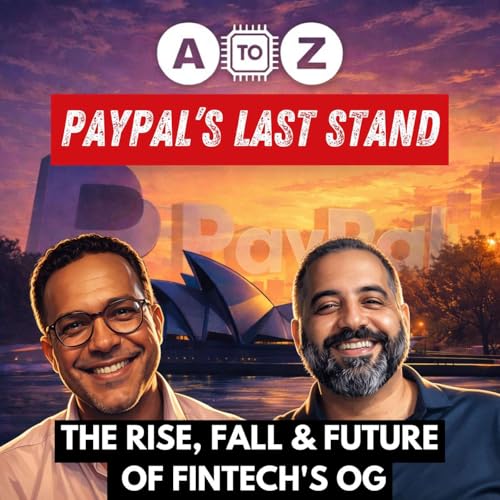
  • PayPal's Last Stand: The Rise, The Coup & The $300 Billion Fall of Fintech's OG
    2026/03/02
    In September 2000, Elon Musk boarded a plane for his honeymoon. By the time he landed in Sydney, he was no longer CEO. His co-founders, Peter Thiel and Max Levchin, had staged a midnight coup, scrapped his everything-app vision, killed the X.com brand, and reborn the company as PayPal.Twenty-five years later, that company has gone from a $360 billion peak to a $65 billion acquisition target. And Elon still owns X.com.In this episode, Aman Narain and Zubin Vandrevala perform a full autopsy on fintech's most important company, tracing PayPal from its PayPal Mafia origins through five failed CEOs, a $300 billion collapse, and three possible futures.What You Will LearnThe Honeymoon Coup — how PayPal was born on betrayal in a Palo Alto boardroomThe Golden Cage — how the eBay acquisition killed PayPal's killer instinctProf Z's Three Eras: Trust Layer, Aggregator Era, and the Commodity TrapThe CEO Parade — five personalities who could not escape the brand's gravityThe Interface War — how Apple Pay and Shopify made PayPal invisibleThree Endgame Scenarios — Stripe acquisition, JPMorgan buyout, or Elon's RevengeEpisode Timestamps00:00 — Cold Open: The Honeymoon Coup04:30 — Zubin's new CCO role at Gr4vy and travel check-in08:00 — The PayPal Mafia Genesis and the X Factor16:00 — The eBay Era: The Golden Cage23:00 — Prof Z's Segment: The Three Eras of PayPal32:00 — The CEO Parade and the Card Scheme Paradox38:00 — The Endgame: Three Scenarios for PayPal's Future45:00 — The Mic Drop: The Training Wheels EffectKey Concepts DiscussedThe Commodity Trap — when solving trust too well makes you irrelevantThe Interface War — why hardware (Apple/Google) beat software (PayPal)The Merchant OS — how Shopify and Adyen built closed-loop ecosystemsThe Accountant CEO — when boards stop hiring builders and hire operatorsFrequently Asked QuestionsWhy is PayPal declining?PayPal is losing the interface war to Apple Pay and Google Pay, which use biometric authentication to remove PayPal's friction advantage. At the merchant layer, Stripe and Adyen offer superior developer APIs and auth rates. PayPal's core moat, digital trust, has become a commodity handled by device hardware, not a standalone service.Who might acquire PayPal in 2025 or 2026?Three scenarios are most discussed. First, Stripe — the Collison brothers want PayPal's 400 million consumer accounts to complement their developer-first merchant stack. Second, JPMorgan and Jamie Dimon could acquire PayPal's consumer base in a single transaction. Third, Elon Musk, who still owns X.com and needs PayPal's regulatory licences across 200 jurisdictions to execute his everything-app vision.What is the PayPal Mafia?The PayPal Mafia refers to the founding team of PayPal, including Peter Thiel, Elon Musk, Reid Hoffman, Max Levchin, and David Sacks, who went on to found or fund LinkedIn, Palantir, YouTube, Tesla, SpaceX, Yelp, and OpenAI. They are considered the founding generation of modern Silicon Valley.What happened to X.com?X.com was Elon Musk's vision for a global financial super-app. After a boardroom coup in 2000, the company was rebranded as PayPal. Musk reacquired the X.com domain from PayPal in 2017 and later rebranded Twitter as X in 2023, partly reviving his original ambition for an everything-app.What is the Commodity Trap in payments?The Commodity Trap describes how PayPal's greatest achievement, making digital payments feel safe, ultimately destroyed its competitive advantage. Once consumers universally trusted digital payments, the trust layer became commoditised and handled by device biometrics. PayPal no longer owned the thing it had spent twenty years building.About the HostsAman Narain is the Founder of A2Z Advisors with 25+ years of experience across Google, HSBC, Standard Chartered, Schroders, and BankBazaar.Zubin Vandrevala is the Chief Commercial Officer of Gr4vy and a former payments executive with experience across Visa, Citi, and global financial institutions.Related EpisodesThe Last Family Portrait: Schroders, Nuveen and the Death of Mid-Sized Active Management10 Bold Predictions for Fintech in 2026Listen and SubscribeRSS Feed: This episode: All episodes: Connect With A2Z FintechLinkedIn: A2Z Fintech PodcastSubstack: A Man Who Blogs by Aman NarainYouTube: A2Z FintechDisclaimer: This podcast is for educational and entertainment purposes only. Nothing discussed constitutes financial, legal or investment advice.
    続きを読む 一部表示
    不明
  • The Last Family Portrait: Schroders, Nuveen & the Death of Mid-Sized Active Management | £9.9bn Deal Autopsy
    2026/02/15

    The Schroder family survived Napoleon, two World Wars, the fall of merchant banking, and the rise of passive investing. On February 12, 2026, they said "cash me out" — agreeing to sell their 222-year-old firm to Nuveen (TIAA) for £9.9 billion.

    The Financial Times called it "the defining deal of a glass half-empty UK." Philip Augar, who worked at Schroders in the 1990s and wrote The Death of Gentlemanly Capitalism, says history is repeating itself — just as the City's merchant banks fell to Wall Street in the 1990s, active fund management at scale is becoming a US-dominated industry. John Gapper calls it the end of the City's émigré alchemy — the era when German-born banking families drove London's financial growth.

    In this Quick Dive, Aman Narain and Manu George — both former Schroders insiders — perform an autopsy on one of the last great family-controlled financial dynasties. They trace the firm through four CEOs (Bischoff, Dobson, Harrison, Oldfield), examine why the wealth management and alternatives pivots fell short, and ask the question the entire industry is avoiding:

    Is this the end of the mid-sized active asset manager?

    KEY TOPICS:

    • The Schroders-Nuveen deal: £9.9bn, 34% premium, Q4 2026 close
    • 222 years of family control: from Napoleonic-era merchant banking to algorithmic allocation
    • Four CEO eras: The Transformer, The Architect, The Great Hope, The Accountant
    • Bruno Schroder's Christmas party and the painting that said everything
    • London's "Wimbledon effect": hosting the game but no longer owning the players
    • The Death of Gentlemanly Capitalism, Part II: from merchant banks to asset managers
    • The passive revolution: how BlackRock, Vanguard, and State Street reshaped the landscape
    • Why no auction? Oldfield didn't shop the company and Evelyn Partners got 50% more on EV/EBITDA
    • Why Schroders' wealth and alternatives pivots were too late
    • The last family-controlled financial dynasties: Rothschild, Lazard, Lombard Odier, Pictet
    • Nuveen and TIAA: the quiet $2.5 trillion empire
    • The triple threat: index-tracking, private markets, and AI
    • The "Telco Trap" for active managers
    • What happens to talent, culture, and clients in the next 18 months


    DEAL FACTS:

    • Deal value: £9.9bn (~$12.8bn) — valued at 16x forecast earnings vs 12.3x for European peers
    • Cash offer: 590p/share + up to 22p permitted dividends
    • Premium: 34% to last close; 61% to 12-month VWAP
    • Analyst consensus target pre-deal: just £4.50/share
    • Schroder family payout: ~£4.06bn (41% stake)
    • Combined AUM: ~$2.5 trillion
    • Expected close: Q4 2026


    THE FT'S VERDICT:

    • Lex: "Ending its listed life with a whimper rather than a bang."
    • Philip Augar: "Wrenching but inevitable... just another brick in the wall."
    • John Gapper: "The end of the City's émigré alchemy."


    GUEST:
    Manu George — 25-year asset management veteran, former Senior Investment Director at Schroders (2007–2020), currently Credit Strategist at Polen Capital.

    HOST: Aman Narain — Founder, A2Z Advisors | Co-Host, A2Z Fintech Podcast | 25+ years across Google, HSBC, Standard Chartered, Schroders, BankBazaar.

    CONNECT:

    🔗 A2Z Fintech on YouTube: https://www.a2zfintech.com/
    🔗 A Man Who Blogs (Substack): https://amanwhoblogs.substack.com/
    🔗 Aman on LinkedIn: https://www.linkedin.com/in/amannarain/
    🔗 Manu on LinkedIn: https://www.linkedin.com/in/manu-george-invmgmt/

    #Schroders #Nuveen #TIAA #AssetManagement #ActiveManagement #PassiveInvesting #FintechPodcast #WealthManagement #MergersAndAcquisitions #PrivateMarkets #CityOfLondon #FinancialDynasty #WimbledonEffect #DeathOfGentlemanlyCapitalism #A2ZFintech #LondonFinance #AIinFinance

    🎧 LISTEN & SUBSCRIBE:
    📡 RSS:

    続きを読む 一部表示
    29 分
  • Healthy Money: How to Build a "Moat of Convenience" in Modern Banking
    2026/02/11

    Ever wondered if banks are just giant dodos stuck in legacy land, or could they actually get hip and healthy? Well, Alastair Campbell is here to dish out the secrets of making money healthy again, minus the boring behind-the-scenes. Buckle up, it’s a juicy ride through data, archetypes, and the ultimate goal: banks that actually get you.

    In this episode:

    • Why 63% of industry value growth is flowing outside incumbents
    • Rethinking archetypes: digital natives, modern families, and the kid pocket money revolution
    • The three core levers of banking transformation: Customers, Architecture, and Leadership
    • How to build a bank for the modern, complex, multi-hyphenated lives of today’s consumers
    • The importance of 'stealing with pride' — reusable tech and collaborative ethos
    • Why 'boring' banks are losing and what's needed to become trusted custodians of your financial life
    • Leadership lessons: owning your architecture, generating customer relevance, and setting the ‘more for less’ standard

    Timestamps:

    00:00 - Welcome to the revolution: making money healthy again
    02:37 - The data behind outside growth: non-incumbents stealing the show
    04:05 - Why the balance sheet isn’t the hero anymore
    06:18 - Digital wallets and multi-banking: the new normal
    10:20 - The three wheels of banking transformation
    12:17 - Leadership’s role in fixing the broken banking model
    16:01 - Archetypes derailed: from nuclear families to digital natives
    20:10 - How banks can innovate for weak signals, not just the average customer
    24:00 - Money = emotions: making banking less boring, more human
    28:39 - The future of customer data: credentials, relationships, and habits
    32:39 - Building a modular tech stack for true customer-centricity
    34:40 - The moat of convenience vs the moat of inconvenience
    36:47 - Regulator’s role: pushing, pulling, and shaping the future of finance
    44:23 - From wire protocols to open banking: standards that unleash innovation
    46:23 - Why leadership tenure matters in successful transformation
    54:22 - Empathy at the core: how young professionals can think differently
    55:02 - Leading with purpose: ownership, career paths, and authentic leadership

    Resources & Links:

    • Healthy Money: How Modern Banks Can Create Value and Trust
    • Thought Machine - Modern core banking software
    • Revolut - Digital banking pioneer for the next generation
    • Standard Chartered - Former employer for both host and guest
    • Singtel - Singapore's leading Telco where Alastair led Strategy
    • NatWest - Leading UK Bank where Alastair was Head of Strategy
    • Alastair Campbell
    • Richard Kibble

    Connect with Alastair:

    • LinkedIn


    Want to overhaul your bank into a modern money machine? This convo is packed with the nuts and bolts of making that happen fast, smart, and with a lot less snooze factor. Buckle up, bankers — it’s time to get healthy!

    ### Links & Resources
    📺 Watch this episode on YouTube

    📄 Read the full transcript

    ### Credits & Guests
    Creators & Guests

    • Aman Narain - Host
    • Alastair Campbell - Guest

    ### Chapters

    続きを読む 一部表示
    49 分
  • NuBank’s US License: The Purple Revolution Arrives
    2026/02/02

    The US banking fortress just got a new neighbor. NuBank—the Latin American titan with 127M+ customers—has officially announced its US National Bank License.

    In this minisode, Aman and Zubin break down why this isn't just another fintech launch. We explore the "Wayne-dependent" reality of US regional banks stuck on 1980s COBOL code and why NuBank’s $1 cost-to-serve makes them a lethal competitor to the "Hollow Middle" of American finance.

    Highlights include:

    • The COBOL Crisis: Why US regional banks are being held hostage by 40-year-old software.
    • Hard Mode Mastery: How NuBank conquered Brazil and why that makes the US market look like "Easy Mode."
    • Focus vs. Breadth: Why NuBank is succeeding where Revolut is still fighting for regulatory ground.
    • The Death of the Legacy Tax: What a cloud-native "siege engine" means for your wallet.

    Chapters:
    00:00 The Hook: COBOL vs. The Purple Glow
    01:30 The Backstory: Fighting "Hard Mode" in Brazil
    04:30 The US Map: Mega-Banks vs. Hollow Regionals
    07:00 Secret Sauce: Why NuBank is different from Revolut
    09:30 Aman’s Mic Drop: The End of the Legacy Tax
    ,
    NuBank US License, NuBank Expansion 2026, A2Z Fintech, David Velez, Cristina Junqueira, National Bank Charter, JPMorgan vs NuBank, Revolut US License, Chime vs NuBank, Jamie Dimon, Fintech Disruption 2026, Legacy Banking, COBOL programming bank, Cloud Native Banking, Cost to Serve Fintech, Core Banking Transformation, Digital Transformation Banking, Fintech Singapore, Fintech Brazil, US Banking Crisis, Neobanks USA

    続きを読む 一部表示
    9 分