『A Conversation about the Symbolism of the Letter 'G' in 'Hallmarked Man'』のカバーアート

A Conversation about the Symbolism of the Letter 'G' in 'Hallmarked Man'

A Conversation about the Symbolism of the Letter 'G' in 'Hallmarked Man'

無料で聴く

ポッドキャストの詳細を見る
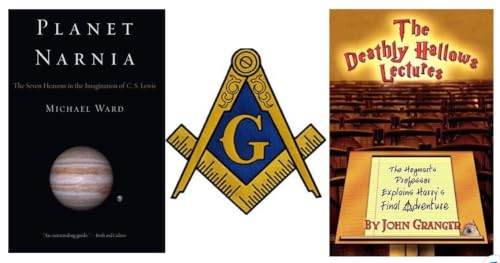
Nick Jeffery and freshly Shorn & Clean Shaven John Granger sit down to discuss John’s two posts about the symbolism of the Letter ‘G’ in Strike 8. Part One of the series did the necessary work of demonstrating that, yes, the letter ‘G’ is all over Hallmarked Man, from the online guess that the murderer carved that initial into ‘William Wright’s back to the Witness G echoing with Green-jacked Gorilla-bearing man and a bit of calligraphic terrorism on the Agency door at street-level. The first also covered the accepted Masonic interpretations of why the ‘G’ is featured in the Compass and Square symbolism of their fraternity.Part Two was a deep dive into more esoteric meanings given to the ‘G’ by Freemasons and by Rene Guenon, notable Perennialist, and into what associations Rowling-Galbraith tried to make between the seventh letter and the key hallmark of the book. It concluded with three answers to “So What?” including some fun speculation about a possible shape for the series, a shape highlighted in Strike 8, and with a discussion of whether Rowling-Galbraith’s subliminal artistry with ‘G’ worked or failed.Perhaps the biggest take-away of this series of posts was to introduce subliminal coloration as the common denominator of Rowling-Galbraith’s signature seven Shed tools. Nick and John open their conversation about the letter ‘G’ with that subject and everything they discuss in the end folds back into that covert artistry.As always, the Dynamic Duo covet your comments and feedback as the best follow-up to their conversation. Please jump right in!Hogwarts Professor is a reader-supported publication. To receive new posts and support my work, consider becoming a free or paid subscriber.The Ten Questions and Relevant Links1. Okay, John, let’s talk coloration. You mentioned some examples in famous authors’ work in Part One of your deep dive into Letter G Symbolism in Hallmarked Man; do we have coloration in Harry Potter? Another Strike novel? * ‘Donegality’ in Planet Narnia, Michael Ward, the subliminal artistry of C. S. Lewis’ Narniad;* From ‘Literary Alchemy: Sacred Science, Sacred Art, and the Alembic of Story’C. S. Lewis, according to Michael Ward, author of Planet Narnia, also felt appreciating the “manner of the author,” his “various special tricks,” especially those connected to creating atmosphere, were critical to understanding the style of the Greats.Again and again, in defending works of romance, Lewis argues that it is the quality or tone of the whole story that is its main attraction. The invented world of romance is conceived with this kind of qualitative richness because romancers feel the real world itself to be ‘cryptic, significant, full of voices, and the mystery of life.’ Lovers of romances go ‘back to fruit tree for its taste; to an air for… what? For itself; to a region for its whole atmosphere – to Donegal for its Donegality and London for its Londonness’ (Ward, 16).Donegal was one of Lewis’favorite vacation spots as a child in Northern Ireland. Ward defined Lewis’ stylistic atmosphere as his ‘Donegality:’By donegality we mean to denote the spiritual essence or quiddity of a work of art as intended by the artist and inhabited unconsciously by the reader. The donegality of the story is its peculiar and deliberated atmosphere or quality; its pervasive and purposed integral tone or flavor; its tutelary but tacit spirit, a spirit that that the author consciously sought to conjure, but which was designed to remain implicit in the matter of the text… the more influentially to inform the work and so affect the reader (Ward 75).Ward’s concern is especially with Lewis’ character Aslan, in whom this donegality is “concentrated and consummated” as a “Christologically representative character” (Idem), but the thesis of Planet Narnia is that the “kappa-element,”[xiv] Lewis’ phrase for the informing, hidden “tutelary but tacit” style of a work, is astrological symbolism, each of the Narnia chronicles representing one of the seven traditional planets. Ward argues that Lewis’ subliminal artistry, the “inner weave” or style of his work in Nabokovian language, is the embedded mythological and astral metaphors to be found beneath the surface of each story. Twain is supposed to have said, “”If you would have your fiction live forever, you must neither overtly preach nor overtly teach, but you must covertly preach and covertly teach.” Lewis, believing as he did that “an influence which cannot evade our consciousness will not go very deep” (Lewis no date), wrote in astrological glyphs to reach covertly his reader’s unconscious depths or noetic heights.* ‘The Eyes of Deathly Hallows’ in The Deathly Hallows Lectures, John Granger, and, briefly, here, and 2010 lecture at New York Public Library; and* ‘The Cross Symbolism of Troubled Blood,’ John Granger2. You list those eyes and ...
adbl_web_anon_alc_button_suppression_t1
まだレビューはありません