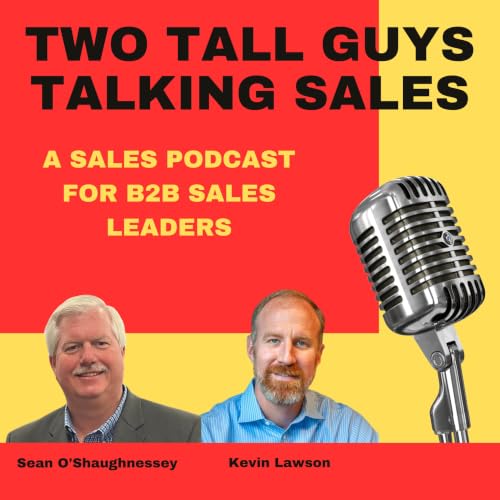
『200 Episodes of B2B Sales Advice - The Lessons That Still Drive Sales Success』のカバーアート

200 Episodes of B2B Sales Advice - The Lessons That Still Drive Sales Success

200 Episodes of B2B Sales Advice - The Lessons That Still Drive Sales Success

無料で聴く

ポッドキャストの詳細を見る

【Amazonプライム会員限定】今ならプレミアムプランが4か月 月額99円。

10月19日まで。※適用条件あり
For the 200th episode of Two Tall Guys Talking Sales, Sean O'Shaughnessey and Kevin Lawson do something they have never done before: record together, in person, with a live studio audience asking the questions. What follows is less a celebration than a wide-ranging examination of what actually drives B2B sales success. Sean and Kevin tackle the resurgence of human relationships in an AI-enabled selling environment, the discipline required to define an ideal client profile, how artificial intelligence and Workflow Automation should eliminate non-selling activities, why great salespeople do not necessarily need industry experience, and what sales management must do differently to coach rather than rescue. They also dig into compensation, value selling, sales productivity gains, and the danger of single-threading Complex Deals. It is 200 episodes of experience compressed into one candid conversation about building sales processes that work when the sales leader is not in the room. Key Topics Discussed 04:04 – What 200 Episodes Have Revealed About Sales Fundamentals Sean and Kevin reflect on the recurring problems they continue to see across sales organizations: unclear ideal client profiles, weak Messaging, inconsistent prospecting, and critical sales knowledge that exists in someone's head instead of in a documented process. Kevin makes the case that documentation turns tribal knowledge into an operating system that can connect sales, marketing, customer service, and delivery. A repeatable sales process must actually be written down before it can be taught, measured, or improved. 14:27 – The Return of Real Relationships in an AI-Enabled Sales World Asked what has changed most over the life of the podcast—other than AI—Kevin points to the renewed importance of authentic, in-person relationships and value realization. Sean pushes the idea further: when prospects are overwhelmed by email, social outreach, and text messages, effective Sales strategies may sometimes look surprisingly old-fashioned. Knock on the door. Attend the event. Send a thoughtful physical note. The technology may be new, but trust still separates signal from noise. 17:45 – Using AI to Create More Selling Time James Sayer asks how salespeople should think about artificial intelligence right now, and Sean immediately frames AI as a productivity tool rather than a novelty. Research, CRM administration, account preparation, and other non-selling activities consume enormous amounts of a salesperson's day. The objective is not to use Generative AI because it is fashionable; it is to use AI, automation, and better tools to create additional opportunities for actual selling. Kevin recommends identifying the most time-intensive task inside prospecting, selling, or customer retention and finding a way to automate it. That is where meaningful sales productivity gains begin. 23:30 – Curiosity, Business Acumen, and Solving Problems Instead of Selling Products When the audience asks what young sales professionals should learn, Kevin argues that sellers need to stop concentrating on what they want to sell and start understanding the problem the customer needs solved. Sean adds curiosity as a foundational skill: understand the customer's business, how it makes money, and—critically—how it loses money. That becomes especially important when selling to a CFO or defending ROI. Later, Sean connects the same curiosity to relationship building: ask open-ended questions, stop talking about yourself, and give the prospect room to reveal what is actually driving the opportunity. 33:43 – Hiring Salespeople, Defining the ICP, and Building a System They Can Enter The discussion turns to one of the most expensive mistakes a business owner can make: hiring a salesperson for an industry Rolodex instead of hiring someone who knows how to sell. Kevin argues that salespeople should be hired into a documented system with clear expectations, onboarding, knowledge checks, and a defined sales process. Sean makes the complementary case that industry knowledge can often be taught far faster than genuine selling skill. The conversation then moves into ICP development: study your friendliest or favorite customers, identify what they have in common, understand their buying signals and psychographics, and use those insights to improve prospecting, Messaging, hiring, and pipeline quality. 49:53 – Sales Leadership, Compensation, Trust, and Multi-Threading Complex Deals Mary Tutton asks what capability matters most for a sales manager, prompting Kevin to identify consistency and analytical thinking. At the same time, Sean draws a sharp distinction between coaching and taking over the salesperson's job. The discussion expands into compensation design—simple enough that the seller should be able to estimate the payout mentally—and then into the realities of Enterprise Sales. In a significant B2B opportunity, one relationship is rarely enough. Sean warns against...
adbl_web_anon_alc_button_suppression_t1
まだレビューはありません