

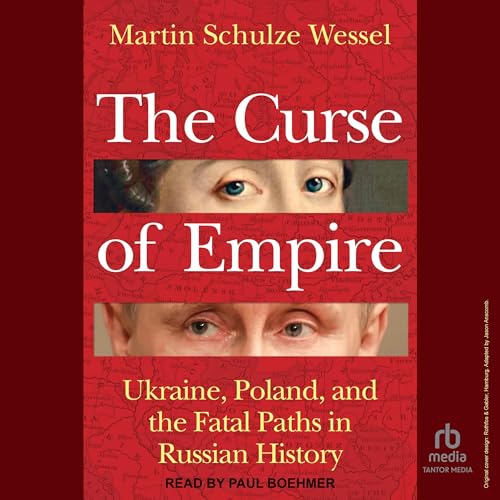
The Curse of Empire
Ukraine, Poland, and the Fatal Paths in Russian History
カートのアイテムが多すぎます
カートに追加できませんでした。
ウィッシュリストに追加できませんでした。
ほしい物リストの削除に失敗しました。
ポッドキャストのフォローに失敗しました
ポッドキャストのフォロー解除に失敗しました
Audibleプレミアムプラン30日間無料体験

The Curse of Empire
¥3,290 で購入
-
ナレーター:
-
Paul Boehmer
Russia's attack on Ukraine marks an epochal break in European and global history. Undoubtedly, the decision to go to war is closely linked to one person, Vladimir Putin, but Russia's war is not driven solely by one man's power calculations. We can only make sense of Russia's actions in Ukraine, argues the distinguished historian Martin Schulze Wessel, by putting them in the broader context of the history of Russian imperialism and the influence it continues to exert today.
Schulze Wessel argues that Russian imperialism was shaped by Russia's relationship to Poland and Ukraine. Poland and Ukraine share a common history characterized by Russian domination and Polish and Ukrainian resistance to it; just as the Polish question challenged the Russian Empire in previous centuries, so too does the Ukrainian question today. Schulze Wessel argues that, as a result of Russia's confrontation with the Polish and Ukrainian questions, Russia's national identity merged with imperial claims in ways that were pernicious and consequential—the curse of empire.
By placing the war in Ukraine in the context of an era of Russian imperialism that spans three centuries, this book sheds new light on one of the bloodiest and most destructive conflicts of our time.
©2026 Martin Schulze Wessel (P)2026 Tantor Media