

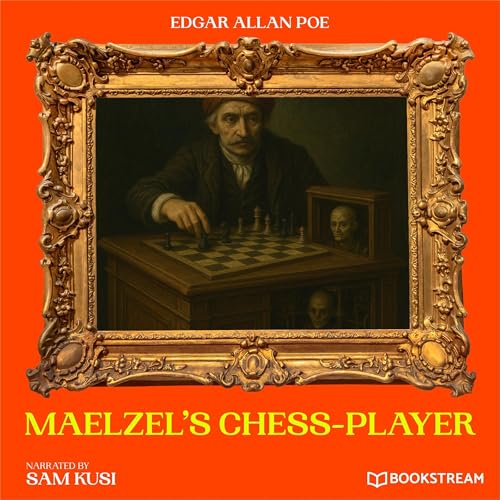
Maelzel's Chess-Player
カートのアイテムが多すぎます
カートに追加できませんでした。
ウィッシュリストに追加できませんでした。
ほしい物リストの削除に失敗しました。
ポッドキャストのフォローに失敗しました
ポッドキャストのフォロー解除に失敗しました
Audibleプレミアムプラン30日間無料体験

Maelzel's Chess-Player
¥1,120 で購入
-
ナレーター:
-
Sam Kusi
-
著者:
-
Edgar Allan Poe
"Maelzel's Chess Player" (1836) is an essay by Edgar Allan Poe exposing a fraudulent automaton chess player called The Turk, which had become famous in Europe and the United States and toured widely. The fake automaton was invented by Wolfgang von Kempelen in 1769 and was brought to the U.S. in 1825 by Johann Nepomuk Mälzel after von Kempelen's death.
In his essay, Poe asserts that a mechanical chess player would play perfectly, but Maelzel's "machine" occasionally errs, and is therefore suspect. Although it is the most famous essay on the Turk, many of Poe's hypotheses were incorrect. He also may or may not have been aware of earlier articles written in the Baltimore Gazette where two youths were reported to have seen chess player William Schlumberger climbing out of the machine. He did, however, borrow heavily from David Brewster's Letters on Natural Magic. Other essays and articles had been written and published prior to Poe's in Baltimore, Philadelphia, and Boston—cities in which Poe had lived or visited before writing his essay.
©2026 Bookstream Audiobooks (P)2026 Bookstream Audiobooks