

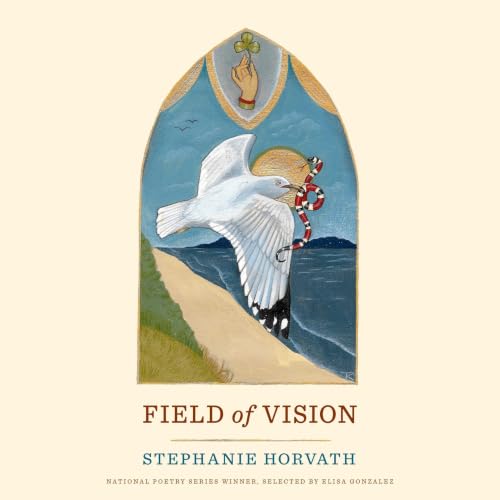
Field of Vision
カートのアイテムが多すぎます
ご購入は五十タイトルがカートに入っている場合のみです。
カートに追加できませんでした。
しばらく経ってから再度お試しください。
ウィッシュリストに追加できませんでした。
しばらく経ってから再度お試しください。
ほしい物リストの削除に失敗しました。
しばらく経ってから再度お試しください。
ポッドキャストのフォローに失敗しました
ポッドキャストのフォロー解除に失敗しました
聴き放題対象外タイトルです。プレミアム会員登録で、非会員価格の30%OFFで予約注文できます。聴けるのは配信日からとなります。
オーディオブック・ポッドキャスト・オリジナル作品など数十万以上の対象作品が聴き放題。
オーディオブックをお得な会員価格で購入できます。
30日間の無料体験後は月額¥1500で自動更新します。いつでも退会できます。

Field of Vision
ナレーター:
Stephanie Horvath
¥1,090で今すぐ予約注文する
-
ナレーター:
-
Stephanie Horvath
In Field of Vision, we traverse the thresholds of past and future, reality and dream, as we accompany the speaker through deserts, forests, rivers, and coasts. These poems capture, viscerally and intimately, a sense of deep time in the rural landscape—dark, damp dirt on one’s hands, a desert over which vultures circle, the decay of wet leaves on a forest floor. A meditation on the horror and resplendence of nature, Field of Vision invokes the ancient history that weaves into each of our individual histories—the earth, the animals, the fossils, the primordial echoes that shape us all.
adbl_web_anon_alc_button_suppression_t1
批評家のレビュー
“Field of Vision is an exquisite, strange contemplation of contrasts that feel both universal and deeply American: the California desert, drenched Maine shores; tenderness and violence; dreams and the dreamlike twists of real life. These poems twist perceptions, drawing us in, lulling us in order to surprise us. They remind me that poetry can be an act of rescue, reviving not only language but also the reader.”
—Elisa Gonzalez, author of Grand Tour
“These poems with patient precision intimately describe a world, flower by flower, field by field, sky by sky. They describe not in the way a circle is described, sweeping the circumference, but in the way life is “described,” sweeping, as the eye of a raptor might, across the terrain of this place we live in, called lives, called human, called suffering, called nature, called Earth. And they do that magic thing reserved for poems in all their potency: while they name, they prod at, they palpate, they make room for, they bring into possibility the vibrating shapes of the unnamable.”
—Eleni Sikelianos, author of Your Kingdom
“'I was an abstract memory of an animal,' writes Stephanie Horvath in Field of Vision, a collection that shape-shifts between the feral and the domestic. In the rural-industrial landscape that Horvath conjures, encounters between proximal, intimate and unknown others brim with anxiety and desire. What is dreamed, traded, recollected or conjured are preoccupations that move this accomplished, closely observed and wondrous debut through the space that surrounds it, unabated yet receding. As Horvath tells us: 'Something ruptures the earth and its mark endures.”'
—Bhanu Kapil
“It has been said so often that the environmental crisis of our moment is too large to see. And yet poets keep begging to differ. Stephanie Horvath takes lyric's intimate quietness and expands it with dream logic, so something far too large for a single voice can be held inside one, briefly, without either breaking.”
—Juliana Spahr, Pulitzer Prize-winning author of Ars Poetica
—Elisa Gonzalez, author of Grand Tour
“These poems with patient precision intimately describe a world, flower by flower, field by field, sky by sky. They describe not in the way a circle is described, sweeping the circumference, but in the way life is “described,” sweeping, as the eye of a raptor might, across the terrain of this place we live in, called lives, called human, called suffering, called nature, called Earth. And they do that magic thing reserved for poems in all their potency: while they name, they prod at, they palpate, they make room for, they bring into possibility the vibrating shapes of the unnamable.”
—Eleni Sikelianos, author of Your Kingdom
“'I was an abstract memory of an animal,' writes Stephanie Horvath in Field of Vision, a collection that shape-shifts between the feral and the domestic. In the rural-industrial landscape that Horvath conjures, encounters between proximal, intimate and unknown others brim with anxiety and desire. What is dreamed, traded, recollected or conjured are preoccupations that move this accomplished, closely observed and wondrous debut through the space that surrounds it, unabated yet receding. As Horvath tells us: 'Something ruptures the earth and its mark endures.”'
—Bhanu Kapil
“It has been said so often that the environmental crisis of our moment is too large to see. And yet poets keep begging to differ. Stephanie Horvath takes lyric's intimate quietness and expands it with dream logic, so something far too large for a single voice can be held inside one, briefly, without either breaking.”
—Juliana Spahr, Pulitzer Prize-winning author of Ars Poetica
まだレビューはありません