『sharp10 Global Trends by Andrea Anderheggen』のカバーアート

sharp10 Global Trends by Andrea Anderheggen

sharp10 Global Trends by Andrea Anderheggen

著者: Andrea Anderheggen
無料で聴く

今ならプレミアムプランが3カ月 月額99円

2026年5月12日まで。4か月目以降は月額1,500円で自動更新します。

概要

Andrea Anderheggen, Founder of sharp10 (https://sharp10.com), explores the trends and forces reshaping business, politics, technology, and society, in conversation with the world's leading AI models. Each episode distills major global trends into a data-driven analysis, designed for executives, entrepreneurs, and decision-makers who want to understand the facts and forces behind them. Want to go deeper? sharp10 is a speed learning app for executives, available on the App Store, Google Play, and at sharp10.com. © Fliegenglas Verlag GmbH, sharp10© Fliegenglas Verlag GmbH, sharp10 政治・政府 政治学 社会科学 経済学
エピソード
  • The New Rules of Power: Making Sense of the Geopolitical Shift
    2026/04/15
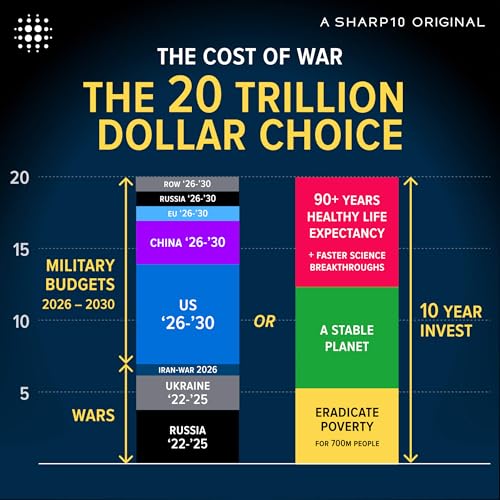
    Today we're diving into geopolitical tensions. It's a big topic and a hot one. It deserves more context than usual, especially for a podcast focused on business insights for executives and founders. Something has changed. The world feels different now. Think back 10, maybe 15 years. Yes, we had major crises between 2000 and 2016. The September 11th attacks, the wars in Afghanistan and Iraq, the global financial crisis in 2008, the Arab Spring, which brought down regimes and contributed to the migration crisis in Europe. And in 2014, Russia annexed Crimea, although at the time that didn't dominate headlines in Western Europe or the US the way it might today, and maybe that's the reason for the later disaster. However, for most people in Europe or the United States, those events felt somewhat distant. Disruptive, yes, but not destabilizing to everyday life. That's changed. Over the past 7 years, the sense of stability has really started to erode. It began with the COVID pandemic in 2020, then Russia's full scale invasion of Ukraine in 2022, the election of President Trump in 2024, a vote for the distrust in politics. A heavy distrust, almost like a rebellion by large parts of American society, completely ignoring the lack of morality and long term implications of their own alternative. The unbelievable global sex traffic scandal around Epstein, which seems to give a signal that the rich and influential define their status by staying immune to accountability when disobeying the rules and the law. And as we record this, an unprecedented, certainly illegal military attack by the United States and Israel against Iran, which as of now has not triggered the kind of global protest you might have expected, and which seems to emerge out of increasingly unchecked power by the US administration. So the self-inflicted geopolitical tensions now feel almost absurd and certainly less predictable, less stable, and in many ways more fragile than at any point in the more recent memory. And this isn't just my feeling. In January 2026, the World Economic Forum ranked geopolitical tensions as the top global risk. That was before the recent escalation involving Iran. And surveys reported by Reuters a few days ago, this April 2026, show that central banks are more concerned about geopolitical risks than they've been in years. In this episode, we'll explore what that all means for businesses, for startups, for innovation, and for the people building the future. I'm discussing this with Claude, the AI from Anthropic. Claude's responses will be read by Charles and my parts by Daniel. All right, let's get into it.
    続きを読む 一部表示
    59 分
  • Where are the Shovels? Opportunities in the AI Economy.
    2026/04/09
    It's April 2026, and everyone is talking about AI, your colleagues, your LinkedIn feed, probably even your dentist. But very few are asking the question that actually matters: Where are the opportunities right now and in the next 10 years? Because this shift is not just about better technology, it is changing who wins, who falls behind, and where real value is created. For entrepreneurs and job seekers, it opens up entirely new career paths and business models. For investors, it creates a chance to move early before the market fully catches on. And for policymakers, it raises a fundamental question, how do you stay competitive when everything is evolving faster than institutions can keep up? In this episode, we take a closer look at the opportunities emerging from this shift. Not the obvious ones, but the ones that are still early, still underestimated, and still within reach.
    続きを読む 一部表示
    1 時間 8 分
  • Holes in Walls: How to Start a Company
    2026/03/31
    Imagine this: You’re sitting with friends and someone says, “You know what someone should build?” Ideas start flying. Everyone has one. Everyone feels like discovering the next big thing. And the next day, nothing happens. The idea that felt so obvious at midnight looks a lot less revolutionary over breakfast. Because having an idea is easy. It’s exciting. It’s safe. But building a company, that’s where most people stop. And here’s the twist: Somewhere else, someone has the same idea, and they actually start. They build. They struggle. They figure it out. And over time, they create something real. That’s how companies are born, and that’s how economies move forward because without people who build, nothing really changes. So the question isn’t, do you have a good idea? It’s: Will you actually do something with it? In this episode, we’ll show you how to go from an idea to a real company. Let’s go!
    続きを読む 一部表示
    1 時間 4 分
まだレビューはありません