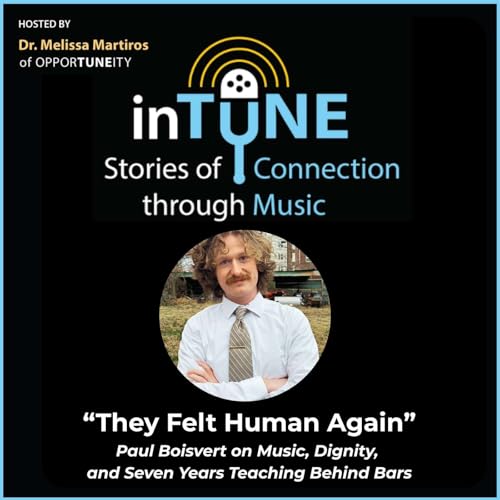
• "They Felt Human Again" — Paul Boisvert on Music, Dignity, and Seven Years Teaching Behind Bars
    2026/02/26

    Send a text

    In this episode of inTUNE, Dr. Melissa Martiros sits down with Paul Boisvert, a former student and long-time teaching artist with opporTUNEity, for a candid conversation about music education, identity, and what happens when classroom learning meets real-world engagement inside a correctional facility.

    Paul shares a journey that began with teaching himself Nirvana songs at 13, wound through music therapy and jazz performance, and included an unexpected personal connection to incarceration. As one of opporTUNEity's first student interns in 2019, he helped build the program from the ground up, eventually becoming a lead teaching artist who overhauled the curriculum and facilitated hundreds of sessions over seven years.

    He reflects on creating a classroom where incarcerated individuals feel treated as humans — where autonomy, humor, and creative expression replace the restrictions of daily life inside. From asking someone to sing their own words aloud, to watching families cry at end-of-semester showcases, Paul captures the deeply human pursuit at the heart of the work — and speaks honestly about what it gave him in return.

    Now pursuing a master's in music theory at UNC Greensboro with plans for a PhD, Paul looks back on seven years of gratitude, growth, and music as a verb.

    Episode Summary A compelling inside look at what it means to teach music in a correctional setting — and how that work transforms not just participants, but the educators who show up for them.

    Key Themes

    • Music as a verb: creation over performance
    • The formation of a teaching artist
    • Dignity, autonomy, and humanity in correctional education
    • Empathy as a skill developed through community engagement
    • The bi-directional impact of service learning
    • Transitioning from intern to leader
    • The value of niche experience in building a music career
    • Gratitude as a lasting legacy of the work

    The Pulse Topic: What community engagement offers music students that classrooms cannot

    Paul's trajectory — from self-taught guitarist to teaching artist to graduate scholar — is a case study in what happens when students are given real responsibility in real spaces. He didn't just observe the program; he helped build it, adapt it, and lead it. That formation doesn't happen in a practice room.

    The modern music career demands flexibility, interpersonal fluency, and the ability to work across communities. Programs like opporTUNEity don't distract from that preparation — they accelerate it.

    Key takeaway: Say yes before you feel ready, show up with humility, and let the work build you.

    Music Featured All music was written, performed, or produced by opporTUNEity students.

    "Tears of a Clown" — December 2019 Songwriting Class; Carl, Travis, D'Angelo, Darrell, Angel, Jason, Kevin, John Wayne, Chris; Teaching Artists: Dan Thomas, Paul Boisvert

    "Changing My Ways" — Spring 2023; Marc Recor; Teaching Artists: Dan Thomas, Paul Boisvert, John Wayne Cormier; Vijay Gupta on Violin

    "Tattoos" — December 2021; CJ & Mosh; Teaching Artists: Dan Thomas, Paul Boisvert, Landon Chesney

    "Wish I May" — OpporTUNEity Songwriting Class (2021)

    Learn more about our programs, stories, and community at https://opporTUNEitymusic.org

    続きを読む 一部表示
    41 分
  • River of Life: Marc Recor on Incarceration, Music and Transformation
    2026/01/28

    Send us a text

    In this episode of inTUNE: Stories of Connection Through Music, Dr. Melissa Martiros sits down with Marc Recor, a Worcester County House of Correction alumnus and opporTUNEity participant, for an intimate conversation about transformation, resilience, and the power of music during incarceration.

    Marc shares his lifelong connection to music—from being the family DJ at age seven to teaching himself guitar at 18 and rediscovering his passion inside the Worcester County Jail. Through opporTUNEity's songwriting program, Marc wrote and performed original songs including "Turtle Suit" (a comedic take on life inside) and "On My Way" (a heartfelt reflection on missing loved ones). He describes how the program gave him "freedom of mind" in a restrictive environment and helped him reclaim control over his own growth and identity.

    Marc reflects on what it means to "do your time" rather than let time do you, using the powerful metaphor of being pulled out of "the river of life" and placed on the banks—where incarceration became an opportunity to slow down, reflect, and change direction. He discusses the role music played in his mental health, the camaraderie it built among participants, and how songwriting gave him a sense of accomplishment that continues to shape his life today.

    Now reunited with his family, attending AA meetings, and continuing to write and play music daily, Marc offers candid advice to those currently incarcerated: take the step, don't be scared, and take advantage of programs that help you grow—because you have everything to gain and nothing to lose.

    Episode Summary
    A powerful firsthand account of how music, accountability, and creative expression can transform incarceration into a stepping stone toward healing and positive change.

    Key Themes

    • Music as mental health and emotional processing
    • "Doing your time" versus letting time do you
    • The "river of life" metaphor: incarceration as perspective
    • Songwriting as identity reclamation and accomplishment
    • Collaboration and camaraderie through creative programs
    • Breaking stereotypes about incarcerated individuals
    • The role of dignity-centered programming in reducing recidivism
    • Life after release: AA, family, and continuing music practice

    The Pulse (Q&A)
    Topic: Building credible teaching teams in correctional spaces

    In correctional settings, what often goes missing is the opportunity to reflect, create, and be heard without judgment. Songwriting changes that—but only when the space is held by people who know how to meet participants where they are.

    Marc described how opporTUNEity's teachers didn't talk at or down to participants. They read the room, spoke their language, and showed up with mutual respect and commitment to the process. When someone writes a song inside, they're organizing memory, naming emotion, and asserting identity in a system designed to reduce people to numbers.

    Key takeaway: Teams that create real change show up prepared, grounded, and fluent in the environment they're entering. Growth happens when people feel respected enough to take risks and challenged enough to be accountable.

    Music Featured

    All music was written, performed, or produced by opporTUNEity students.

    "Nowhere Right Now" — Lyrics by J. Commey, S. Oppong, T. Boutwell-Campbell, Vocals recorded by M. Recor and J.W. Cormier produced by OpporTUNEity Records LLC.

    “5-Minute Beat (Challenge)” — Zae. Main Jail Beatmaking & Production (Spring 2025); Teaching Artists: Dan Thomas and Dan DeCristofaro

    "Turtle Suit" — Lyrics by Marc Recor, Teaching Artists: Dan Thomas, Paul Bois

    Learn more about our programs, stories, and community at https://opporTUNEitymusic.org

    続きを読む 一部表示
    33 分
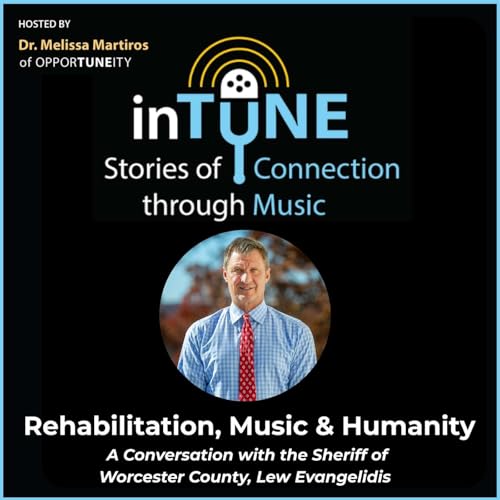
  • Rehabilitation, Music & Humanity — A Conversation with the Sheriff of Worcester County, Lew Evangelidis
    2025/12/22

    Send us a text

    In this episode of inTUNE: Stories of Connection Through Music, Dr. Melissa Martiros sits down with Worcester County Sheriff Lew Evangelidis for a wide-ranging conversation about music, rehabilitation, leadership, and humanity inside the correctional system. Sheriff Evangelidis reflects on his lifelong relationship with music, his 15-year tenure as sheriff, and his belief that incarceration—when done with dignity, accountability, and opportunity—can be a powerful catalyst for change.

    From early memories of growing up surrounded by music, to discovering jazz, classical, folk, hip hop, and country throughout different stages of life, Evangelidis shares how music has remained a grounding and restorative force alongside a demanding career in law enforcement. He speaks candidly about his path from Wall Street to law school, prosecution, public office, and ultimately to reimagining what the sheriff’s office could be—not just a place of confinement, but a place of rehabilitation.

    Throughout the conversation, Evangelidis explains why he believes in treating incarcerated individuals with dignity and respect, investing in mental health and substance abuse services, elevating the quality of the staff, and partnering with educational and creative programs like opporTUNEity. He describes how music programs inside the Worcester County House of Corrections foster camaraderie, emotional expression, and cultural shifts that extend beyond the classroom and into the broader jail environment.

    Episode Summary
    A deep conversation about leadership, rehabilitation, and the role of music as a humanizing and restorative force inside correctional institutions. Sheriff Evangelidis shares how creative programming, accountability, and dignity-centered policies can reduce recidivism, strengthen community safety, and support meaningful reentry.

    Key Themes
    • Music as a lifelong source of healing, balance, and spiritual grounding
    • Rehabilitation versus punishment in correctional settings
    • Leadership without political favoritism or “past practice” constraints
    • Treating incarcerated individuals with dignity and respect
    • The role of creative and educational programming in reducing recidivism
    • Music as a tool for emotional expression, camaraderie, and cultural change
    • Why “if the inmate wins, we all win”

    The Pulse (Q&A)
    Topic: Using music to build community inside correctional institutions

    Dr. Martiros shares three practical strategies for educators and musicians interested in teaching or starting music programs inside jails or prisons:

    1. Partner with existing institutions
    2. Design trauma-informed, flexible lessons
    3. Center dignity, not charity

    Music Featured
    All music was written, performed, or produced by opporTUNEity students.

    “5-Minute Beat (Challenge)” — Zae. Main Jail Beatmaking & Production (Spring 2025); Teaching Artists: Dan Thomas and Dan DeCristofaro

    "Gratitude" — Performed by Teaching Artist Dan DeCristofaro. Collaborative Songwriting at Everyday Miracles Recovery Center

    All-Midi Scenic — Dan D. Main Jail Beatmaking & Production (Fall 2025)
    Teaching Artists: Dan Thomas and Dan DeCristofaro

    “Wish I May” — WCHA Worcester County Housing Authority (2021)

    Get in Touch

    Submit questions or topics for future episodes at
    https://opporTUNEitymusic.org/intune

    Episode produced and edited by Angela Senicz.

    Learn more about our programs, stories, and community at https://opporTUNEitymusic.org
    続きを読む 一部表示
    36 分
  • The Story Behind inTUNE: Music, Inclusion, and Connection
    2025/11/24

    Send us a text

    In our debut episode, Melissa shares the foundational stories that shaped her approach to inclusive music education. Through early teaching challenges, work inside correctional facilities, and years of building opporTUNEity, she explores what inclusion truly means—and how music helps every individual find their voice.

    Welcome to the first episode of inTUNE: Stories of Connection Through Music. Melissa explores inclusion in music education as a mindset and a movement, shaped by early teaching experiences and work across community music schools, jails, and reentry programs. A pivotal student encounter led her toward deeper study in pedagogy, special education, and higher education leadership, eventually inspiring the founding of opporTUNEity—an organization using music to connect people across backgrounds and life experiences.

    She also shares how object writing and songwriting inside correctional facilities help participants tell their stories, process emotions, and reclaim identity.

    Episode Summary
    Stories from community studios, correctional settings, and opporTUNEity programs show how inclusive teaching helps students feel seen, valued, and empowered to express themselves.

    Key Themes
    • Inclusion as accessibility, representation, reciprocity, belonging
    • Why labels can be limiting
    • Flexible and responsive learning spaces
    • Songwriting as emotional processing
    • Music as connection and identity
    • Practical ways to teach beyond the label

    The Pulse (Q&A)
    Question: What if a student clearly has a disability, but the parent has not shared the label?
    Answer: Use entrance surveys, strengths/challenges lists, flexible options, and simple questions such as “What helps you learn best?”

    Music Featured
    All music was written, performed, or produced by opporTUNEity students.

    “5-Minute Beat (Challenge)” — Zae
    Main Jail Beatmaking & Production (Spring 2025)
    Teaching Artists: Dan Thomas and Dan DeCristofaro
    Notes: Created in under five minutes during a rapid-fire exercise.

    “Frenemy” — Derek and Dan
    Songwriters Circle, Community Justice & Support Center (2025)
    Notes: Created live; Derek had been released two weeks earlier after a 15-year sentence.

    “Tattoos” — CJ and Mosh
    Main Jail Songwriting Class (Dec 2021)
    YouTube: https://youtube.com/shorts/K0u70i2myo4?si=paBNkn1Nh9CAaqsY

    “Wish I May” — WCHA
    Worcester County House of Corrections (2021)
    YouTube: https://youtube.com/shorts/I0gW7QHmvDI?si=BhMbeE66ZOkk0LUJ

    Submit questions or topics for future episodes at https://opporTUNEitymusic.org/intune.

    Learn more about our programs, stories, and community at https://opporTUNEitymusic.org

    続きを読む 一部表示
    14 分