エピソード

  • #196 Winter of the world: Greybeard (1964) by Brian Aldiss
    2026/06/19

    20 years ago, Alfonso Cuaron's film Children of Men was released to some acclaim. Today, its depiction of a decaying, paranoid UK is often described as chillingly prescient. Less discussed is the central concept - of a sterile world, a world without children being born. The film was loosely based on P.D. James' 1992 novel, which itself has been described as "derivative" of Greybeard - a 1964 novel by British SF legend Brian Aldiss.

    This episode takes a close look at Greybeard, which was written as means for Aldiss to process a difficult time in his personal life and which is a powerfully effective entry in the tradition of the British catastrophe novel.

    Get in touch with a text message!

    For more classic SF reviews and discussion, visit andyjohnson.xyz. To get free weekly classic SF updates, sign up here.

    続きを読む 一部表示
    11 分
  • #195 Immortality and morality: The Dancers at the End of Time (1972-6) by Michael Moorcock
    2026/06/12

    This episode returns to the work of Michael Moorcock, and to one of his many trilogies - the playful, baroque books that make up The Dancers at the End of Time. Strongly influenced by the writing and art of the 1890s, these are tales of superpowered, decadent immortals living at the end of everything.

    Get in touch with a text message!

    For more classic SF reviews and discussion, visit andyjohnson.xyz. To get free weekly classic SF updates, sign up here.

    続きを読む 一部表示
    8 分
  • #194 Where we come from: The Inheritors (1955) by William Golding
    2026/05/14

    Fateful encounters in the long dawn of early humanity

    Neanderthals seem to have been a recurring theme here lately. They have shown up in Pat Murphy's The Shadow Hunter (episode 157), in Stephen Baxter's Mammoth trilogy (episode 179), and most recently in Wilson Tucker's novel Ice and Iron (episode 185).

    This episode focuses on one of the most notable examples of prehistoric SF, William Golding's 1955 novel The Inheritors. What was a secondary element of Baxter's novels - the conflict between Neanderthals and early humans - is at the core of this novel, Golding's follow-up to his better known 1954 debut Lord of the Flies.

    Described by the Science Fiction Encyclopedia as having "considerable, even hallucinatory, force", this is a striking novel from the alien perspective of our own ancestors.

    Get in touch with a text message!

    For more classic SF reviews and discussion, visit andyjohnson.xyz. To get free weekly classic SF updates, sign up here.

    続きを読む 一部表示
    9 分
  • #193 Communication breakdown: Fiasco (1986) by Stanislaw Lem
    2026/05/07

    Humans attempt to communicate with aliens - at any cost

    It's time to cover - for the first time here - a work by the Polish science fiction icon Stanislaw Lem. It's an unconventional entry point, as this episode focuses on his last novel, Fiasco, published in 1986. It is a fascinating but deeply gloomy piece of work, in which Lem doesn't so much burst the bubble of optimism about humankind's place in the stars, but systematically demolishes it.

    Approached from various philosophical perspectives, Fiasco is a startlingly pessimistic novel which Lem used to cap his science fiction career - a challenging testament to human hubris and frailty, an indictment of how much we have to learn.

    Get in touch with a text message!

    For more classic SF reviews and discussion, visit andyjohnson.xyz. To get free weekly classic SF updates, sign up here.

    続きを読む 一部表示
    10 分
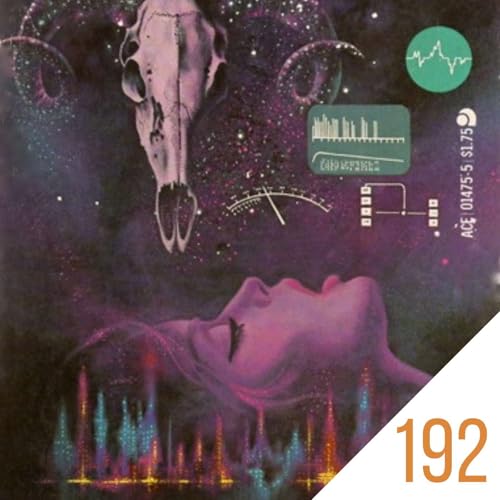
  • #192 Mind, body, spirit, space: Alien Embassy (1977) by Ian Watson
    2026/04/18

    A challenging novel of mysticism, power, and alien contact

    This week brought the news that the British science fiction writer Ian Waton had passed away in Spain, where he had lived for some time. Coincidentally, I was reading Watson's 1977 novel Alien Embassy, the subject of this week's episode.

    Watson wrote numerous challenging SF novels, including The Embedding (1973) and The Jonah Kit (1975), both previously covered here in episodes 131 and 163, respectively. Watson was also the writer of the very first novels to tie in with the Warhammer 40,000 setting, and so helped to set the stage for the vast and growing body of writing set in the grim future of the 41st millennium.

    Alien Embassy is something very different, an idea-packed look at a post-disaster future in which humanity is reaching out to the stars - but with the mind, not with spacecraft. I will certainly be reading more of Watson's work and in the meantime, I hope you find this look at one of his early novels to be interesting.

    Get in touch with a text message!

    For more classic SF reviews and discussion, visit andyjohnson.xyz. To get free weekly classic SF updates, sign up here.

    続きを読む 一部表示
    8 分
  • #191 Under the domes: Fury (1947) by Henry Kuttner and C. L. Moore
    2026/04/11

    An influential classic of power and revenge on Venus

    Like Kallocain, which I covered in episode 188, Fury is another SF novel which was published earlier than my usual jurisdiction - the 1950s to the 1990s. Written by Henry Kuttner and an uncredited C. L. Moore, it is a classic of the so-called "golden age of science fiction", a term I'd personally consign to history.

    As we'll see, Fury is focused on a highly driven antihero on a transformative mission of revenge on a habitable Venus, the last refuge of humans who have ruined the Earth. Its legacy lives on in the various works which have been influenced by it, not least novels by Alfred Bester and Harry Harrison.

    Get in touch with a text message!

    For more classic SF reviews and discussion, visit andyjohnson.xyz. To get free weekly classic SF updates, sign up here.

    続きを読む 一部表示
    8 分
  • #190 Living in the abyss: Medusa’s Children (1977) by Bob Shaw
    2026/04/02

    An entertainingly wild aquatic adventure on two worlds

    A mid-period novel by Northern Irish SF writer Bob Shaw, Medusa's Children centres on a bizarre scenario. A dwindling group of humans struggle to survive inside a liquid planetoid, preyed upon by hungry squid-like creatures. What does this have to do with Tarrant, an inept aquafarmer working on the Pacific Ocean?

    Get in touch with a text message!

    For more classic SF reviews and discussion, visit andyjohnson.xyz. To get free weekly classic SF updates, sign up here.

    続きを読む 一部表示
    7 分
  • #189 Computer fugitive: The Shockwave Rider (1975) by John Brunner
    2026/03/19

    On the run in the networked society

    This episode returns to the work of a writer featured frequently here: John Brunner. His prolific output, creative and commercial struggles, and untimely death at the Glasgow Worldcon in 1995 are contribute to him being a fascinating figure.

    The Shockwave Rider is one of his few novels currently in print. Like his magnum opus Stand on Zanzibar, it is a part of the SF Masterworks series. Written in the mid-1970s, it is one of Brunner's ambitious "tract novels", an attempt to confront imaginatively the seismic shifts that he saw coming in the 21st century. In this particular case, Brunner imagined a world in many ways like our own: politically repressive, technologically advanced, and interconnected by omnipresent computing. But as we will see, Brunner's vision from 1975 is quite unlike our present reality.

    Get in touch with a text message!

    For more classic SF reviews and discussion, visit andyjohnson.xyz. To get free weekly classic SF updates, sign up here.

    続きを読む 一部表示
    11 分