

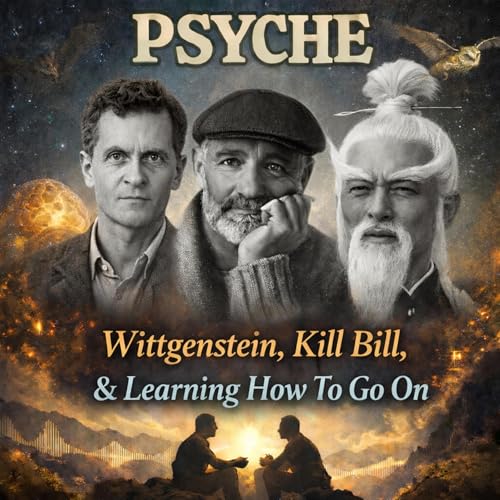
Wittgenstein, Kill Bill, & Learning How To Go On
カートのアイテムが多すぎます
カートに追加できませんでした。
ウィッシュリストに追加できませんでした。
ほしい物リストの削除に失敗しました。
ポッドキャストのフォローに失敗しました
ポッドキャストのフォロー解除に失敗しました

Wittgenstein, Kill Bill, & Learning How To Go On
-
ナレーター:
-
著者:
概要
In this episode in my Philosophy and Solution-Focused Therapy series, I reflect on Quentin Tarantino’s Kill Bill through the lens of Ludwig Wittgenstein’s idea that meaning is use. After a recent client urged me to finally watch the film, I did, for the first time, and absolutely loved it. What especially stayed with me were the scenes between the Bride and Pai Mei, where repetition, correction, action, and discipline begin to look like more than just training. They begin to look like a philosophy of practice.
I explore how Wittgenstein’s thought helps us see that understanding is not primarily a hidden inner possession, but something that takes shape in use, in action, in learning how to go on within a form of life. From there, I connect Pai Mei’s brutal pedagogy to psychotherapy, and especially to solution-focused therapy’s attention to small actions, exceptions, patterns, and the lived practices through which change becomes possible.
Along the way, I consider what Kill Bill reveals about repetition, mastery, embodiment, and the difference between having an idea and being formed into a capacity. This is an episode about training, meaning, action, and the ways new futures become real not only through insight, but through practice.