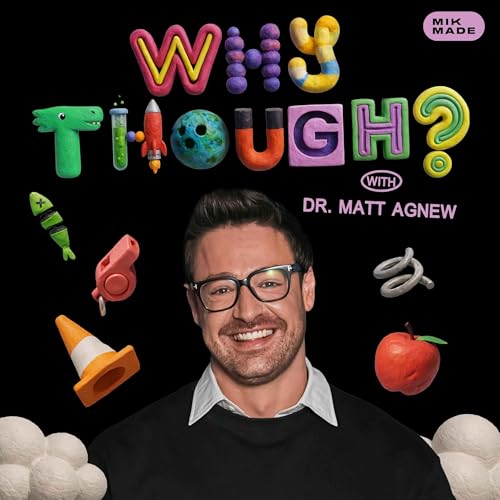
『Why Though? with Dr. Matt Agnew』のカバーアート

Why Though? with Dr. Matt Agnew

Why Though? with Dr. Matt Agnew

著者: MIK and Dr Matt Agnew
無料で聴く

Hosted by scientist Dr Matt Agnew, Why Though? is Australia's new science podcast for curious kids aged 8–12.


Every episode starts with one question kids actually ask... and ends with a science adventure. Real answers, weird facts, and the kind of stuff that makes you look at the world differently on the walk home from school.


Perfect for car trips, classrooms, and kids who can't stop asking why.


Why Though? The show for little scientists who love asking big questions. Follow or subscribe now so you don't miss Episode One.

Hosted on Acast. See acast.com/privacy for more information.

MIK and Dr Matt Agnew
科学
エピソード
  • Why Does Looking at the Sun Make Some People Sneeze?
    2026/06/20

    Have you ever walked outside on a bright sunny day and suddenly sneezed... with no dust, no pepper, no cat fluff anywhere? Just sunshine and a sneeze? There's a real science reason behind it.


    Dr Matt Agnew investigates the sun sneeze mystery. What even is a sneeze? Why does bright light trigger one for some people? And why does it run in families?


    What you'll learn:

    • Sneezing is your body's nose cleaning button... a blast of air that clears anything annoying from your mucous membrane
    • When bright sunlight hits your eyes, your brain urgently signals blink and squint
    • For about 1 in 4 people, the blink button and the sneeze button sit really close together in the brain... so pressing one accidentally bumps the other
    • Scientists call this ACHOO Syndrome... short for Autosomal Dominant Compelling Helio-Ophthalmic Outburst
    • Sun sneezing is linked to your genes, which means it can run in families
    • Sun sneezes won't hurt you... but stop before the sneeze hits if you're on a bike or crossing the road


    Key Science Ideas:

    • Mucous membrane: The sticky lining inside your nose that catches dust, germs and anything annoying
    • Optic nerve: The nerve that carries signals from your eyes to your brain
    • ACHOO Syndrome: The scientific name for sun sneezing... and yes, the acronym was absolutely intentional
    • Genes: The instructions inside your body that decide things like eye colour, height, and apparently whether sunshine makes you sneeze
    • Reflex: An automatic body response your brain triggers without you choosing it


    Fun Experiment: The Family Sun Sneeze Survey Ask everyone in your family whether they sneeze when they look at bright light. Try a torch in a dark room if the sun isn't cooperating. Keep track of who does and who doesn't. If sun sneezing runs in your family, you'll start to see a pattern... and you'll have just conducted your first genetics experiment at the kitchen table.


    Why Though? The show for little scientists who love asking big questions. Follow or subscribe so you never miss an episode.


    Follow Dr Matt Agnew:

    Instagram: instagram.com/drmattagnew

    TikTok: tiktok.com/@drmattagnew

    YouTube: youtube.com/@whythoughpod

    Website: drmattagnew.com


    Find Why Though? podcast across the internet and share with your friends!

    Instagram: instagram.com/whythoughpod

    TikTok: tiktok.com/@whythoughpod

    Facebook: facebook.com/whythoughpod


    Hosted on Acast. See acast.com/privacy for more information.

    続きを読む 一部表示
    5 分
  • Why Are Farts Smelly?
    2026/06/13

    Here's something nobody tells you. Most of a fart has absolutely no smell. So what's actually making everyone pinch their nose?


    Dr Matt Agnew investigates the science of farts. How do smells actually work? What is a fart made of? And why do some foods make the whole situation so much worse?


    What you'll learn:


    • Smells are tiny invisible particles floating in the air that your olfactory receptors grab and send to your brain
    • A fart is gas made by bacteria in your intestines while they break down food
    • Most fart gas has absolutely no smell... nitrogen, hydrogen, carbon dioxide, oxygen and even methane are all odourless
    • The real culprit is hydrogen sulfide... just 1% of a fart but enough to clear a room
    • Foods like beans, eggs, broccoli, brussels sprouts, garlic, onion and cheese all produce more hydrogen sulfide
    • Most people fart between 10 and 20 times a day... farts are natural, healthy, and a sign your body is doing its job
    • Astronauts on the International Space Station have to think carefully about farts because the gas can be trapped and even flammable


    Key Science Ideas:


    • Olfactory receptors: The tiny parts inside your nose that detect smell and send signals to your brain
    • Bacteria: Tiny living things in your intestines that help break down food... and make gas while doing it
    • Hydrogen sulfide: The gas responsible for that rotten egg smell... and basically every bad fart ever
    • Intestines: The long tube where food gets broken down after leaving your stomach
    • Microbiome: The community of bacteria living inside your body doing useful work every day


    Fun Experiment: The Food Fart Tracker Pick two days this week. On day one eat a meal with plenty of broccoli, beans or eggs. On day two eat a meal without any of those. Pay attention to what happens a few hours after each meal. That difference is hydrogen sulfide in action... your gut bacteria working harder on certain foods and producing more of that one very specific gas. Science is everywhere, even when you'd rather it wasn't.


    Why Though? The show for little scientists who love asking big questions. Follow or subscribe so you never miss an episode.


    Follow Dr Matt Agnew:

    Instagram: instagram.com/drmattagnew

    TikTok: tiktok.com/@drmattagnew

    YouTube: youtube.com/@whythoughpod

    Website: drmattagnew.com


    Find Why Though? podcast across the internet and share with your friends!

    Instagram: instagram.com/whythoughpod

    TikTok: tiktok.com/@whythoughpod

    Facebook: facebook.com/whythoughpod


    Hosted on Acast. See acast.com/privacy for more information.

    続きを読む 一部表示
    4 分
  • Why Does Thunder Always Come After Lightning?
    2026/06/06

    Lightning and thunder happen at exactly the same time. So why does the flash always arrive before the boom?


    In this episode of Why Though?, Dr Matt Agnew explains how static electricity builds up inside storm clouds, what lightning actually is, why thunder is the sound of super-heated air exploding outward, and how a simple counting trick lets you measure how far away a storm is using nothing but your eyes, ears, and a few seconds.


    What you'll learn:

    • Static electricity happens when electrons jump from one surface to another... like the zap from a doorknob after shuffling across carpet in socks
    • Inside storm clouds, ice and water particles bump and swap electrons until a massive charge builds up
    • When the charge gets big enough, it jumps to the ground as a giant electrical spark... lightning
    • Lightning heats the surrounding air hotter than the surface of the Sun, so fast the air explodes outward as a shockwave... and that shockwave is thunder
    • Light reaches your eyes almost instantly, but sound travels about one kilometre every three seconds
    • That gap between flash and boom is how far the storm is from where you're standing


    Key Science Ideas:

    • Electron: A tiny particle with a negative electric charge
    • Static electricity: Built-up charge that can suddenly discharge... the giant version is lightning
    • Electrical discharge: Charge moving rapidly to balance itself out
    • Shockwave: A fast-moving pressure wave made when air expands suddenly... thunder is exactly this
    • Speed of light vs speed of sound: Light arrives almost instantly, sound takes about three seconds per kilometre


    Fun Experiment: The Balloon Static Trick Blow up a balloon and rub it on your hair or a dry jumper. Hold it close to your hair and watch the strands lift up toward it. That's static electricity... the same force that builds up inside storm clouds, just in a much safer, much smaller version. No storm required.


    Flash-to-Bang Storm Distance Trick Next time there's a storm outside, watch for a lightning flash from indoors. Start counting... one, two, three. When you hear the thunder, stop and divide your number by three. That's roughly how many kilometres away the lightning struck. Three seconds is one kilometre, six is two, nine is three. If thunder follows almost immediately, the storm is very close... stay inside and away from windows.


    Why Though? The show for little scientists who love asking big questions. Follow or subscribe so you never miss an episode.


    Follow Dr Matt Agnew:

    Instagram: instagram.com/drmattagnew

    TikTok: tiktok.com/@drmattagnew

    YouTube: youtube.com/@whythoughpod

    Website: drmattagnew.com


    Find Why Though? podcast across the internet and share with your friends!

    Instagram: instagram.com/whythoughpod

    TikTok: tiktok.com/@whythoughpod

    Facebook: facebook.com/whythoughpod


    Hosted on Acast. See acast.com/privacy for more information.

    続きを読む 一部表示
    5 分
adbl_web_anon_alc_button_suppression_t1
まだレビューはありません