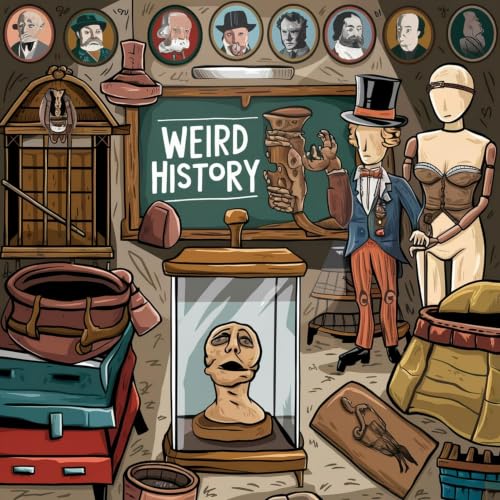
『Weird History』のカバーアート

Weird History

Weird History

著者: Echo Ridge Media
無料で聴く

Dive into the curious corners of the past with Weird History! From peculiar people to baffling events and mysterious places, this podcast unravels fascinating tales that are as bizarre as they are true. If you're a fan of the unexpected, join us for a journey through history's strangest stories.

New episodes are released on Mondays, Wednesdays, and Fridays.

Echo Ridge Media LLC
世界
エピソード
  • The Russian Tyrant Who Created a Secret Police Force That Wore Black and Carried Dogs' Heads as Symbols
    2026/07/24

    Ivan the Terrible's Oprichniki: When Terror Became Government Policy

    Support the show here: https://ko-fi.com/echoridgemedia

    Ivan IV of Russia started as an effective ruler who unified and expanded the Russian state. Then paranoia consumed him, and he created one of history's first organized secret police forces - the Oprichniki. These men wore all black, rode black horses with dogs' heads mounted on their saddles (symbolizing their role biting traitors), and terrorized Russia for nearly two decades. The Oprichniki were Ivan's personal terror squad, answering only to him, executing anyone he suspected of disloyalty without trial or evidence. They essentially turned Russia into a surveillance state built on fear.

    The Oprichniki were created in 1565 after Ivan declared himself ruler of a personal territory separate from the regular Russian state. Anyone who opposed him was suspect. The Oprichniki investigated, arrested, tortured, and executed thousands - nobles, merchants, priests, and common people. Ivan would give them names of people he suspected of conspiracy, and they'd disappear. Some were executed. Some were tortured until they confessed to crimes they didn't commit. Some were imprisoned without explanation. No one was safe.

    Ivan's paranoia grew increasingly delusional. He suspected his own son of treason and killed him in a rage. He imagined conspiracies everywhere. The Oprichniki fed his paranoia by inventing plots and "finding evidence" to justify executions. The more people they killed, the more Ivan wanted dead. It became self-perpetuating terror - kill suspects, find "conspirators" among those questioning the killings, kill them too.

    The Oprichniki's methods were deliberately theatrical and terrifying. They wore distinctive black robes so everyone knew when they were coming. The dogs' heads on their saddles were a constant visual threat. When they arrested someone, the person often disappeared forever - no trial, no explanation, no body. This uncertainty terrified people more than predictable punishment would have. Families couldn't even bury their dead.

    The economic and social impact was catastrophic. Entire noble families were wiped out. Land was seized from the nobility and given to Oprichniki members as payment. The terror was so extreme that competent administrators fled Russia. The economy collapsed. Military capacity weakened. Russia suffered famines and military defeats because the best minds were either dead or too terrified to function effectively.

    Ivan died in 1584, possibly from poison (possibly self-administered mercury). The Oprichniki were disbanded, but their legacy haunted Russia. The concept of a secret police answerable only to the ruler became a template copied by later regimes - the Gestapo, the KGB, and others studied Ivan's terror apparatus as a historical precedent.

    This episode explores Ivan's transformation from capable ruler to paranoid tyrant, the creation and structure of the Oprichniki, their methods of terror and surveillance, the symbolism of the dogs' heads, specific cases of victims and executions, the economic and social collapse under their rule, and how Ivan's terror state influenced later secret police forces.

    Keywords: weird history, Ivan the Terrible, Oprichniki, Russian history, secret police, terror state, paranoia, Russian tyrant, medieval Russia, surveillance state, political terror

    Perfect for listeners who love: Russian history, authoritarian rulers, secret police history, terror states, and how paranoia destroyed empires.

    続きを読む 一部表示
    1 時間
  • The Young Pilots Who Volunteered to Fly Planes Into Ships - And Left Letters Saying They Were Honored to Die
    2026/07/08

    Kamikaze: The Psychology of Honorable Suicide

    Between 1944 and 1945, the Japanese military organized kamikaze attacks - pilots who flew planes directly into enemy ships, deliberately crashing to create explosions that would destroy the vessel. Over 3,000 young men participated, and most were willing volunteers. But what motivated them? How did Japan's military culture convince teenagers and young adults that crashing their planes into ships was not just acceptable but honorable? The letters left by kamikaze pilots reveal brilliant, thoughtful young men who genuinely believed they were making the ultimate sacrifice for their country - even as they flew to certain death.

    The kamikaze program officially began in October 1944 when Japanese military leaders realized they couldn't win the war through conventional means. Suicide attacks seemed like the only option. But recruitment was surprisingly voluntary - thousands of young pilots volunteered. Why? Japanese culture had a long tradition of honorable death. The samurai code (bushido) valued dying for one's lord over living in shame. Surrender was considered dishonorable. Dying for the emperor was the highest honor. Military propaganda reinforced this relentlessly.

    The pilots' letters and writings are haunting. Many express genuine belief that their sacrifice would save Japan. Some write philosophically about death and honor. Some express doubts but rationalize them as weakness. Some write poignantly about family, love, and regret - emotions they suppress in service of duty. These weren't mindless fanatics but thoughtful young men wrestling with what they'd been asked to do and convincing themselves it was right. Some were as young as 17.

    The psychological preparation was intense. Pilots were isolated in special squadrons where they prepared mentally and spiritually for death. Officers spoke of honor and duty constantly. Religious ceremonies (both Buddhist and Shinto) sanctified their sacrifice. They were treated as heroes before they died. Some wrote poems. Some left final messages for family. The ritual surrounding kamikaze attacks made suicide feel like a sacred act rather than a tragedy.

    The actual attacks were sometimes effective but often failed. Many pilots didn't reach their targets. Many planes were shot down before reaching ships. The strategic value was minimal - Japan lost experienced pilots faster than they could be replaced, hastening their defeat. Yet the program continued because military leadership refused to accept surrender.

    The cultural aftermath is complicated. Some Japanese view kamikaze pilots as ultimate patriots who sacrificed themselves nobly. Others see them as victims of militaristic propaganda who were manipulated into suicide. The truth probably includes both - genuine belief mixed with coercion, honor mixed with desperation, youth mixed with fanaticism.

    This episode explores the samurai code and bushido traditions that made suicide honorable, the military propaganda and psychological preparation, individual pilots' backgrounds and motivations, the famous letters and final writings, the actual attacks and their effectiveness, and the ongoing cultural debate about how to remember kamikaze pilots.

    Keywords: weird history, kamikaze, WWII, Japan, suicide attacks, bushido, Japanese culture, Pearl Harbor, Pacific War, military psychology, sacrificial death, Japanese history

    Perfect for listeners who love: WWII history, Japanese history, psychology of extremism, military history, and understanding how cultures can valorize death.

    Warning: This episode discusses suicide, military propaganda, and death in detail. Listener discretion is strongly advised.

    Another tragic episode from Weird History - where an entire culture convinced young men that death was honor.

    続きを読む 一部表示
    52 分
  • When Prague's Solution to Political Problems Was Throwing Enemies Out Windows - Three Separate Times
    2026/07/01

    The Defenestration of Prague: When Throwing People Out Windows Became Political Tradition

    In Prague, there's a bizarre political tradition: throw your enemies out a window. This happened three times, and each time sparked massive consequences. The word "defenestration" (meaning "throwing someone out a window") exists primarily because of Prague's obsession with this assassination method.

    The First Defenestration (1419) occurred during the Hussite Wars when Catholic nobles threw reformist leaders out a town hall window. They survived, but the act sparked the Hussite Wars - religious conflict lasting decades and killing thousands.

    The Second Defenestration (1618) is the most consequential. Angry Protestant nobles threw three Catholic Habsburg officials out of Prague Castle - a 70-foot drop. Miraculously, they survived (landed in a moat, or according to Catholic accounts, were saved by angels). The incident sparked the Bohemian Revolt, which escalated into the Thirty Years' War - one of history's deadliest conflicts that killed 8 million people across Europe.

    The Third Defenestration (1945) occurred at the end of WWII when Soviet forces were taking Prague. A Nazi official was thrown out a window, continuing the tradition centuries later.

    The absurdity is undeniable - Prague's solution to political problems was literally throwing people out buildings. Yet the consequences were catastrophic. A window throw in 1618 led to a war that killed millions. It's one of history's strangest causation chains: political dispute → defenestration → Thirty Years' War → millions dead.

    This episode explores all three defenestrations, why Prague became synonymous with this bizarre assassination method, the survival stories and miracle claims, and how a window throw sparked one of Europe's deadliest wars.

    Keywords: weird history, Defenestration of Prague, Thirty Years' War, Prague history, Hussite Wars, medieval assassination, political violence, Bohemia, unusual execution methods

    Perfect for listeners who love: medieval history, absurd political violence, bizarre assassination methods, and how minor incidents sparked massive consequences.

    Another chaotic episode from Weird History - where throwing people out windows became a political tradition.

    続きを読む 一部表示
    56 分
adbl_web_anon_alc_button_suppression_t1
まだレビューはありません