エピソード

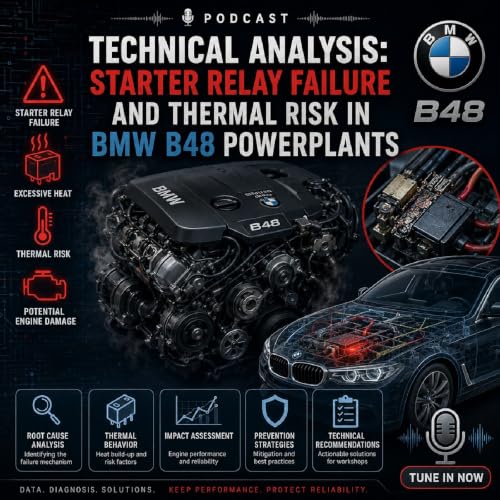
  • Starter Relay Failure and Thermal Risk in BMW B48 Powerplants
    2026/07/16
    Introduction and Scope of Investigation
    This forensic report details a critical safety vulnerability identified within the BMW B48 engine ecosystem. What was initially categorized as a localized mechanical malfunction of the starter motor has been reclassified as a systemic thermal hazard. This investigation encompasses approximately 29,000 Plug-in Hybrid Electric Vehicle (PHEV) units, representing an expansion of a previous recall action affecting over 200,000 conventional internal combustion vehicles. The strategic importance of this analysis lies in the transition of a common electrical failure into a high-severity thermal event, posing significant risks to vehicle occupants and adjacent structures. The scope of this report is confined to the B48 2.0-liter turbocharged four-cylinder powertrain architecture and the associated failure modes of its starter motor assembly.
    Engineering Context: The B48 Powerplant and Starter Architecture
    The B48 engine is a cornerstone of the modern BMW and Toyota Supra lineups, serving as a modular power unit across diverse vehicle segments. This widespread application creates a systemic vulnerability; a design deficiency in an ancillary component, such as the starter motor, propagates across a vast fleet. Understanding the architectural commonalities—and subtle differences—between variants is essential for failure mode mapping.
    The investigation identifies that while affected vehicles utilize the shared B48 engine platform, they do not share the exact factory-equipped starter motor:
    PHEV (iPerformance) Models: Utilize specialized starter motors integrated for hybrid start-stop duty cycles.
    Conventional IC Models: Utilize standard starter motors tailored for traditional ignition requirements.
    Despite the utilization of different part numbers and supplier iterations, the underlying vulnerability remains consistent: a failure of the relay housing to effectively exclude moisture. This shared failure mode indicates a fundamental design or material specification deficiency in the starter relay's environmental sealing.
    Root Cause Analysis: Galvanic Corrosion and Short-Circuit Dynamics
    Forensic evaluation of failed units emphasizes the catastrophic potential of the ingress of aqueous contaminants into critical electronic components. In the B48 starter assembly, the failure is initiated by environmental stressors that overcome the relay’s dielectric integrity.
    The failure chain is sequenced as follows:
    Ingress of Aqueous Contaminants: Moisture penetrates the starter relay housing due to inadequate sealing or material degradation under thermal cycling.
    Galvanic Corrosion of Conductive Pathways: The presence of moisture facilitates the structural and chemical degradation of internal contacts and conductive traces.
    Dielectric Breakdown and Electrical Failure: Advanced corrosion bridges the gap between terminals, initiating an internal short circuit within the starter assembly.
    The "Thermal Event" catalyst is a result of uncontrolled resistive heating. When the internal short circuit occurs, current draw exceeds design limits, leading to rapid heat dissipation within the starter windings and relay housing. This temperature spike frequently exceeds the auto-ignition threshold of adjacent polymer components and engine bay fluids, transforming an electrical failure into sustained combustion.

    Become a supporter of this podcast: https://www.spreaker.com/podcast/vehicles-recalls--6499215/support.
    続きを読む 一部表示
    22 分
  • Case Study: Toyota’s V6 Reliability Crisis (2024–2026) – A Masterclass in Industrial Crisis Managemen
    2026/07/16
    Anatomy of a Systemic Defect: The #1 Main Bearing Failure
    In automotive engineering, the health of the "bottom end" relies on Hydrodynamic Lubrication. The failure of the V35A engine follows a precise, destructive sequence where this mechanical principle is violated:
    Microscopic Oil Film: Under normal operation, a pressurized film of oil prevents metal-on-metal contact between the high-speed rotating crankshaft and the fixed main bearings.
    Lubrication Disruption: A breach in this film—whether via debris or excessive force—collapses the barrier.
    Hydrodynamic Failure and Friction: Without the oil wedge, friction causes localized temperatures to skyrocket, leading to material fatigue and surface degradation.
    Catastrophic Outcome (Rod Knock): The bearing effectively "fuses" to or wipes against the crankshaft. This results in terminal mechanical thumping (rod knock) and total engine seizure.
    "I was two-thirds of the way through a 180-mile drive when the engine began sounding louder than usual... I noticed a bad sound at idle and especially at low speed, describing it as muffled. The next day, a Toyota dealer diagnosed the sound as rod knock, a fatal condition." — Toyota Tundra Owner (Forum Account)
    Vulnerability Factors Engineering data indicates these failures are most prevalent during high-load, high-altitude, or towing operations. Under these conditions, the engine operates at peak thermal and mechanical stress, leaving zero margin for lubrication errors. From a safety perspective, the "so what" is critical: a sudden, total loss of motive power without prior warning lights leaves drivers vulnerable in high-speed traffic or remote environments.

    Become a supporter of this podcast: https://www.spreaker.com/podcast/vehicles-recalls--6499215/support.
    続きを読む 一部表示
    21 分
  • The_Tiny_Bolt_Costing_Aston_Martin_Millions
    2026/05/18
    Case Study: The Cost of Quality—Suspension Safety and Financial Impact in the Automotive Sector
    1. Introduction: The Aston Martin DBX Recall Crisis
    In the high-stakes world of luxury automotive manufacturing, brand equity is tethered to the uncompromising standard of engineering integrity. Even for a marquee manufacturer like Aston Martin, a localized technical oversight can escalate into a systemic crisis. This case study examines a significant safety recall affecting the DBX platform. This retrospective analysis illustrates how a non-conformance in a singular fastening component created a cascading liability that necessitated a rigorous, data-driven intervention to safeguard both the consumer and the brand's financial health.
    Fact Sheet: Recall Overview
    Models Affected: Aston Martin DBX, DBX707, DBX S, DBX Straight-six
    Production Dates: 27.02.2020 – 05.11.2025
    Recall Code: RA-41-2086 1
    Country of Origin: United Kingdom
    EC-Type Approval: AM8, AM8SS (e92007/46680400-KS18/85811438*00-*04)
    While the brand represents the pinnacle of luxury, this single technical oversight created a massive safety and financial liability.
    The Anatomy of a Technical Failure
    From the perspective of a Quality Architect, this incident represents a classic "domino effect" failure. The root of the mechanical breakdown was not an assembly error, but a Supplier Quality Engineering (SQE) failure regarding incoming component geometry. A specific bolt failed to meet the required shank diameter specification, triggering a sequence of failures within the vehicle's rear architecture.
    The Failure Chain:
    1. Bolt Defect: A supplier-provided bolt is delivered with a reduced shank diameter, falling outside of the critical tolerance zone.
    2. Torque Pin Movement: Because the bolt shank cannot provide the necessary interference or clamping force, the torque pin is not properly secured and slides out of its housing in the rear lower suspension arm.
    3. Suspension Arm Failure: The displacement of the torque pin causes a mechanical overload on the rear lower suspension arm, leading to catastrophic structural failure under operational loads.
      1. Brake/Accident Risk: The collapsing suspension geometry damages the rear braking system and surrounding chassis components, resulting in a loss of vehicle control and an acute accident risk.
      This technical chain reaction leads directly to significant legal and financial repercussions.


    Become a supporter of this podcast: https://www.spreaker.com/podcast/vehicles-recalls--6499215/support.

    This episode includes AI-generated content.
    続きを読む 一部表示
    33 分
  • Million_Vehicle_Ford_Recall_Mustang_Bronco_Explorer_Fix_Timelin
    2025/12/02
    Case Study: The Ford "Loss of Thrust" Recall
    Introduction: Understanding Product Safety in Action
    A vehicle recall is a critical tool for consumer safety, issued when a manufacturer or government agency determines that a vehicle model has a safety-related defect. It represents a formal process to correct the problem, usually at no cost to the owner.
    A large-scale Ford recall, officially filed for 2025 and affecting over one million vehicles, serves as a clear example of this process. This case study will break down the specific defect, its widespread impact, and the structured corrective action to illustrate key concepts in product safety and regulatory oversight.
    1. The Problem: Identifying the Core Defect
    To initiate a successful recall, the problem must be understood with precision. This involves defining the specific failure, its root cause, and the resulting risk to the consumer.
    • Defining the Failure The specific defect identified in the affected Ford vehicles is a "loss of thrust at high temperatures."
    • Pinpointing the Cause The root cause of this failure was traced to an "inadequate fuel supply," suggesting a potential fault within the fuel injection system.
    • Explaining the Safety Risk Synthesizing these points reveals the primary safety implication for a driver. An inadequate fuel supply can cause the vehicle to suddenly lose power or "thrust," especially under demanding conditions like high temperatures. This unexpected loss of acceleration or propulsion can significantly increase the risk of a collision, particularly in high-speed traffic situations.
    This clearly identified defect was found to affect a vast number of vehicles across multiple popular models.

    Become a supporter of this podcast: https://www.spreaker.com/podcast/vehicles-recalls--6499215/support.
    続きを読む 一部表示
    12 分
  • The_Hidden_Danger_of_Missing_Steel__Why_400,000_Honda_Civics_We
    2025/11/08
    Honda Civic Wheel Recall: An Incident Analysis of a Supply Chain Quality Control Failure
    1.0 Incident Overview
    In the automotive industry, recalls are often symptoms of process control failures within the global supply chain. The recall affecting 2016–2021 Honda Civic models is a critical case study that illustrates how a localized process control failure at a Tier 1 supplier can result in wide-reaching consequences for an original equipment manufacturer (OEM). This analysis deconstructs the incident to identify its root cause, scope, and the lessons it offers for supply chain quality management.
    Incident at a Glance
    Metric
    Details
    Vehicles Affected
    2016–2021 Honda Civic
    Total Recall Scope
    406,290 vehicles
    Estimated Defective Units
    3,276
    Core Defect
    Missing lug seat inserts on 18-inch aluminum wheels
    Identified Root Cause
    Manufacturing process error at an Italian supplier
    This summary outlines the core facts of the recall, which resulted from a specific manufacturing defect with significant safety implications.
    2.0 Technical Breakdown of the Manufacturing Defect
    The integrity of a vehicle's wheel assembly is fundamental to vehicle safety. This section deconstructs the component failure at the heart of the Honda recall to clarify the direct safety risk involved.
    The core defect was the absence of lug seat inserts on certain aluminum wheels. These are hard steel inserts pressed into the softer aluminum alloy where the lug nuts make contact. Their primary function is to provide a durable, load-bearing surface that prevents the softer aluminum from galling or deforming under the high clamping force of tightened lug nuts. Without these inserts, the aluminum contact area could become deformed, reducing the clamping force and causing the lug nuts to work loose. The ultimate potential consequence of this failure sequence is the detachment of the wheel from the vehicle while in motion.

    Become a supporter of this podcast: https://www.spreaker.com/podcast/vehicles-recalls--6499215/support.
    続きを読む 一部表示
    11 分
  • Aston_Martin_Valkyrie_Fire_Risk__Why_the_Recall_Notice_Fails_to
    2025/10/27
    Technical Incident Report: Aston Martin Valkyrie Recall RA-18-2044
    1.0 Incident Identification and Scope
    This report details the technical findings and mandated actions for Aston Martin recall RA-18-2044. The following summary establishes the foundational parameters of the incident, defining the affected vehicle population and relevant regulatory identifiers.
    Recall Summary
    Identifier
    Details
    Manufacturer
    Aston Martin
    Affected Model
    Valkyrie
    Production Period
    16. 6. 2020 – 23. 12. 2024
    Total Units Affected
    137
    Internal Mfr. Code
    RA-18-2044
    Regulatory Body
    Kraftfahrt-Bundesamt (KBA)
    Regulatory Ref. Number
    15104R
    KBA Publication Date
    23. 10. 2025
    The root cause of this recall stems from a specific manufacturing defect, as detailed in the following analysis.
    2.0 Detailed Defect Analysis
    A precise root cause analysis has identified a component specification failure as the primary defect. This failure is centered on a critical electrical assembly.
    The root cause is a manufacturing defect; specifically, the screws utilized on the cover plate of the rear fuse box are too long.
    The direct physical impact of this defect is that the oversized screws make contact with the adjacent wiring harness. This contact causes physical damage to the wiring harness, which is the primary failure point identified in this incident. This breach in the wiring harness's integrity creates multiple vectors for critical system failure and presents a significant fire risk.

    Become a supporter of this podcast: https://www.spreaker.com/podcast/vehicles-recalls--6499215/support.
    続きを読む 一部表示
    11 分
  • Ferrari_Recall_Critique__How_to_Justify__Do_Not_Drive__and_Mana
    2025/10/27
    Case Study Analysis: Ferrari 296 Recall (NHTSA ID: 25V716000)1.0 Executive OverviewThis formal case study analyzes the Ferrari North America recall (NHTSA ID: 25V716000), deconstructing the technical defect, potential risks, and prescribed remedy based exclusively on the official filing. The analysis begins with the foundational identification and scope of the recall.2.0 Recall Identification and ScopeThe accurate identification of a recall's scope establishes the fundamental parameters of the event, defining the responsible manufacturer, the affected vehicle population, and the component systems involved. These details for recall 25V716000 are as follows:IdentifierDetailsManufacturerFerrari North America, Inc.NHTSA ID Number25V716000Manufacturer Recall NumberRC 93Affected ComponentsENGINE AND ENGINE COOLINGAffected Vehicles2025 296 GTS and 296 GTBPotential Number of Units Affected6With the specific vehicles and limited number of units identified, the analysis can now focus on the underlying technical problem that necessitated this recall action.3.0 Technical Problem AnalysisThe defect's root cause, a failure in assembly-line quality control, highlights a critical vulnerability in the vehicle's engine and cooling system. Ferrari's investigation pinpointed a specific mechanical failure as the source of the defect.The technical defect stems from an assembly process error. The core issue is precisely described as follows:The nut securing the oil filter connection to the turbocharger oil feed pipes was tightened incorrectly and may cause an oil leak.The direct consequence of this defect is a potential oil leak from a critical engine component. This single point of failure introduces a significant vulnerability within the engine and engine cooling system. This oil leak transforms a minor assembly defect into a critical fire hazard.4.0 Risk Assessment and Safety ImplicationsAn assessment of a defect's consequences determines its severity and the required urgency of the response. In this case, the mechanical failure creates a direct and severe risk to vehicle occupants, necessitating an immediate owner directive.The primary risk associated with the potential oil leak is severe. As stated directly in the recall documentation, "An oil leak near a combustible source increases the risk of a fire." This elevates the defect from a potential performance issue to a critical safety hazard.In response to this significant risk, a "Do Not Drive Warning" has been issued to all owners of the affected vehicles. This measure is reserved for defects with a high potential for severe consequences and is a critical step to mitigate the identified fire risk. The directive instructs owners to cease operating their vehicles immediately until a repair can be performed, prioritizing owner safety until the official remedy is implemented. With the immediate risk contained through this directive, the focus shifts to the official remedy required to make the vehicles safe for operation.5.0 Corrective Action and Remediation PlanThe remediation plan for this recall is defined by a clear corrective action, a no-cost provision for owners, and a structured communication strategy. This plan is designed to ensure full compliance and restore vehicle safety.The official remedy is a multi-step process designed to correct the defect:1. Immediate Owner Action: Owners are advised not to drive their vehicles until they have been repaired.2. Official Repair Procedure: Ferrari will verify tightness and retighten the attachment nut.3. Cost to Owner: The remedy will be provided free of charge.Owner Notification and SupportTo ensure all affected parties are informed, Ferrari has established a clear communication plan. Owner notification letters detailing the recall and required actions are expected to be mailed on December 20, 2025. For immediate inquiries, owners may contact Ferrari customer service at 1-201-816-2668.Ultimately, the remediation plan provides a comprehensive solution, addressing the technical fault, owner communication, and cost liability.6.0 ConclusionThe analysis of NHTSA recall 25V716000 documents a contained but critical safety event. A manufacturing defect, specifically an incorrectly tightened nut on an oil filter connection, created a significant fire risk for six 2025 Ferrari 296 vehicles. The resulting corrective action included an immediate "Do Not Drive" warning and a straightforward, no-cost remedy to retighten the component. This case demonstrates that even minor assembly-line errors can necessitate a comprehensive recall response to mitigate severe safety risks and ensure regulatory compliance.Become a supporter of this podcast: https://www.spreaker.com/podcast/vehicles-recalls--6499215/support.
    続きを読む 一部表示
    11 分
  • Audi_Fire_Risk__The_Software_Fix_for_a_Five-Year_Battery_Flaw_a
    2025/10/27
    FOR IMMEDIATE RELEASE: Audi Announces Voluntary Safety Recall of Select Q7, A8, and Q8 Models to Address Battery Fire Risk
    INGOLSTADT, Germany – [Date]
    Audi AG announced today it is proactively conducting a worldwide voluntary safety recall for 18,652 specific Audi Q7, A8, and Q8 vehicles. The recall addresses a potential fire risk associated with the high-voltage battery. The company has developed a software update that will resolve the issue and will be provided to customers free of charge.
    1.0 The Safety Concern and Audi's Proactive Response
    At Audi, the safety of our customers is our highest priority. In adherence to this principle, we are taking decisive, precautionary action to uphold the highest standards of quality and safety. Following our rigorous internal monitoring, we have identified a potential condition where the cell modules of the high-voltage battery may overheat during charging. This overheating presents a potential risk of fire.
    2.0 Affected Vehicle Identification
    This voluntary safety recall is specific to the following vehicle population:
    • Affected Models: Audi Q7, A8, Q8
    • Total Number of Vehicles (Worldwide): 18,652
    • Production Period: 22 August 2019, to 31 July 2024
    We urge owners of vehicles matching this description to follow the instructions outlined below to have the corrective action performed.
    3.0 Resolution and Clear Instructions for Owners
    Audi has developed an effective and straightforward solution that will be implemented at no cost to vehicle owners. The issue will be resolved by updating the software for the high-voltage battery. This software-based solution allows for an efficient and precise update to the battery management system, ensuring the continued safety and performance of the vehicle.
    To ensure a smooth and efficient process, we ask affected owners to take the following steps:
    1. Await Official Notification: Audi will contact the owners of affected vehicles directly.
    2. Contact an Authorized Dealer: Contact your local authorized Audi workshop to confirm if your specific vehicle is included in this recall and to schedule an appointment for the service.
    3. Schedule the Free-of-Charge Repair: The software update will be performed by certified technicians at no cost to the customer.
    4.0 Official Recall Information
    This recall action is being officially monitored by the German Federal Motor Transport Authority (Kraftfahrt-Bundesamt) to ensure its effective and complete execution. The official reference information for this recall is as follows:
    Authority/Reference
    Identifier
    Monitoring Authority
    Kraftfahrt-Bundesamt (KBA)
    KBA Reference Number
    15663R
    Audi Internal Code
    93QQ
    Audi is fully committed to carrying out this recall efficiently and with the least possible disruption to our customers.
    5.0 Our Unwavering Commitment to Safety and Quality
    We are committed to delivering the quality and safety our customers expect and deserve. We sincerely regret any inconvenience this recall may cause. We thank our owners for their patience and continued trust in the Audi brand as we complete this important safety measure.
    --------------------------------------------------------------------------------
    About Audi
    The Audi Group is one of the most successful manufacturers of automobiles and motorcycles in the premium and luxury segment. With its brands Audi, Bentley, Lamborghini, and Ducati, it is committed to "Vorsprung durch Technik" and shaping the future of sustainable, premium mobility.
    Media Contact:
    [Name/Title] [Department] [Email Address] [Phone Number]


    Become a supporter of this podcast: https://www.spreaker.com/podcast/vehicles-recalls--6499215/support.
    続きを読む 一部表示
    11 分