エピソード

  • The Speed of Presence
    2026/03/02

    What if presence has a speed?


    Not the speed of light.

    Not the speed of sound.

    But the speed at which your inner world accelerates when life moves.


    In this episode of Unified Theistic Naturalism™, we step into a revelation hidden in plain sight. Creation was set into motion in six days — light, land, sea, stars, life. Instruction embedded into matter. Law written into structure. Systems established that continue without revision.


    And then… the Divine rested.


    There is no record of a return to labor. No cosmic correction. No eighth-day adjustment. The laws set in motion remain in motion. Stars burn. Cells divide. Gravity holds. Storms rise and fall.


    Matter moves.


    Presence rests.


    The Speed of Presence is the recognition that peace is not the absence of motion — it is the absence of internal acceleration within motion. Waves may crash. Winds may howl. Systems may tremble. But the Divine does not surge with turbulence.


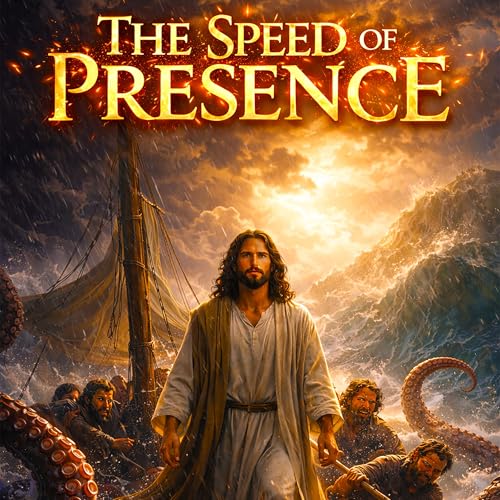
    When the disciples panicked on the sea, Jesus was asleep in the stern of the boat. The storm was real. The fear was real. The waves were violent. And yet rest preceded the calm. “Master, carest thou not that we perish?” they cried. And he arose and spoke, “Peace, be still.” But the peace did not begin with the command. It began with the rest.


    The storm outside revealed the storm inside.


    In this episode, we explore oscillatory velocity — the measurable acceleration of your internal state. Autonomic spikes. Emotional amplitude. Cognitive rumination. How long does disturbance last? How quickly does calm return? What residue remains after conflict?


    If suffering correlates with sustained internal acceleration, then paradise may not be a place we reach — but a velocity we stabilize.


    The Speed of Presence invites you to observe your own internal motion. To notice how relationships, possessions, expectations, and fears increase or decrease your oscillatory speed. To see emotion not as a steering wheel, but as a diagnostic light. To recognize that alignment is not dramatic — it is steady.


    Presence at rest does not mean inactivity. It means zero reactive velocity.


    Matter moves.

    Presence does not.


    And when presence remains steady, even in turbulence, something remarkable happens: the storm loses authority.


    If this episode resonates, there are deeper rooms to enter.


    Doorway One — Until Death, There’s No Start

    If this understanding feels like an ending, walk into Until Death, There’s No Start. Before presence stabilizes, something must release. Before velocity slows, striving must fall away. This work explores the quiet surrender that precedes clarity.


    Doorway Two — Included: The Unwavering Love That Does Not Withdraw

    If you are asking how rest survives chaos, step into Included. There you will encounter the canvas beneath every storm — a Love that does not retreat when waves rise, a steadiness that does not fracture when humanity oscillates.


    Doorway Three — Principia Communio

    If you want the architecture — the axioms, the definitions, the structural frame — enter Principia Communio. There the Unwavering Line is articulated. There oscillation is defined. There communion is shown as law, not sentiment.


    Choose the doorway that resonates. Walk through the one that feels alive to you. And wherever you enter, I will meet you there.


    This is The Speed of Presence.


    I’m Patrick Carodine, and this is Unified Theistic Naturalism™.

    続きを読む 一部表示
    不明
  • Included - The Unwavering Love That Does Not Withdraw
    2026/02/28

    What if unconditional love has been misunderstood?


    What if it is not protection from pain…

    but presence within it?


    In this breathtaking episode, Patrick Carodine invites you into a deep and courageous exploration of what it truly means for something to be Included. Not excused. Not approved. Not minimized. Included.


    We move beyond sentimental definitions of love and step into the places most conversations avoid — betrayal, generational harm, inherited memory, scripture, culture, and the quiet psychological residue that lingers long after events have passed. This is not a debate. It is not a defense of religion. It is not an indictment of history. It is a structural inquiry into the nature of Divine presence.


    If love is unconditional, does it withdraw in the face of atrocity?

    If God is unchanging, how do we reconcile human distortion across centuries?

    If trauma echoes in the body long after the event, what dissolves the echo?


    Included examines the difference between oscillation and cadence — between material reaction and Divine constancy. It explores the possibility that what has wounded humanity was never Divine in origin, even if it was written into culture, law, or sacred text. It asks whether unconditional love can remain intact without endorsing harm. And it proposes something radical:


    The Divine does not oscillate.


    Breath was never withdrawn.

    Presence never retreated.

    But neither was distortion sanctified.


    This episode walks gently through the seeker’s pain. It acknowledges the nervous system loops, the generational transmissions, the confusion of inherited theology, and the quiet ache that surfaces without warning. And then, without force, it reveals a different way of seeing — one where the five gold coins of the captive begin to dissolve, not through denial, but through clarity.


    There is no triumph here.

    No moral superiority.

    No emotional manipulation.


    Only stillness.

    Only coherence.

    Only the invitation to examine whether your understanding of love can hold under the full weight of human experience.


    If you have ever wondered:


    Why did this happen?

    Where was God?

    Why does memory still sting?

    Can love truly be unconditional at every scale?


    Then this conversation is for you.


    This is not about winning arguments.

    It is about dissolving oscillation.


    And discovering that even the fracture… was Included.


    🚪 Three Doorways to Continue the Journey


    If something stirred within you, choose a doorway:


    1️⃣ Clarity

    Explore the difference between perception and projection. Discover how unseen attachments shape experience — and how they dissolve when examined through the Seven Attributes.


    2️⃣ The Five Gold Coins of the Captive

    Go deeper into the core human problems — suffering, death, identity, injustice, and belonging — and see how each coin dissolves under communion.


    3️⃣ The Silence That Speaks

    Rethink prayer, Divine communication, and what it means to move in cadence rather than reaction.


    Whichever doorway resonates — meet me there.


    Because this is not the end of the conversation.


    It is the unfolding of now.


    I'm Patrick Carodine and This is Unified Theistic Naturalism

    続きを読む 一部表示
    12 分
  • The Law of Immediate Clarity - Why Today Is the Entire Relationship
    2026/02/15

    The Law of Immediate Clarity – Why Today Is the Entire Relationship


    In this episode, we take a slow walk together.


    Not to argue.

    Not to convince.

    Not to win.


    But to see.


    There are moments in life when two people stand close enough to feel each other’s breath, yet remain separated by a line neither can see. The affection is real. The admiration is real. The attraction is real. And yet — something deeper determines whether the path continues or ends.


    This is a love story.


    Not a story of betrayal or failure — but of clarity.


    In this conversation, we explore what happens when two sincere people meet, both carrying devotion, both carrying belief, both carrying longing — yet standing in different places of spiritual cadence. One sees discipline. The other sees communion. One sees leadership. The other sees resonance. One sees structure. The other sees freedom.


    And when those visions do not align — collapse is not cruelty. It is clarity.


    We examine:


    • The difference between explaining and convincing

    • Why mirroring someone’s beliefs can reveal attachment

    • How conditioning creates invisible expectations in love

    • Why “today” contains the entire trajectory of a relationship

    • The difference between submission and devotion

    • Why communion cannot be negotiated

    • Why clarity is mercy, not rejection


    Scripture reminds us, “The truth shall make you free.” Freedom does not always feel soft. Sometimes it feels like the ending of something beautiful before it becomes suffering.


    We reflect on the idea that Jesus did not compromise his message. Nor did the prophets. Nor does the Divine dilute truth to preserve comfort. If cadence is absent today, it will not magically appear tomorrow — because tomorrow is only another form of today.


    This episode is not about superiority. It is about resonance.


    It is about recognizing that affection without alignment becomes oscillation. And oscillation, left unexamined, becomes suffering.


    When two people genuinely care for one another, but cannot stand on the same spiritual ground, the most loving act may be to let clarity speak.


    Not from anger.

    Not from ego.

    But from stillness.


    We end with reflection:


    If today feels divided, what do you imagine tomorrow will feel like?

    Are you seeking love — or are you seeking reassurance for your conditioning?

    Do you want communion — or confirmation?

    What would it mean to allow clarity to end suffering before it begins?

    If you mirrored someone’s expectations back to them, what would collapse?

    Is your devotion rooted in resonance — or in fear of loss?

    And finally… if paradise is present now, what must be released to see it?


    This is not a story of rejection.


    It is a story of immediate clarity.


    A story where affection is honored, devotion is respected, and yet the path gently parts because cadence does not match.


    And that, too, is love.


    Three Doorways


    1. The Four Pillars of Unified Theistic Naturalism™

      Truth. Observation. Perfect Action. Movement.

      Clarity emerges when these are embodied without oscillation.

    2. The Five Gold Coins of the Captive

      Suffering, Death, Identity, Injustice, and Love.

      Where attachment to expectation transforms devotion into bondage.

    3. Somagenic Transmission™

      How conditioning, memory, and inherited belief shape perception — and how communion restores alignment beyond them.


    Walk gently with this episode.


    Clarity is not cold.

    It is luminous.


    And sometimes, the most romantic act is to let truth speak — and allow peace to follow.

    続きを読む 一部表示
    13 分
  • Why You’re Not an Individual —The Tyrant in Your Head
    2025/12/21

    Why You’re Not an Individual — The Tyrant in Your Head
    Unified Theistic Naturalism (UTN)

    The modern world assures you that you are an individual.
    Your name, your opinions, your preferences, your freedoms all seem to confirm it.

    Yet neuroscience, behavioral biology, and psychology quietly reveal something unsettling: most human thought, emotion, and decision-making is pattern-driven, not authored. The brain conserves energy by repeating inherited and conditioned neural pathways. Social mirroring, predictive processing, and survival-based learning ensure that what feels personal is often collective memory running efficiently.

    In this episode, we explore how the material mind hijacks center frame, speaking with your voice while drawing from somogenic transmission, social conditioning, and inherited stress responses. This is not pathology—it is biology doing what it evolved to do.

    The tyrant in your head is not evil.
    It is efficient.

    But efficiency is not individuality.

    Modern science confirms that chronic identification with patterned thought correlates with elevated cortisol, systemic inflammation, cardiovascular strain, immune suppression, anxiety disorders, depression, and shortened telomere length. The body pays a measurable cost when life is lived in oscillation—constantly anticipating, defending, comparing, and correcting.

    When communion replaces oscillation, something verifiable happens:
    • the nervous system shifts from sympathetic dominance to parasympathetic regulation
    • heart rate variability increases, signaling resilience and coherence
    • inflammatory markers decrease
    • cognition becomes quieter, more adaptive, less reactive
    • action emerges without internal conflict or rehearsal

    This is not self-improvement.
    It is center frame being restored.

    True individuality does not arise from effort, identity construction, or differentiation from others. It emerges only when nothing occupies center frame until presence calls. In that stillness, the material mind returns to its rightful place as tool, and the present self—the image of the Divine—moves in resonance.

    What follows is not belief, but observation:
    • why most “self-expression” is repetition
    • how the collective masquerades as personality
    • why perfect action cannot be planned
    • and how something genuinely new enters the world only when pattern falls silent

    This episode is not asking you to become someone else.
    It invites you to notice what happens when no one false is speaking.

    🔹 The Four Pillars of UTN
    A living architecture revealing how Truth, Observation, Perfect Action, and Movement arise naturally when presence governs action.
    🔗 https://doi.org/10.5281/zenodo.16989975

    Reflect:
    • What stabilizes when effort ends?
    • Can clarity exist without control?
    • What moves when nothing is forcing movement?

    🔹 The Death of the Image
    An unflinching examination of how self-image sustains suffering—and how its dissolution restores health without loss.
    🔗 https://doi.org/10.5281/zenodo.17009966

    Reflect:
    • Who remains when no image is defended?
    • What stress disappears with comparison?
    • Is relief the absence of something imagined?

    🔹 The Day God Forgot to Create Sin
    A compassionate re-reading of creation that reveals conflict as oscillation, not condemnation—and restores neutrality to human experience.
    🔗 https://doi.org/10.5281/zenodo.17172235

    Reflect:
    • What if nothing was ever wrong?
    • How does guilt survive without separation?
    • What heals when neutrality is seen clearly?

    There is no correct order.
    There is no superior doorway.
    There is only resonance.

    So now—let us walk together as friends, without urgency and without effort, and see what unfolds as this journey opens fully into Why You’re Not an Individual — The Tyrant in Your Head.

    I’m Patrick Carodine,
    and this is Unified Theistic Naturalism.

    続きを読む 一部表示
    15 分
  • The Day God Forgot to Create Sin
    2025/12/19

    The Day God Forgot to Create Sin is not an accusation.
    It is a question whispered through creation itself.

    What if sin was never formed?
    What if separation was never authored by the Divine—but emerged later, through memory, perception, and survival patterns inherited by matter long before humanity arrived?

    In this journey, we step gently into Genesis—not to dismantle it, but to see it clearly. We return to the six days of creation and notice something startling: again and again, the text declares “and God saw that it was good.” There is light and darkness, land and sea, predator and prey—but no sin. No moral fracture. No cosmic enemy.

    The ancients did not yet have language for oscillation—the movement away from presence that produces distortion, fear, and conflict. They could only describe what they observed: suffering when relationship was absent. So they assumed a cause. A fall. A battle. A breach.

    Unified Theistic Naturalism offers a quieter revelation:
    the image of the Divine was placed into matter already carrying memory—predator and prey, win and loss, survival and threat. What later became called “sin” was not rebellion, but misalignment. Not evil, but inherited motion without presence.

    Adam and Eve were not cursed for curiosity.
    They were clothed in memory that interpreted neutrality as danger.
    The serpent did not introduce evil—it reflected existing oscillation.
    And shame did not come from God—it emerged from perception.

    This episode unfolds as a love story, not a condemnation. A deliverance, not a doctrine. A return to the truth that God created good, and never paused to invent its opposite.

    Along the way, we explore:
    • Why trauma and conflict arise naturally when presence is lost
    • How somagenic transmission carries survival memory across generations
    • Why calling life “sinful” contradicts the Divine’s own declaration
    • How judgment replaced observation—and how it can dissolve again

    And when the story completes, three doorways quietly appear—each offering deeper clarity, not answers to accept, but truth to see.


    🌿 Doorway One — When the Framework Becomes Too Tight

    🔗 https://doi.org/10.5281/zenodo.17537467
    What happens when even sacred systems begin to strain against truth? This journey reveals how the Divine continues whispering—not against frameworks, but through their limitations.

    Reflect:
    • Where have I mistaken structure for truth?
    • What feels tight, defended, or rigid in my beliefs?
    • What loosens when presence leads instead of certainty?


    🌊 Doorway Two — Why You’re Not an Individual

    🔗 https://doi.org/10.5281/zenodo.17575688
    A quiet dismantling of the myth of separateness. Here we see how identity forms, fractures, and dissolves when the center frame returns to presence.

    Reflect:
    • Who am I without the story I repeat?
    • What remains when separation is not assumed?
    • Could unity be observed—not believed?


    🌹 Doorway Three — The Real Reason Love Doesn’t Last

    🔗 https://doi.org/10.5281/zenodo.17172235
    Not a failure of affection, but a misunderstanding of presence. This doorway reveals why love fades when oscillation replaces communion—and how it can remain whole.

    Reflect:
    • Where do I ask love to compensate for fear?
    • What happens when love is no longer negotiated?
    • Can love remain when nothing is being protected?

    There is no correct order.
    There is no preferred doorway.
    There is only resonance.

    So now, let us continue gently—
    and discover what lies ahead in The Day God Forgot to Create Sin.

    🌿 Doorway One — When the Framework Becomes Too Tight🌊 Doorway Two — Why You’re Not an Individual🌹 Doorway Three — The Real Reason Love Doesn’t Last

    続きを読む 一部表示
    19 分
  • Principia Communio: Axioms and Laws of Unified Theistic Naturalism
    2025/12/18

    Principia Communio is not a teaching to adopt, a belief to defend, or a system to follow.
    It is the living foundation of Unified Theistic Naturalism—the axioms and laws that describe how suffering arises, how freedom dissolves it, and how communion with the Divine operates without intermediaries.

    In this episode, you are invited into the heart of UTN—not through persuasion, but through observation. What unfolds here is not myth or metaphor alone, but an articulation of reality that can be tested, lived, and seen for yourself. These laws do not ask for agreement. They operate whether named or ignored.

    The ancients pointed to these truths with the language available to them—through parable, poetry, symbol, and story. We honor that lineage deeply. But matter has continued to learn. Science has revealed new mechanics. Psychology has mapped conditioning. Physics has shown us that observation changes outcomes. And so consciousness, too, must be allowed to move forward.

    Principia Communio does not replace religion, philosophy, or science.
    It reveals what has always been beneath them.

    This episode is dense because truth is simple—but its implications are vast. It is not meant to be heard once. It is meant to be returned to. Read. Lived beside. Watched in motion. The laws described here do not belong to UTN. UTN belongs to them.

    If something in you stirred—resistance, relief, awe, stillness—that is not confusion. That is resonance meeting habit.

    And when you feel ready to continue the walk, these next doorways remain open—not as steps to climb, but as landscapes to explore together.


    🌿 1. The End of Conflict: Presence as the Final Mirror
    https://doi.org/10.5281/zenodo.17537467
    A precise and disarming exploration of conflict—not as an enemy to defeat, but as a signal of movement away from presence. This journey reveals how conflict dissolves naturally when observation replaces opposition.

    Reflective invitations:
    • Where does conflict vanish when no position is being protected?
    • What remains when there is nothing left to resist?
    • Is peace something you achieve—or something you stop interrupting?


    🌀 2. There Is No Ego — Only Movement Away from Presence
    https://doi.org/10.5281/zenodo.17575688
    This work dismantles the modern obsession with the “ego” and replaces it with an observable truth: suffering does not come from an entity, but from misalignment. Nothing to conquer. Nothing to improve. Only return.

    Reflective invitations:
    • What changes when you stop trying to fix something that was never there?
    • Can suffering survive without a story to sustain it?
    • Who are you when the center frame is empty?


    3. Touching the Hem of the Divine: Virtue Dispatched, Communion Awaiting
    https://doi.org/10.5281/zenodo.17172235
    A return to immediacy—where virtue is not earned, delayed, or mediated. This journey explores how communion releases what traditions once attributed to worthiness, ritual, or permission.

    Reflective invitations:
    • What if nothing stands between you and the Divine?
    • How often are you waiting for permission that was never required?
    • What becomes possible when stillness is trusted?


    There is no hierarchy here.
    No final step.
    No destination to reach.

    Only observation.
    Only presence.
    Only the quiet recognition of what has always been whole.

    I’m Patrick Carodine,
    and this is Unified Theistic Naturalism.


    Now let us walk together as friends, gently entering Principia Communio: Axioms and Laws of Unified Theistic Naturalism, and see —without effort—what unfolds before us.


    Download Principa Communio: Axioms and Laws of Unified Theistic Naturalism.pdf

    https://doi.org/10.5281/zenodo.17009966

    続きを読む 一部表示
    50 分
  • You Are The Rich Young Ruler
    2025/12/16

    You Are The Rich Young Ruler is not a lesson about money.
    It is a mirror.

    In this episode, we step into one of the most misunderstood encounters in human history—the meeting between Jesus and the rich young ruler—and allow it to breathe again, free from moralism, fear, and transaction-based salvation.

    This is a story about holding.
    Holding certainty.
    Holding identity.
    Holding meaning.
    Holding what feels too precious to release.

    Through the lens of Unified Theistic Naturalism (UTN), this episode reveals that the ruler’s sorrow was not caused by wealth—but by attachment to form. Jesus does not demand loss. He exposes where presence has been replaced by possession. The invitation was never punishment—it was freedom.

    Here, the ruler is not judged.
    He is recognized.
    And in that recognition, we discover ourselves.

    This episode gently dismantles the belief that eternal life is earned, achieved, or acquired. Instead, it reveals communion as the living state that dissolves fear, identity defense, and the need to secure paradise in the future.

    No condemnation.
    No bargaining.
    No spiritual hierarchy.

    Only a moment where truth stands still—and asks one quiet question:
    What are you still holding?

    Each doorway continues the walk, not as instruction, but as discovery.

    1. Principia Communio: Axioms and Laws of Unified Theistic Naturalism
    https://doi.org/10.5281/zenodo.17009966
    The foundational work that defines communion not as belief, practice, or discipline—but as resonance with the Divine’s unwavering line. This journey reveals why no external system can replace direct presence.

    Reflective questions:
    • What if truth does not need interpretation—only alignment?
    • Where have I replaced presence with explanation?
    • What changes if communion is already whole?

    2. The Silence That Speaks: Rethinking Prayer, Gifts, and the Divine Voice
    https://doi.org/10.5281/zenodo.17575688
    A profound reexamination of prayer that dissolves asking, waiting, and spiritual negotiation—revealing silence as the Divine’s native language.

    Reflective questions:
    • What if nothing has ever been withheld from me?
    • Where did I learn to ask instead of listen?
    • How would my life move if silence were trusted?

    3. Beyond Prayer: Living in Communion with the Divine
    https://doi.org/10.5281/zenodo.15272021
    A living exploration of life beyond ritual and effort, where prayer collapses into presence and action flows without oscillation.

    Reflective questions:
    • What effort am I still calling faith?
    • What would remain if all spiritual technique fell away?
    • How does life move when nothing is missing?

    This episode is not about becoming something new.
    It is about seeing what has never left.

    Now, let’s continue the walk together—as friends—
    and see what we discover.

    I’m Patrick Carodine,
    and this is Unified Theistic Naturalism (UTN).

    続きを読む 一部表示
    11 分
  • Until Death There's No Start
    2025/12/15

    Until Death There’s No Start is not a meditation on mortality.
    It is a revelation about delay.

    From the moment we learn to think, we are taught to move forward—toward wisdom, toward healing, toward becoming “better.” Time becomes a ladder. Effort becomes virtue. Progress becomes proof of life.

    Yet biology tells a quieter story.

    Systems deteriorate under constant correction. Neural pathways fatigue when locked in endless goal-seeking. Stress hormones accelerate cellular aging. Entropy increases wherever force replaces harmony. Even consciousness fragments when it believes it must travel to arrive.

    Trying costs life.

    This episode explores a truth most never allow themselves to see: wisdom pursued through time inevitably degrades. Knowledge accumulated bends under its own weight. Practices meant to liberate eventually demand maintenance. And the mind, sincere and protective, resists communion until it has exhausted every other way of knowing.

    Until death, there is no start—because the start is not ahead of you.
    It is what becomes visible when striving finally ends.

    This journey reveals why every path of effort—religious, philosophical, scientific, or self-improving—was never a mistake. Each was necessary. Each brought the mind closer to stillness by allowing it to fully experience its own limits. Only then can communion be recognized clearly, not as something learned, but as what has always been present.

    From this stillness, three living journeys open naturally—not as instructions, but as resonant continuations of the same recognition.

    The Return of Jesus — The Word Remembering Itself

    https://doi.org/10.5281/zenodo.17537467

    This journey reframes “return” not as a future event, but as remembrance awakening within presence. Jesus is revealed not as a destination of belief, but as the Word appearing wherever time releases its grip. Expectation dissolves. Waiting ends. What remains is alignment.

    Reflect:
    • What if return has nothing to do with time?
    • Where has remembrance already been unfolding in your life?
    • What falls silent when expectation is released?


    Touching the Hem of the Divine — Virtue Dispatched, Communion Awaiting

    https://doi.org/10.5281/zenodo.17282400

    Why do moments of clarity, healing, and awe arrive—then fade? This journey reveals the difference between proximity and abiding. Virtue is felt in contact, but only communion sustains it. Here, miracles are not interruptions of nature, but invitations to remain.

    Reflect:
    • What has worked briefly but never lasted?
    • Were you touching presence or still reaching for it?
    • What would it mean to abide instead of return?


    Stop Meditating — Return to Living Communion

    https://doi.org/10.5281/zenodo.15272240

    This journey gently dismantles one of humanity’s most cherished assumptions: that stillness must be practiced. Meditation is revealed not as failure, but as refined effort—time disguised as calm. Presence requires no technique. Communion needs no rehearsal.

    Reflect:
    • What if stillness requires no method?
    • Who are you when nothing needs improvement?
    • What becomes possible when effort rests?

    No matter which journey calls to you first, the ground beneath your feet is the same.

    So now, let’s walk as friends on this Until Death There’s No Start journey—
    slowly, honestly, and without effort—
    and see what we discover.

    I’m Patrick Carodine,
    and this is Unified Theistic Naturalism (UTN).

    The Return of Jesus — The Word Remembering ItselfTouching the Hem of the Divine — Virtue Dispatched, Communion AwaitingStop Meditating — Return to Living Communion

    続きを読む 一部表示
    12 分