エピソード

  • Chesterton's Thoughts on Mistakes in Modern Education
    2026/09/01

    G.K. Chesterton gave an entire quarter of What's Wrong with the World to what he called the mistake about the child, and his verdict was blunt: the schoolmaster works not for the parent but against him. In this solo back-to-school episode, Joe Grabowski follows that argument through to the line Chesterton offers as the whole purpose of teaching—to pour that fiery simplicity upon the whole of life—and asks what it would take to recover the childlike wonder Chesterton insisted was education's only real aim.

    What's in This Episode:

    • Why G.K. Chesterton opened What's Wrong with the World with a chapter about medicine, and what a doctor's knowledge of a healthy body has to do with schools
    • The chapter Chesterton titled The Outlawed Parent, where he charges that the schoolmaster works against the parent rather than for him
    • The single sentence Chesterton offers as the only real aim of education, and why it is easy to miss in a book this quotable
    • What Chesterton meant in In Defence of Baby Worship by a new universe inside every child's head, and why it does not make him an idealist
    • The passage in Orthodoxy where Chesterton imagines God saying "do it again" to the sun every morning

    Resources Mentioned:

    • What's Wrong with the World
    • Orthodoxy
    • The Everlasting Man
    • The Defendant
    • Chesterton Schools Network

    Chapters:

    • 00:00: Introduction
    • 00:30: Back to school, and what education is actually for
    • 02:29: The medical mistake, and why we stopped asking what is right
    • 04:47: Education, or the mistake about the child
    • 07:42: Parents standing up at school board meetings
    • 09:33: The Chesterton Schools Network
    • 11:59: The only real aim of education
    • 14:18: Keeping familiarity from breeding contempt
    • 19:08: In Defence of Baby Worship, and a new universe in every head
    • 21:31: The delight children take in inventing words
    • 23:48: Man the sign maker, and Walker Percy on language
    • 26:11: The eternal appetite of infancy

    FOLLOW US

    • Instagram
    • Facebook
    • X

    SUPPORT

    • Donate
    • Shop

    Produced by Saint Kolbe Studios

    続きを読む 一部表示
    34 分
  • G.K. Chesterton's Conversion and its Augustinian Parallels
    2026/08/25

    On the feasts of Saints Monica and Augustine, Grettelyn Darkey and Joe Grabowski trace G.K. Chesterton's long road into the Catholic Church, beginning with his 1903 newspaper battle with Blatchford and McCabe and ending at the sacramental hesitation that held him back until 1922. They show why Chesterton refused to hang his belief on one or two arguments, and why a man for whom every daisy was already a miracle found it hardest to meet God in one particular priest. The takeaway is a habit any reader can practice: reading the world for connections, on the saints' feasts and on every other day of the year.

    In This Episode:

    • Why Chesterton fits no single school. He is Augustinian, Thomistic, Franciscan, and Scotistic at once
    • What Chesterton actually told McCabe about the "two great pegs" his conversion supposedly hung on
    • Why fear, not doubt, marked Chesterton's final approach—and how it echoes Augustine's "not yet"
    • The sacramental hurdle for a man who already found God in sunshine and daisies
    • A Chestertonian habit to practice: connecting the unlikely and reading everything for truth

    Resources Mentioned:

    • The Catholic Church and Conversion
    • Orthodoxy
    • The Man Who Was Thursday
    • The City of God (St. Augustine)
    • Episode art image credit: Nheyob, CC BY-SA 4.0, via Wikimedia Commons

    Chapters:

    • 00:00: Introduction
    • 00:33: Welcome and Today's Topic
    • 01:48: Why Chesterton Resists Every Label
    • 05:30: The First Conversion and the Blatchford Controversy
    • 10:38: Reading from The Catholic Church and Conversion
    • 12:29: Fear, Not Doubt
    • 14:52: The Sacraments as the Last Step
    • 17:34: Free Will and the Marriage Metaphor
    • 19:39: Augustine's Search and the Grace Behind It
    • 23:09: Restlessness and the Search for Peace
    • 27:07: The Policeman, the Anarchist, and the Fence
    • 33:35: How to Become Chestertonian

    FOLLOW US:

    • Instagram
    • Facebook
    • X

    SUPPORT:

    • Donate
    • Shop

    Produced by Saint Kolbe Studios

    続きを読む 一部表示
    38 分
  • G.K. Chesterton vs. Communism and Socialism
    2026/08/18
    In 2016, Danish politician Ida Auken described the year 2030 as a happy place to live: no car, no house, no appliances, no privacy, and a living room lent out for business meetings whenever she steps away. Joe Grabowski and Grettelyn Darkey read Ida Auken's essay beside G.K. Chesterton, who had already named the bargain nearly a century before it was offered—that privacy is the mark of property, and that a people stripped of both are being fitted for a hive instead of a home. In This Episode: Why G.K. Chesterton tied privacy to property, and why he said the Englishman's castle was too often hardly even a houseThe bees, the beavers, and G.K. Chesterton's fundamental principle of private propertyHow Auken's 2030 city matches the servile state that G.K. Chesterton and Hilaire Belloc warned aboutThe one thing absent from a utopia built on shared living rooms: marriage, children, familyWhy "having nothing and possessing all things" means the opposite of what socialism offers Resources Mentioned: Ida Auken, "Welcome to 2030. I own nothing, have no privacy, and life has never been better" (World Economic Forum, 2016) G.K. Chesterton, "Prohibition and Property" (The New Witness, October 7, 1921) G.K. Chesterton, "The Real Nature of Property (Again)" (The Illustrated London News, February 16, 1924) G.K. Chesterton, "More About Divorce" (The Illustrated London News, September 2, 1922) G.K. Chesterton, "The Peril of the Impersonal" (G.K.'s Weekly, November 9, 1929) Chapters: 00:00: Welcome 02:38: Ida Auken's 2030 04:24: A living room used for business meetings 06:22: The people left outside the city 08:05: "No real privacy" 11:57: Renting by another name 13:49: G.K. Chesterton: privacy is like property 17:36: The hive and the home 21:19: The servile state 25:55: Bees, beavers, and the neglected commons 28:42: Divorce, marriage, and the telling pronoun 35:58: Having nothing and possessing all things FOLLOW US Instagram Facebook X SUPPORT Donate Shop Produced by Saint Kolbe Studios
    続きを読む 一部表示
    48 分
  • Why G.K. Chesterton Defended the French Revolution—and Why His Critics Still Misread Him
    2026/08/11
    Grettelyn Darkey and Joe Grabowski take up the most neuralgic subject in G.K. Chesterton scholarship: his defense of the French Revolution. Working through a 1921 Illustrated London News column, a 1905 Daily News essay setting the French and Russian revolutions side by side, and a 1918 New Witness piece that turns without warning to Prussianism, they trace his distinction between the ideals of a revolution and its working out, and his insistence that what a revolution exists to restore is the rights of man and not the wrongs of man. In This Episode: Why G.K. Chesterton distinguished the motivations behind the French Revolution from its working out under Robespierre and the TerrorThe negative equality G.K. Chesterton faulted the revolutionaries for—abolishing things for everybody instead of extending them to everybodyWhy reading G.K. Chesterton on this subject without his British and monarchical audience in view produces anachronism, and what he held against Edmund BurkeG.K. Chesterton on positive and negative liberalism, and his warning that the modern revolutionist is free to hate anything, liberty itself includedThe white post from Orthodoxy, radicalism as a return to the roots, and G.K. Chesterton's claim that revolution is the divine part of man Resources Mentioned: The Rightness of the French Revolution by G.K. Chesterton Two Revolutions by G.K. Chesterton The Two Feasts of Freedom The Outline of Sanity by G.K. Chesterton (100th anniversary edition) The Man Who Was Thursday by G.K. Chesterton Chapters: 00:00: Introduction 00:30: Welcome—Revolutions, Independence Day, and Bastille Day 03:55: "The Rightness of the French Revolution" (1921) 05:26: Negative Equality and the Rationalist Epoch 07:40: G.K. Chesterton's Audience and the Danger of Anachronism 10:01: Politically Homeless—Belloc, the Vendée, and Edmund Burke 13:12: Knowing What You Are Talking About 17:11: "Two Revolutions" (1905) and the Songs of the Revolution 23:46: The White Post and the Job of the Conservative 26:27: "The Two Feasts of Freedom" (1918) and the Prussian Paralysis 28:00: Revolution as the Divine Part of Man 35:38: Watt Tyler and Painting the Fence Post FOLLOW US Instagram Facebook X SUPPORT Consider making a donation Visit our Shop Produced by Saint Kolbe Studios
    続きを読む 一部表示
    41 分
  • What G.K. Chesterton Said about St. John Vianney
    2026/08/04
    For the memorial of St. John Vianney, Joe Grabowski reads a rarely reprinted G.K. Chesterton essay—The Challenge of the Curé d'Ars—written as an afterword to F.J. Sheed's 1929 translation of Henri Ghéon's The Secret of the Curé d'Ars. Chesterton's portrait is not the gentle village priest most readers expect but a militant one, a walking contradiction who denied everything his century most confidently affirmed. You'll hear why Chesterton thought the critics who file the Church under the medieval past have misread her entirely, and why the Curé's holiness shone brightest in the full daylight of the age of reason. In This Episode: Where to find G.K. Chesterton's rarely reprinted essay on St. John Vianney—and why it sits at the back of Ghéon's book rather than the front Chesterton's argument that the Church predates every nation, and why that makes "international" the wrong word for herThe sharp line Chesterton drew between an apologia and an apology, and what Catholic argument lost when the two words collapsed into one Chesterton's reading of the Curé d'Ars as provocative rather than merely pious—a priest whose entire life functioned as a denial of his ageHow Chesterton used Lourdes and Ars to answer critics who treat the Church as a relic of a particular past Resources Mentioned: Main biographies of the Curé d'Ars, including Abbé Francis Trochu's The Secret of the Curé d'Ars by Henri Ghéon, translated by F.J. Sheed The Challenge of the Curé d'Ars by G.K. Chesterton (1929 edition, full text) Act of Love of the Holy Curé d'Ars Chapters: 00:00: Cold Open 00:26: Welcome and the Memorial of the Curé d'Ars 02:50: Making Reparation in the Aftermath of the Revolution 05:08: Introducing G.K. Chesterton's Essay on the Curé d'Ars 07:26: The Church, the Nations, and the Word Apologetics 09:43: A Militant Faith and the French Religious Quarrel 12:06: A Denial at the Height of the Revolution 14:26: Neither Medieval Nor Modern 16:44: St. John Vianney's Act of Love FOLLOW US Instagram Facebook X SUPPORT Consider making a donation Visit our Shop Produced by Saint Kolbe Studios
    続きを読む 一部表示
    19 分
  • G.K. Chesterton on the Death of Literacy
    2026/07/28
    A new Atlantic cover story argues that America is sliding into a postliterate age—but G.K. Chesterton diagnosed the same collapse in 1928, years before Marshall McLuhan or Neil Postman raised the alarm. Joe Grabowski goes solo to walk through Rose Horowitch's statistics on the death of reading, then turns to two Illustrated London News essays in which Chesterton describes a public that has stopped reading connected prose and now only kisses books it has never opened. What emerges is a practical challenge for anyone who wants to recover the habit Chesterton simply assumed his own readers still had. In This Episode: Why G.K. Chesterton said so little about illiteracy—and what that silence reveals about how genuinely new this problem is Chesterton's 1928 warning that making reading "easier" signals a slump in reading rather than a boomWhat Chesterton meant by a public relapsing into the horn book and the cat on the mat—and why Joe Grabowski thinks he would have said much the same of reels, Shorts, and TikTokThe 1921 essay in which Chesterton argued that the books shaping the world are the ones nobody has actually opened: Darwin, Marx, and the rumor that replaces the textWhy Chesterton's critique lands on podcast listeners too—the risk of becoming the very type of person Chesterton described, taking opinions secondhand from influencers and favorite podcasters Resources Mentioned: "The End of Reading Is Here" by Rose Horowitch, The Atlantic "On Reading, and Not Being Able To," The Illustrated London News, December 8, 1928 What Mr. Belloc's Servile State Means by G. K. Chesterton FOLLOW US Instagram Facebook X SUPPORT Consider making a donation Visit our Shop Produced by Saint Kolbe Studios Chapters: 00:00: Introduction—A Crisis Worth Paying Attention To 04:20: The Atlantic Article: Rose Horowitch on the End of Reading 06:42: The Numbers—Who Still Reads, and How Little 09:06: Schools, Screens, and the Warnings of McLuhan and Postman 11:29: Why It Matters: Media Literacy in an Age of AI 13:56: If No One Reads, Who Wants to Write? 16:19: Writers Come from Readers 18:31: Turning to G.K. Chesterton and His 1928 Essay on Reading 23:20: Newsprint Headlines, Reels, and the Attention Economy 25:38: The 1921 Essay—The Books the World Has Not Read 30:07: An Examination of Conscience 32:33: The Challenge: Take the Book Down off the Shelf
    続きを読む 一部表示
    34 分
  • The Chestertonian Writer on the Road to Canonization
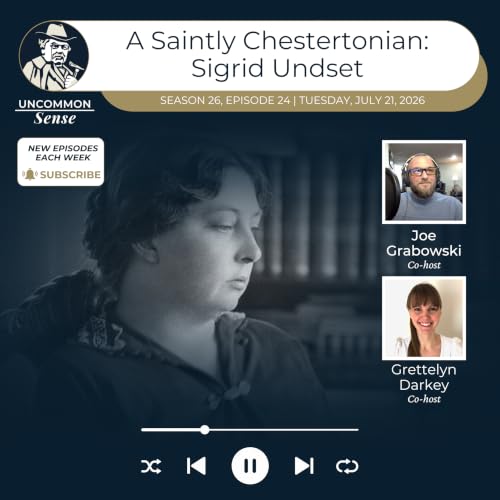
    2026/07/21
    On the heels of the announcement that Sigrid Undset's cause for canonization has been opened, Grettelyn Darkey and Joe Grabowski consider the Nobel laureate through the lens of G.K. Chesterton—the writer she admired, collected, and translated into Norwegian before visiting him at his home in Beaconsfield. Received into the Church just two years after G.K. Chesterton, Undset shared his conviction that sanctity belongs to the ordinary life of the laity, and her vivid portraits of medieval saints carry the same paradoxical spirit that made Chesterton's own work startle and delight. In This Episode: How Sigrid Undset's path into the Church paralleled G.K. Chesterton's—two converts of the same era drawn by the medieval and the BaroqueWhy G.K. Chesterton and Undset both located holiness in the vocation of the laity rather than the cloisterThe debt Undset owed to writers in G.K. Chesterton's orbit—Robert Hugh Benson's Lord of the World and the English Catholic revival Undset's translation of G.K. Chesterton's The Everlasting Man into Norwegian, and her reading of his distributismThe shared Chestertonian paradox in Undset's fiction: making the strange familiar and the familiar strange Resources Mentioned: The Everlasting Man by G.K. Chesterton Gilbert Magazine Kristin Lavransdatter by Sigrid Undset Catherine of Siena by Sigrid Undset Lord of the World by Robert Hugh Benson Chapters: 00:00: Welcome and the news of Sigrid Undset's cause 02:12: Who Sigrid Undset was 06:20: What publishers wanted versus what readers loved 09:58: The Willa Cather parallel 11:51: Belief, doubt, and the interior life of the novel 16:41: Undset's road to conversion and Robert Hugh Benson 23:20: The radical cost of her conversion 24:04: Dorothy Day and saints who don't fit the mold 27:09: Collecting and translating G.K. Chesterton 30:38: When Undset met G.K. Chesterton 33:19: Holiness for the laity 38:15: Why Undset and G.K. Chesterton speak to today FOLLOW US Instagram Facebook X SUPPORT Consider making a donation Visit our Shop Produced by Saint Kolbe Studios
    続きを読む 一部表示
    43 分
  • The Idea That Makes America More Like a Church Than a Nation
    2026/07/14
    This episode is a re-air. For Independence Day, Grettelyn Darkey and Joe Grabowski set conversation aside and let G.K. Chesterton speak. This special gathers a curated series of Chesterton's reflections on America—the idea of the citizen, the creed at the heart of the Declaration of Independence, the nature of true patriotism, the true soldier, and the difference between the right sort of patriot and the wrong sort of politician—woven together with the strains of the nation's great patriotic songs. Drawn largely from What I Saw in America, they reveal a Chesterton who saw the American experiment more clearly than most Americans do. In This Episode: Why G.K. Chesterton called America "the one great state in the world in which many types and races are united by one idea"—the idea of the citizen—and "almost more like a great church than merely a great nation"G.K. Chesterton's case that America is "the only nation in the world that is founded on a creed," one set forth in the Declaration of Independence with "dogmatic and even theological lucidity"What G.K. Chesterton meant by true patriotism, and why he held that "my country, right or wrong" is something "no patriot would think of saying, except in a desperate case"G.K. Chesterton on the true soldier, who "fights not because he hates what is in front of him, but because he loves what is behind him"G.K. Chesterton's account of "Americanization"—the making of "a nation out of exiles"—and why he found the process unlike anything else in the world Resources Mentioned: What I Saw in America by G.K. Chesterton (Special Semiquincentennial Edition) The Society of Gilbert Keith Chesterton Chapters: 00:00: Introduction 00:51: America United by the Idea of the Citizen 01:28: Tradition and the Presence of Penn and Franklin 02:13: Equality, Patriotism, and the Divine Basis of Democracy 03:54: Testing Patriotism Through the Old Songs 04:48: The Only Nation Founded on a Creed 06:24: The True Soldier and the War Ballads 07:35: Americanization—A Nation Made of Exiles 08:51: Fighting the Representatives We Choose 09:38: Liberty and Obedience FOLLOW US Instagram Facebook X SUPPORT Donate Shop Produced by Saint Kolbe Studios
    続きを読む 一部表示
    11 分