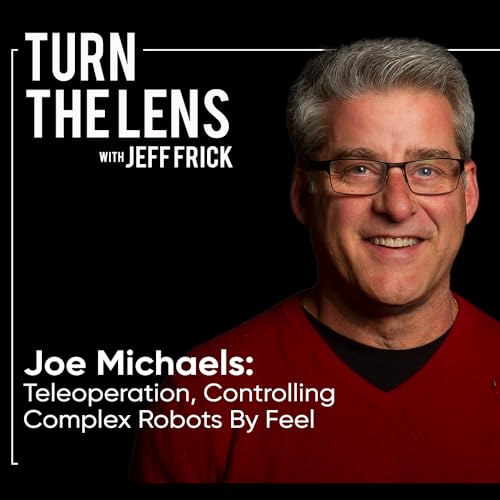
『Turn the Lens with Jeff Frick』のカバーアート

Turn the Lens with Jeff Frick

Turn the Lens with Jeff Frick

著者: Jeff Frick
無料で聴く

概要

Turn the Lens is about exploring the people, topics, and pieces of media that help shape my perspective on the world. The concept behind 'turn the lens' is to look beyond the foreground, beyond the obvious, to see things in a different context, to see things that you might have missed before. Let's get past our own bias and point of view to try and look from a broader point of view, to expand our learning beyond the obvious.© Menlo Creek Media, 2020 All rights reserved. 経済学
エピソード
  • Jeff Burnstein: Robotics Imperative, Standards, National Strategy | Turn the Lens Ep49
    2026/01/30

    Jeff Burnstein, President of the Association for Advancing Automation (A3), reveals why eight countries have national robotics strategies while America doesn't—and what four decades of industrial robot history teaches us about humanoid adoption.

    In this interview from Humanoids Summit SV 2025, Jeff explains the critical role of safety standards in commercialization, why Japan's 1960s strategy created sustained leadership while China dominates today, and how A3 is reframing "robotics" as "embodied AI" to gain traction in Washington D.C.

    Key Topics:

    • Why national robotics strategies drive competitive advantage

    • Safety standards: from 1986 industrial robots to 2025 humanoids

    • Cultural barriers: Hollywood's Terminator vs. Japan's friendly robots

    • Hospital robotics: the under-recognized opportunity beyond manufacturing

    • Historical lessons: hype cycles, dark periods, and realistic timelines

    • Data privacy and AI training data issues for home robots

    About Jeff Burnstein:
    Jeff is President of the Association for Advancing Automation (A3), leading the organization's standards development, industry advocacy, and policy work including the push for a National Robotics Strategy. A3 developed the first American national robot safety standard in 1986, which became the basis for international ISO standards. With four decades in the robotics industry, Jeff witnessed the first industrial robot revolution and brings essential perspective on adoption cycles and commercialization barriers.

    Resources:
    Association for Advancing Automation (A3): https://www.automate.org

    World Robot Conference (Beijing): https://www.worldrobotconference.com

    This interview is co-released by Turn the Lens and Humanoids Summit. Humanoids Summit is organized and hosted by ALM Ventures.

    Recorded at the Humanoids Summit SV 2025, Computer History Museum, Mountain View, California.

    For more on Humanoids Summit, including May 2026 in Tokyo visit https://humanoidssummit.com/

    For more from Humanoids Summit SV https://www.youtube.com/watch?v=iRz7mBlytVs&list=PLJCOPK6OJb1CLbLLXmBCS9sQPTj3kyE-F

    Jeff Burnstein: Robotics Imperative, Standards, National Strategy | Turn the Lens with Jeff Frick Ep49

    Disclaimer and Disclosure

    All products, product names, companies, logos, names, brands, service names, technologies, trademarks, registered trademarks, and registered trademarks (collectively, *identifiers) are the property of their respective owners. All *identifiers used are for identification and illustrative purposes only.

    Use of these *identifiers does not imply endorsement.

    Other trademarks are trade names that may be used in this document to refer to either the entities claiming the marks and/or names of their products and are the property of their respective owners.

    We disclaim proprietary interest in the marks and names of others.

    No representation is made or warranty given as to their content.

    The user assumes all risks of use.

    © Copyright 2026 Menlo Creek Media, LLC, All Rights Reserved

    続きを読む 一部表示
    14 分
  • Ed Colgate: Soft Hands, Dexterous Robots | Turn the Lens Ep48
    2026/01/29

    Ed Colgate, Northwestern University, and Director of the HAND ERC reveals why the secret to dexterous manipulation isn't precision engineering, but something surprisingly simple: softness and large contact areas.

    In this conversation from Humanoids Summit 2025, Ed explains the fundamental difference between human and robot manipulation, how AI finally enables control of complex hands, and why artificial muscles might solve the chronic overheating problem.

    Key Topics: • Why large soft contact areas matter more than finger articulation • How softness enables sensing and control, not just collision safety • The HAND ERC: 5 universities, 33 faculty tackling robotics' hardest problem • AI-enhanced prosthetics bridging the brain-machine interface bandwidth gap • Artificial muscles using thermal, light, and electrical stimulation • The "beautiful negotiation" of dexterity between humans and environment • Why motion smoothness dramatically affects human acceptance of robots

    About Ed Colgate: Ed is a Professor at Northwestern University and Director of the HAND ERC (Human AugmentatioN via Dexterity Engineering Research Center), a major NSF-funded initiative bringing together MIT, Carnegie Mellon, Florida A&M, and Texas A&M. The center focuses on advanced hardware, AI control systems, and human-robot interfaces with a decade-long mission to develop dexterous robots that help people be more productive.

    Recorded at Humanoids Summit 2025, Computer History Museum, Mountain View, California

    Links & Resources: • HAND ERC: [URL] • Northwestern University Robotics: [URL] • Ed Colgate Faculty Page: [URL] • Humanoids Summit: https://humanoidssummit.com • Full show notes: [your website URL/episode] • Video version: https://youtu.be/rO_miJL--n4

    What surprised you most about the role of softness in robotic hands? Share your thoughts on our website or social media.

    About This Series: Part of our comprehensive coverage from Humanoids Summit 2025, featuring 10+ conversations with leaders in embodied AI and robotics.

    More Humanoids Summit Interviews: • Carolina Parada (Google DeepMind) • Pete Florence (Physical Intelligence) • Jeff Burnstein (A3 - Association for Advancing Automation)

    This interview is co-released by Turn the Lens and Humanoids Summit. Humanoids Summit is organized and hosted by ALM Ventures.

    Recorded at the Humanoids Summit SV 2025, Computer History Museum, Mountain View, California.

    Subscribe for more interviews on the future of work, AI adoption, robotics, and organizational change.

    続きを読む 一部表示
    12 分
  • Nic Radford: Declining Labor, Generalizable Skills, Ready Market | Turn the Lens Ep47
    2026/01/26

    Nic Radford, Co-founder and CEO of Persona AI, sits down with Jeff Frick at Humanoids Summit 2025 (presented by ALM Ventures) to unpack a hard truth: robots aren't difficult to build—they're difficult to make useful.

    Radford's career arc reads like a tour of extreme environments: NASA space robotics, deep ocean exploration, and now shipbuilding automation. Each demanded solving communication, distance, and harsh conditions. This time, he's focused squarely on commercial viability from the start.

    His framework for finding the right market is brilliant: look beyond the traditional "3Ds" (dirty, dull, dangerous) to the fourth D—declining labor supply. But not just any shortage. Radford specifically targets industries where workers are well-compensated, the labor pool is shrinking, and companies are open to innovation. That intersection led him to shipbuilding and the skilled trade of welding.

    The technical insight? Focus on generalizable skills, not general-purpose robots. Welding represents tool manipulation within defined rules—a capability that extends to painting, grinding, and other skilled trades requiring precision with tools.

    But the conversation goes beyond technology. Radford addresses the non-technical barriers that can kill adoption: insurance, liability, ethics, and regulatory frameworks. He reveals that Persona's first advisory board hire was an ethics committee chair. Drawing parallels to autonomous vehicles, he explains why insurance companies struggle with accidents "at the hands of a machine," even when overall fatality rates drop dramatically.

    After three robotics ventures, Radford finally has the convergence he needs: capable AI, willing investors, and most importantly, customer partnerships embedded from day one. He's tired, but he couldn't stay away from the opportunity.

    This interview is co-released by Turn the Lens and Humanoids Summit. Humanoids Summit is organized and hosted by ALM Ventures.

    Recorded at the Humanoids Summit SV 2025, Computer History Museum, Mountain View, California.

    Transcript and Extensive Show Notes

    YouTube

    For more on Humanoids Summit, including May 2026 Summit in Tokyo visit
    https://humanoidssummit.com/

    For more from Humanoids Summit SV
    https://www.youtube.com/watch?v=9mbbeOzRPQk&list=PLJCOPK6OJb1CLbLLXmBCS9sQPTj3kyE-F

    続きを読む 一部表示
    19 分
まだレビューはありません