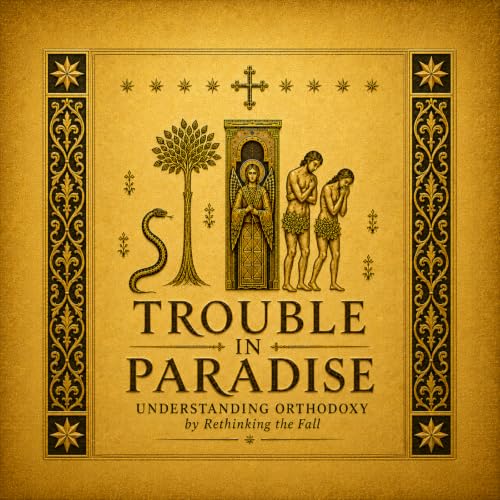
『Trouble in Paradise - Understanding Orthodoxy by Rethinking the Fall』のカバーアート

Trouble in Paradise - Understanding Orthodoxy by Rethinking the Fall

Trouble in Paradise - Understanding Orthodoxy by Rethinking the Fall

著者: Matthew Lyon
無料で聴く

概要

Trouble in Paradise explores why Eastern Orthodoxy often seems confusing to other Christians — and how rethinking Original Sin reshapes the entire Christian story.

Through personal story, historical theology, and spiritual reflection, this podcast walks listeners through the crisis and discovery that can occur when those assumptions are challenged.

For Protestants, Catholics, and Orthodox Christians seeking a deeper understanding of the Christian story.

Matthew Lyon 2026
キリスト教 スピリチュアリティ 哲学 社会科学 聖職・福音主義
エピソード
  • Energy, Synergy, and Union: How Salvation Actually Works — Untangling Yourself from Death and Satan – Part 1
    2026/03/16

    Episode 8 —

    Energy, Synergy, and Union: How Salvation Actually Works

    Untangling Yourself from Death and Satan – Part 1

    This episode explores salvation as liberation and restored union with God, not simply forgiveness. A central question frames the discussion: What would happen if references to Satan and spiritual bondage were removed from the Bible?

    In the Gospels—especially Mark—a large part of Christ’s ministry involves casting out demons. This suggests the problem Christ addresses is not only human sin but also bondage to death, corruption, and spiritual powers.

    Humanity’s Union With Death

    Scripture often describes human existence in terms of union. Humanity is born into union with Adam and therefore inherits mortality and corruption. The word corruption originally referred to physical decay—rust, rot, or spoilage. Over time these terms became moral descriptions.

    Many words associated with moral failure began as descriptions of decay:

    • corruption
    • rotten
    • spoiled
    • depraved

    The biblical pattern often follows this progression:

    death → decay → fear → sin

    Human beings inherit mortality, and fear of death drives self-preservation. When survival is pursued apart from trust in God, sin follows. Hebrews describes humanity as enslaved through the fear of death.

    Fear and Trust

    Jesus addresses this fear in Matthew 10. He tells His disciples not to fear those who can kill the body but to fear God.

    Trust in God becomes the antidote to fear-driven self-preservation.

    Sin as Misplaced Union

    Sin can be understood as misdirected union.

    Union with God produces life and freedom. Union with destructive passions or spiritual forces produces bondage.

    Sin ultimately becomes self-preservation without trust. When trust weakens, union with God weakens. Repentance restores that relationship.

    Baptism and New Union

    In the early Church, preparation for baptism included exorcism prayers, symbolizing a break from the dominion of darkness.

    Baptism represents participation in Christ’s death and resurrection. Believers die with Christ and rise with Him. Through this participation a new union begins—union with Christ instead of union with the death inherited from Adam.

    Chrismation and the Spirit

    After baptism comes Chrismation, where the believer receives the Holy Spirit. The Spirit strengthens the human person and restores freedom of will, enabling cooperation with God’s life.

    Essence, Energies, and Synergy

    The Fathers distinguished between God’s essence and energies. God’s essence is what God is; His energies are how He acts and gives life. Humans cannot share God’s essence but participate in His energies.

    Salvation therefore involves synergy—God acts first and human beings respond.

    The Fathers illustrated this with iron in fire. The iron remains iron but becomes radiant and filled with the fire’s energy.

    The Goal: Theosis

    As St. Athanasius said:

    “God became man so that man might become god.”

    Not by nature, but through participation in the life of God.

    Next Episode

    Next time on Trouble in Paradise, we’ll explore the biblical images that describe this participatory union, including the vine and branches, living water, temple imagery, and marriage imagery.

    These images reveal salvation as organic participation in the life of God.

    続きを読む 一部表示
    19 分
  • Is the Sovereign God Actually Free?
    2026/03/04

    Episode 7 —

    Is the Sovereign God Actually Free?

    Christians regularly affirm three things about God:

    God is sovereign. God is free. God is love.

    But those claims only hold their meaning if we clarify one deeper concept: necessity.

    When something happens necessarily, it means it could not have been otherwise. Not unlikely, not difficult, but impossible to be different. Two plus two equals four necessarily. A dropped stone falls necessarily.

    This episode asks a simple but far-reaching question: Is God’s willing like that?

    To illustrate the issue, imagine two kings.

    The first is King Ironlaw. Everything in his kingdom unfolds inevitably from who he is. No one forces him, and nothing compels him. But if you understood his nature perfectly, you could predict every decree forever. Nothing could have been otherwise. He is sovereign, but the future is inevitable.

    The second is King Artisan. He is just as powerful and wise, but when he surveys his kingdom he sees many genuine possibilities. He could build by the sea or in the mountains. None of these possibilities are inferior or forced. He chooses one simply because he wills it.

    Both kings are sovereign. But only one has real alternative possibility.

    This contrast helps frame a tension inside Western theology. Many traditions strongly emphasize that nothing happens outside God’s decree. Every salvation, every sin, every event falls within divine providence.

    But that raises a question: Could anything have happened differently?

    If the answer is no—not because God freely chose among real alternatives, but because it could never have been otherwise—then reality begins to look inevitable. God still acts from Himself, but the openness we normally associate with freedom disappears.

    The question becomes sharper when applied to election. Both Catholic and Reformed traditions affirm that God shows mercy to the elect while others remain outside salvation. There is a distinction between mercy and judgment.

    But if those outcomes were structurally necessary—if God could not have saved the reprobate or refrained from saving the elect—then what do we mean by grace or mercy?

    The distinction remains, but the openness seems to vanish.

    Interestingly, this conclusion can arise from two different directions.

    One path begins with metaphysics: ideas about divine simplicity and God as Pure Act, where God’s will flows necessarily from His nature.

    The other path begins with anthropology: the doctrine of original sin. If fallen humans cannot seek God and always act according to their nature, then freedom gets redefined as acting according to one’s desires rather than having the ability to do otherwise. Salvation must then come entirely from God’s initiative. From there, the logic of divine decree and providence expands until every event—including the Fall itself—lies within God’s will.

    Different starting points, but the same structural outcome: freedom defined as non-coercion, while alternative possibilities disappear.

    That brings us to the final question of the episode.

    When Christians say that God freely created, freely elected, and freely loves, what exactly does “freely” mean?

    If God could not have done otherwise, then divine action becomes inevitable. And inevitability is not the same thing as freedom.

    At the bottom of reality, does everything ultimately reduce to necessity? Or does explanation finally end with a personal act of will?

    The answer determines whether ultimate reality is best understood as a structure or as a sovereign mind—and that difference shapes how we understand creation, grace, and the nature of divine love.

    続きを読む 一部表示
    18 分
  • Born Afraid: The Engine of Sin
    2026/03/03

    Episode 6 —

    Born Afraid: The Engine of Sin

    What if we’ve misdiagnosed the human problem?

    Many Christian traditions begin with inherited depravity — the idea that we sin because we were born corrupt at the root. But Scripture may emphasize something even more foundational: death and the fear it produces.

    In this episode, we explore whether mortality — not metaphysical corruption — is the deeper engine beneath human sin.

    Core Question

    Do we sin because we are sinners?

    Or are we sinners because we sin?

    And if we sin, is it because we were born evil — or because we were born mortal?

    The Biblical Frame

    Hebrews 2:14–15

    Humanity is described as enslaved “through fear of death.” The bondage is existential and lifelong.

    Genesis 3

    The first recorded response after the fall is fear:

    “I was afraid… and I hid myself.” (Genesis 3:10)

    Death enters. Fear awakens. Hiding begins.

    Romans 5

    Paul emphasizes that:

    • Sin entered the world.
    • Death entered through sin.
    • Death “reigned.”

    The focus is not only corruption — but dominion.

    1 Corinthians 15

    “The last enemy that shall be destroyed is death.” If death is the last enemy, perhaps it is also the deepest one.

    A Provocative Thesis

    What if sin is self-preservation without trust?

    What if sin is self-medicating fear?

    • Lust quiets loneliness.
    • Greed quiets insecurity.
    • Control quiets vulnerability.
    • Religious performance quiets anxiety.

    If death is the atmosphere of fallen humanity, fear becomes instinct — and sin becomes anesthesia.

    Christ’s Reversal

    In Gethsemane:

    “My soul is exceeding sorrowful, even unto death…” (Matthew 26:38)

    On the cross:

    He refused the anesthetic (Matthew 27:34).

    Jesus does not numb fear. He enters death fully conscious — and breaks it from the inside.

    If death is the root problem, resurrection life must be the root solution.

    The Conclusion

    Our predicament does not require inherited depravity as the engine when we have already inherited death.

    If death reigned, then resurrection must reign stronger.

    If fear fueled sin, then the destruction of death removes fear’s leverage.

    If we share in Christ’s life, then fear no longer writes our prescriptions — and sin no longer defines our destiny.

    Scripture References

    • Hebrews 2:14–15
    • Genesis 3:10, 19
    • Romans 3:9
    • Romans 5:12–14
    • 1 Corinthians 15:22, 26, 55
    • Matthew 26:38–39
    • Matthew 27:34
    続きを読む 一部表示
    9 分
まだレビューはありません