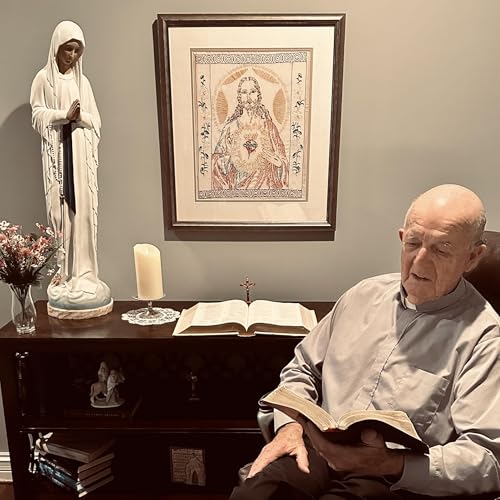
『Treasures of Our Faith with Deacon Richard Vehige』のカバーアート

Treasures of Our Faith with Deacon Richard Vehige

Treasures of Our Faith with Deacon Richard Vehige

著者: Deacon Richard Vehige
無料で聴く

概要

Daily readings from one of the Fathers of the Church, Saints or Catholic official documents.2023 キリスト教 スピリチュアリティ 聖職・福音主義
エピソード
  • Build up your Church and gather all into unity
    2026/02/14
    Today, February 14th, as our Church celebrates the Memorial of Cyril Monk and Methodius, Bishop, we are encouraged to reflect on a passage from the first letter of Saint Peter the apostle (5:1-11), entitled "The duties of pastors and laity". Our treasure, which follows, is from an Old Slavonic Life of Constantine. The first letter of Saint Peter begins with an address by Peter to Christian communities located in five provinces of Asia Minor, including areas evangelized by Paul. Christians there are encouraged to remain faithful to their standards of belief and conduct despite threats of persecution. Numerous allusions in the letter suggest that the churches addressed were largely of Gentile composition, though considerable use is made of the Old Testament. The primary message of the First Letter of St. Peter is a call to hopeful perseverance and holy living amid suffering, grounded in the saving work of Jesus Christ. Writing to Christians facing hostility and marginalization, Peter reminds them that they have been reborn through Christ's Resurrection into a living hope and an imperishable inheritance (1 Pet 1:3–5). Suffering, he teaches, is not a sign of abandonment but a participation in Christ's own sufferings, which purifies faith and leads to glory. Believers are urged to live as a holy people and a royal priesthood, bearing witness through humility, obedience, and love, even toward those who oppose them (1 Pet 2–3). Throughout the letter, Peter anchors Christian endurance in the assurance that God is faithful, Christ is victorious, and future glory far outweighs present trials. The brothers, Saint Cyril and Saint Methodius, called the Apostles of the Slavs, were born in Thessalonica, in 827 and 826 respectively. Though belonging to a senatorial family they renounced secular honors and became priests. They were living in a monastery on the Bosphorous, when the Khazars sent to Constantinople for a Christian teacher. Cyril was selected and was accompanied by his brother. They learned the Khazar language and converted many of the people. Soon after the Khazar mission there was a request from the Moravians for a preacher of the Gospel. German missionaries had already labored among them, but without success. The Moravians wished a teacher who could instruct them and conduct Divine service in the Slavonic tongue. Because of their acquaintance with the language, Cyril and Methodius were chosen for their work. In preparation for it Cyril invented an alphabet and, with the help of Methodius, translated the Gospels and the necessary liturgical books into Slavonic. They went to Moravia in 863 and labored for four and a half years. Despite their success, they were regarded by the Germans with distrust, first because they had come from Constantinople where schism was rife, and again because they held the Church services in the Slavonic language. On this account the brothers were summoned to Rome by Nicholas I, who died, however, before their arrival. His successor, Adrian II, received them kindly. Convinced of their orthodoxy, he commended their missionary activity, sanctioned the Slavonic Liturgy, and ordained Cyril and Methodius bishops. Cyril, however, was not to return to Moravia. He died in Rome, 4 Feb., 869. Saint Methodius went to Constantinople around 870, and with the assistance of several priests, he completed the translation of the Holy Scriptures, with the exception of the Books of Maccabees. He translated also the "Nomo canon", i.e. the Greek ecclesiastical-civil law. The enemies of Methodius did not cease to antagonize him. His health was worn out from the long struggle, and he died 6 April, 885.
    続きを読む 一部表示
    6 分
  • Recognize the dignity of your nature
    2026/02/13

    On Friday of the Fifth Week in Ordinary Time our Church invites us to first read and reflect on a passage from the letter of the apostle Paul to the Galatians (5:1-25) entitled "The freedom of those who live by faith". Our treasure, which follows, is from a sermon by Saint Leo the Great, pope.

    Saint Leo became pope in the year 440. Saint Leo was a Roman aristocrat and was the first pope to have been called "the Great". Saint Leo is known as one of the best administrative popes of the ancient Church. His work branched into many areas of the church, indicative of his notion of the pope's total responsibility for the flock of Christ. In the 96 sermons which have come down to us, we find Leo stressing the virtues of almsgiving, fasting, and prayer, and expounding Catholic doctrine with clarity and conciseness, particularly the dogma of the Incarnation. Leo is perhaps best known for having met Attila the Hun in 452 and having persuaded him to turn back from his invasion of Italy.

    The Galatians to whom the letter is addressed were Paul's converts, most likely among the descendants of Celts who had invaded western and central Asia Minor in the third century B.C. and had settled in the territory around Ancyra (modern Ankara, Turkey). Paul had passed through this area on his second missionary journey and again on his third. It is less likely that the recipients of this letter were Paul's churches in the southern regions of Pisidia, Lycaonia, and Pamphylia where he had preached earlier in the Hellenized cities of Perge, Iconium, Pisidian Antioch, Lystra, and Derbe; this area was part of the Roman province of Galatia, and some scholars think that South Galatia was the destination of this letter.

    St. Paul's Letter to the Galatians teaches that justification comes through faith in Jesus Christ, not through works of the Mosaic Law, and that to return to the Law as a means of salvation is to fall back into spiritual slavery. Paul insists that the Gospel he preached is of divine origin and defends the freedom of Gentile believers against those who required circumcision and legal observance. He presents Christ's death and resurrection as the decisive act that frees humanity from sin, the Law's curse, and the powers of the flesh. True Christian freedom, Paul explains, is not license but life in the Spirit, where believers are transformed inwardly and enabled to fulfill the Law through love, producing the fruits of the Spirit as the visible sign of life in Christ.

    続きを読む 一部表示
    5 分
  • Let Christ be formed in you
    2026/02/12

    On Thursday of the Fifth Week in Ordinary Time our Church invites us to read and reflect on a passage from the letter of the apostle Paul to the Galatians (4:8-31) entitled "Our divine inheritance and the Freedom of the new covenant". Our treasure, which follows, is from an explanation of Paul's letter to the Galatians by Saint Augustine, bishop.

    Saint Augustine was born at Tagaste in Africa in 354. He was unsettled and restlessly searched for the truth until he was converted to the faith in Milan and baptized by Ambrose. Returning to his homeland, he embraced an ascetic life and subsequently was elected bishop of Hippo. For thirty-four years he guided his flock, instructing it with sermons and many writings. He fought bravely against the errors of his time and explained the Faith carefully and cogently through his writings. He is also a preeminent Catholic Doctor of the Church. His writings influenced the development of western philosophy and western Christianity, and he is viewed as one of the most important Church Fathers of the Latin Church in the Patristic Period. He died in 430.

    The Galatians to whom the letter is addressed were Paul's converts, most likely among the descendants of Celts who had invaded western and central Asia Minor in the third century B.C. and had settled in the territory around Ancyra (modern Ankara, Turkey). Paul had passed through this area on his second missionary journey and again on his third. It is less likely that the recipients of this letter were Paul's churches in the southern regions of Pisidia, Lycaonia, and Pamphylia where he had preached earlier in the Hellenized cities of Perge, Iconium, Pisidian Antioch, Lystra, and Derbe; this area was part of the Roman province of Galatia, and some scholars think that South Galatia was the destination of this letter.

    続きを読む 一部表示
    6 分
まだレビューはありません