エピソード

  • What Trump Got Right
    2026/05/05
    Episode 004 — What Trump Got RightShow NotesThe EpisodeFor thirty years, the bipartisan economic establishment promised America a deal: send the factories overseas, and something better will come back. The workers would upskill. The towns would reinvent themselves. The invisible hand would sort it out.The invisible hand sorted out 6.7 million manufacturing jobs. The towns got opioid distributors. The workers got a pamphlet about retraining. And the people who designed the policy got consulting retainers, board seats, and speaking fees.This episode names the names.We trace the deliberate, documented, decades-long dismantling of American manufacturing — from Nixon and Kissinger's 1972 opening of China, through George H.W. Bush's quiet rehabilitation of Beijing after Tiananmen, to Bill Clinton's decision to make China's WTO accession his top second-term priority while calling it "a hundred-to-nothing deal for America." We look at Hillary Clinton's six years on the Walmart board while Walmart was secretly sourcing from China through a shell company — during their own "Buy American" ad campaign. We look at Jack Welch, who turned offshoring into a corporate religion and got called Manager of the Century for it.And we make the uncomfortable case that on this one issue — manufacturing, market access, and what America traded away — Donald Trump was pointing at a real thing.What We CoverComparative advantage — why David Ricardo's 200-year-old theory sounds elegant on a whiteboard and falls apart when it touches actual human beings in actual townsThe China trade opening — from Nixon's 1972 visit through the systematic bipartisan accommodation of Beijing across five presidenciesHenry Kissinger — architect of the China opening, founder of Kissinger Associates (1982), operator of China Ventures, and the most conflict-of-interest-adjacent "disinterested statesman" in American historyGeorge H.W. Bush and Tiananmen — the secret Scowcroft/Eagleburger mission to Beijing six weeks after the massacre, the two vetoes of congressional human rights conditions, and the back-channel message that Tiananmen was "an internal affair"Bill Clinton's reversal — from "butchers of Beijing" in 1992 to signing Permanent Normal Trade Relations in 2000, and calling it "the equivalent of a one-way street" in America's favorHillary Clinton and Walmart — six years on the board (1986–1992) while Walmart was building its China-sourcing strategy through a shell company called Pacific Resources Export LimitedJack Welch — "Neutron Jack," GE's U.S. workforce from 277,000 to 70,000, and the management doctrine that made offshoring a corporate virtueThe China Shock — what the academic literature actually found about what happened to workers and communities, versus what the models predictedDeaths of despair — Case and Deaton's 2015 findings on rising mortality among middle-aged Americans without college degrees, concentrated in deindustrialized communitiesTechnology transfer — why it's irreversible, how China structured it deliberately, and what America traded away that it cannot get backTariffs vs. strategy — what Trump got right, what he got wrong, and what an actual industrial policy would need to look likeThe People NamedName Role in the Story | Henry Kissinger | Architect of the 1972 China opening; founder of Kissinger Associates; operator of China Ventures investment fund | Richard Nixon | Opened diplomatic relations with China, 1972 | George H.W. Bush | Renewed China's MFN status after Tiananmen; vetoed human rights conditions twice (1991, 1992); sent secret delegation to Beijing six weeks after the massacre | Brent Scowcroft | National Security Advisor; led secret post-Tiananmen mission to Beijing, July 1989 | Bill Clinton | Reversed MFN human rights conditions (1994); signed PNTR October 10, 2000; called the deal "a hundred-to-nothing win for America" | Hillary Clinton | Walmart Board of Directors, November 1986 – May 1992; first woman on the board | Sam Walton / Walmart | Built China-sourcing operation through shell company PREL while running "Buy American" campaign | Jack Welch | GE CEO 1981–2001; pioneered mass offshoring and outsourcing; "Neutron Jack"; Fortune "Manager of the Century" | Newt Gingrich | Vocal Republican champion of China trade throughout the 1990s | Bill Archer (R-TX) | Lead House sponsor of the PNTR billThe ResearchThe China Shock The foundational academic work on what actually happened to American workers and communities when China entered the WTO. Economists David Autor (MIT), David Dorn (University of Zurich), and Gordon Hanson (Harvard) found that labor-market adjustment was "remarkably slow" — wages and employment remained depressed for over a decade in affected regions, and the promised offsetting job gains in other industries did not materialize.Autor, D., Dorn, D., & Hanson, G. (2013). "The China Syndrome: Local Labor Market Effects of Import Competition ...
    続きを読む 一部表示
    30 分
  • The Empire That Keeps on Giving (Problems)
    2026/04/30

    The Empire That Keeps on Giving (Problems)

    King Charles III is in Washington this week for a state visit, which feels like the universe handing us a gift. So we took it.

    This episode is a guided tour through the parts of British imperial history that don't make it into the brochure — the borders drawn by people who'd never visited the places they were dividing, the democratic governments removed for being inconveniently democratic, and the famines that happened while exports continued. Not a conspiracy. Not a screed. Just the paper trail, followed to its logical conclusion.

    Spoiler: the paper trail is long. And it leads somewhere uncomfortable.

    In this episode:

    • Why the "Special Relationship" is built on more than shared values — and what else it's built on
    • The Sykes-Picot Agreement (1916) — how two men with a map redesigned the Middle East without asking anyone who lived there
    • Mohammad Mossadegh, the 1953 Iranian coup, and the operation the British side literally named "Boot"
    • How the Anglo-Persian Oil Company became Anglo-Iranian Oil Company became British Petroleum became BP — and why the rebranding timeline is instructive
    • India, the "crown jewel," the Bengal Famine of 1943, and the railways everyone keeps bringing up
    • Why 1979 is a direct consequence of 1953, and why 2026 is a direct consequence of 1979
    • The difference between history being over and history being deferred

    Key people and things mentioned:

    • King Charles III — currently visiting the US, very good posture
    • Mohammad Mossadegh — democratically elected Prime Minister of Iran, 1951; removed in a coup, 1953; under house arrest until his death
    • Mark Sykes & François Georges-Picot — the two diplomats who divided the Middle East in 1916 and then went home
    • The Sykes-Picot Agreement (1916) — the line-drawing exercise that continues to have opinions
    • Operation AJAX / Operation BOOT (1953) — the CIA and MI6 joint operation to remove Mossadegh; named "Boot" by the British, which tells you everything
    • The Anglo-Persian Oil Company — founded 1908, later Anglo-Iranian Oil Company, later British Petroleum, later BP
    • The Bengal Famine (1943) — an estimated 2–3 million deaths during British rule; exports continued
    • Churchill's wartime food policies — his documented attitudes toward India and the famine are part of the historical record
    • Utsa Patnaik — economist at Jawaharlal Nehru University whose research quantifies wealth extraction from India under British rule
    • The partition of India and Pakistan (1947) — another set of hastily drawn borders, another set of consequences still being lived with
    • The Iranian Revolution (1979) — the moment the deferred consequences of 1953 showed up, on schedule

    Want to go deeper:

    • Inglorious Empire by Shashi Tharoor — a clear-eyed accounting of British rule in India
    • All the Shah's Men by Stephen Kinzer — the definitive account of the 1953 Iranian coup
    • A Line in the Sand by James Barr — on Sykes-Picot and the carving up of the Middle East
    • Utsa Patnaik's research on colonial wealth extraction from India, published in Agrarian and Other Histories (2018)
    • The declassified CIA documents on Operation AJAX — available via the National Security Archive

    From the episode:

    "History doesn't disappear. It compounds. And if you want to understand the interest payments, you need to go back and look at the original loan."

    New episodes every Tuesday and Thursday.

    Find us on Apple Podcasts, Spotify, YouTube, Overcast, and RSS.

    All claims cited. Dispute openly.

    TINFOILHATSMATTER.COM

    続きを読む 一部表示
    21 分
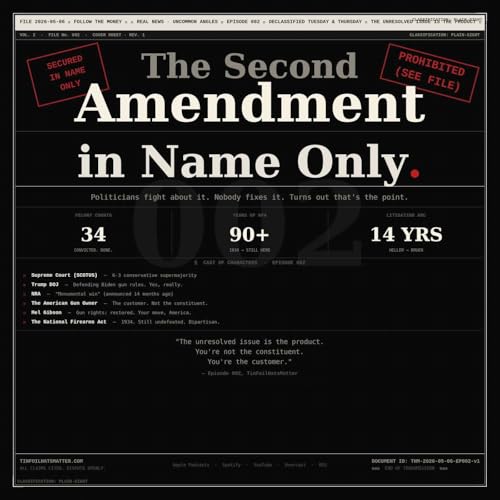
  • The Second Amendment in Name Only
    2026/04/28
    TinFoilHatsMatter — Episode 002The Second Amendment in Name OnlyFile No.: 002 Declassified: Tuesday Running Time: TBD Classification: Plain-SightThe Second Amendment is a real, individual, constitutionally protected right. The Supreme Court has said so — repeatedly, emphatically, and with increasingly aggressive language. So why, after seventeen years of landmark rulings, does it still feel like you're one election cycle away from losing it?Because a settled question generates nothing. A right under permanent siege generates billions of dollars, millions of votes, and decades of career security for people who have every incentive to keep the fight going and no incentive whatsoever to finish it.This episode, we read the receipts.What's in the FileWe trace the modern Second Amendment from Heller (2008) through the Supreme Court's 2025 term — not as a political debate, but as a paper trail. What did the Court actually hold? What did the administration actually do? And why is the most popular rifle in America still in legal limbo while the Court "circles back"?Along the way, we note — with genuine journalistic restraint — that the President of the United States signed an executive order protecting your Second Amendment rights while being legally prohibited, under federal law, from owning a firearm. His own Justice Department is currently defending that law before the Supreme Court.We also note that Mel Gibson can own guns again. America contains multitudes.The Dossier — Key Cases CoveredDistrict of Columbia v. Heller (2008) — The Court settles it: individual right. Not a militia right. An individual right. Scalia writes that certain policy choices are off the table. Politicians immediately treat this as a suggestion.McDonald v. City of Chicago (2010) — The right applies to states too. Great. States begin drafting workarounds.New York State Rifle & Pistol Association v. Bruen (2022) — No more interest-balancing. Gun regulations must be consistent with historical tradition from the founding era. States respond by arguing everything is a "sensitive place."United States v. Rahimi (2024) — 8-1: people under domestic violence restraining orders can be temporarily disarmed. Even under the new historical test, this wasn't close.Garland v. Cargill (2024) — The ATF's bump stock ban, issued by the Trump administration after Las Vegas, was unlawful. A bump stock does not convert a rifle into a machinegun under federal statute. The Court throws it out. The same administration that banned them campaigned as your last line of defense. Institutionalism is a heck of a drug.Bondi v. VanDerStok (2025) — Ghost guns. 7-2, with Justice Gorsuch writing the majority, joined by Kavanaugh and Barrett. The Biden ATF's rule treating ghost gun parts kits as firearms is upheld. The Trump DOJ defended it. Thomas and Alito dissented. If you're keeping score: the biggest gun regulation victory of 2025 was written by a Republican-appointed justice, joined by two Trump appointees, defended by the Trump administration.AR-15 / Cert Denial (June 2025) — The Court declines to take up Maryland's assault weapons ban. Thomas, Alito, and Gorsuch would have taken it. Kavanaugh writes separately that the Fourth Circuit is probably wrong, and the Court "should and presumably will" address the issue "in the next term or two." Residents of Maryland, California, and Illinois are living under laws three sitting justices already think are unconstitutional. The Court will circle back. Eventually. Slowly.The Structural Problem Nobody Talks AboutRegulations move fast. An agency memo can ban an accessory, rewrite a definition, or issue enforcement guidance that results in a near six-fold increase in dealer license revocations — and it's done before anyone files a brief.Restoring rights moves through federal court. Motion to dismiss. Discovery. Ruling. Appeal. Cert petition. Supreme Court. Mandate. Stay litigation. We are talking years. Sometimes a decade. Heller to Bruen is a fourteen-year arc of litigation to establish rights that, per the Court, were in the Constitution the whole time.During those fourteen years, the challenged laws stayed on the books. People lived under them. People were prosecuted under them. And politicians sent fundraising emails about fighting for you.Friction favors the status quo. The status quo is more regulation, not less. That's not a conspiracy. That's just physics.The Part That Should Bother You Regardless of Where You StandRepublican unified control, 2017–2019: no NFA repeal, no national reciprocity signed into law, bump stocks banned administratively.Trump's second term: a sweeping executive order, some ATF policy tweaks, a proposed rule to restore gun rights to some non-violent offenders — and the DOJ defending a Biden-era ghost gun regulation before the Supreme Court while gun rights groups publicly say the record has been "very mixed."Ask them for the bill number. Ask what they did with ...
    続きを読む 一部表示
    18 分
  • The Iran War - America's Greatest Product Demo
    2026/04/23

    America's relationship with Iran didn't start with a missile strike — it started with a CIA coup in 1953. Operation Ajax overthrew Iran's democratically elected Prime Minister Mohammad Mosaddegh, who had the audacity to suggest Iranian oil should belong to Iran. We installed the Shah, funded his brutal secret police, and acted surprised when 26 years of repression exploded into the 1979 Islamic Revolution.

    The hostage crisis followed. 66 Americans held for 444 days. A botched rescue mission. Jimmy Carter's presidency, effectively over. The hostages were released the exact minute Ronald Reagan was inaugurated — timing that historians have been arguing about ever since.

    For the next 45 years, every American president had Iran on their desk and none of them pulled the trigger on full military action. That streak ended when Trump launched Operation Midnight Hammer in June 2025 — B-2 bombers, bunker-busters, three nuclear sites destroyed. Then on February 28, 2026, the US and Israel struck again, this time killing Supreme Leader Khamenei himself.

    Iran's response: close the Strait of Hormuz. Twenty percent of the world's oil supply, gone. Brent crude hit $126 a barrel. The IEA called it the greatest energy security crisis in history. South Korea — which gets 70% of its crude through the Strait — is down to 26 days of reserves. Four of its airlines are in emergency mode. Its stock market had its worst single session in 43 years.

    Meanwhile, RTX stock is up 67% in a year. Lockheed is up 40%. Defense CEOs met with Trump at the White House within a week of the strikes.

    The bill goes to you. It always has. Welcome to the product demo.

    続きを読む 一部表示
    20 分