

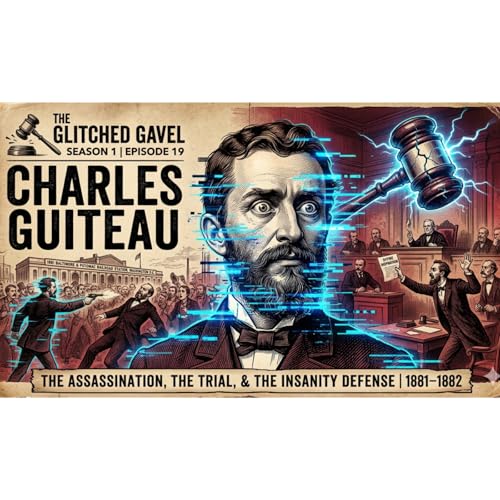
The trial of Charles Guiteau (1881)
カートのアイテムが多すぎます
ご購入は五十タイトルがカートに入っている場合のみです。
カートに追加できませんでした。
しばらく経ってから再度お試しください。
ウィッシュリストに追加できませんでした。
しばらく経ってから再度お試しください。
ほしい物リストの削除に失敗しました。
しばらく経ってから再度お試しください。
ポッドキャストのフォローに失敗しました
ポッドキャストのフォロー解除に失敗しました

The trial of Charles Guiteau (1881)
-
ナレーター:
-
著者:
Trial of Charles Guiteau (1881–1882)
In this episode of The Glitched Gavel, we explore the chaotic and controversial trial of Charles Guiteau, the man who assassinated President James A. Garfield, and how his case forced the American legal system to grapple with the blurred lines between political fanaticism and clinical insanity.
- The Divine Delusion: After being rejected for a federal appointment he believed he was owed, Charles Guiteau—a failed lawyer, preacher, and former member of a religious commune—convinced himself that God had commanded him to "remove" the President to heal the fractured Republican Party. On July 2, 1881, he shot Garfield at a Washington train station, famously shouting, "I am a Stalwart of the Stalwarts!"
- The Insanity Defense on Trial: The trial was one of the first high-profile cases in the U.S. to center almost entirely on the insanity defense. Guiteau’s defense team argued he was legally insane, while Guiteau himself frequently interrupted the proceedings with bizarre outbursts, poems, and insults, claiming he was not medically insane but that God had simply "suspended his free will."
- The "Glitch" in the Gavel: The "glitch" in this episode highlights the rigidity of the M'Naghten Rule—the legal standard used at the time. Judge Walter Cox instructed the jury that Guiteau could only be acquitted if he literally did not understand that his actions were wrong. Because Guiteau had meticulously planned the shooting and sought protection afterward, the law viewed him as a sane criminal, even though his behavior throughout the trial suggested a profound mental collapse (later suspected to be neurosyphilis).
- The Verdict: Despite the obvious signs of mental illness, the jury took only one hour to find Guiteau guilty. He was hanged on June 30, 1882, dancing his way to the gallows and reciting a poem he had written for the occasion.
The episode concludes by examining how the Guiteau trial led to a massive public distrust of the insanity defense and indirectly triggered the end of the "spoils system" in American politics, proving that even a "glitched" trial can result in systemic reform.
adbl_web_anon_alc_button_suppression_t1
まだレビューはありません