エピソード

  • Why Sustainable Fintech Requires Real Infrastructure
    2026/03/06

    In this episode of The Value Creation Mindset, host A.J. Singh, CEO of Modularis, sits down with Sulav Singh, founder of Vittas International, to explore why sustainable fintech requires real financial infrastructure, especially in emerging markets.

    Sulav shares the story of how Vittas began by lending to healthcare businesses in Nigeria and how customer conversations revealed a deeper problem. Small and medium-sized businesses were not just struggling to access capital. They lacked the financial tools, data visibility, and banking infrastructure needed to make better financial decisions and become truly bankable.

    That insight led to a major strategic shift. Instead of remaining a niche lending company, Vittas began building a financial infrastructure platform that connects banks, payment systems, and small businesses, creating an orchestration layer that helps companies access financial services more effectively.

    The conversation dives into the realities of building fintech startups in emerging markets, where unreliable infrastructure, regulatory complexity, and fragmented banking systems create challenges very different from those faced by startups in the United States or Europe.

    Sulav also discusses how Vittas approaches product development, why small engineering teams can outperform larger organisations, and how startups can design products that solve real customer problems rather than chasing hype or trends.

    The discussion also explores the role of AI in fintech and software development, including how automation can help startups move faster while still maintaining the stability and trust required when building systems that handle financial transactions.

    Throughout the conversation, Sulav explains why trust, reliability, and infrastructure are the foundations of sustainable fintech businesses and why companies that focus on solving the underlying systems problems will create the most long-term value.

    This episode is ideal for founders, fintech leaders, startup operators, engineers, and investors interested in financial technology, emerging markets, and building scalable technology platforms that create real economic impact.

    In this episode, you will learn:

    Why access to financial infrastructure matters more than access to capital

    • The real challenges of building fintech products in emerging markets
    • How startups can pivot when customer insights reveal a larger opportunity
    • Why small engineering teams can move faster than large organisations
    • The importance of stability and trust when building financial platforms
    • How AI is being used in modern fintech product development
    • What it takes to build sustainable fintech infrastructure that scales globally

    About the guest

    Sulav Singh is the founder of Vittas, a fintech company focused on building financial infrastructure for emerging markets. Vittas works with small and medium-sized businesses, banks, and payment platforms to improve financial access, data visibility, and decision-making through modern financial technology systems.

    About the podcast

    The Value Creation Mindset explores the principles and decisions that successful business leaders use to create real value for their customers and their organisations. Each episode examines the strategic choices, trade-offs, and lessons behind building sustainable companies in technology, finance, and global markets.

    Follow us on:
    Facebook - https://www.facebook.com/modularisinc/
    LinkedIn - https://linkedin.com/company/modularis
    YouTube - https://www.youtube.com/@modularis42

    続きを読む 一部表示
    59 分
  • Why Sustainable Businesses Start With Integrity
    2026/02/06

    Why Sustainable Businesses Start With Integrity | Rakesh Tiku | The Value Creation Mindset

    In this episode of The Value Creation Mindset, host A.J. Singh is joined by Rakesh Tiku, President and CEO of Infield Solutions, for a deep conversation on why sustainable businesses start with integrity, ethical leadership, and long-term thinking.

    Rakesh shares his journey from an academic upbringing to becoming a serial entrepreneur focused on solving real problems through technology, IoT platforms, and workflow automation. The discussion explores decision-making with incomplete information, forgiveness in leadership, fairness in negotiations, and why people are the only asset that truly increases in value over time.

    If you are a founder, CEO, CTO, or business leader building for the long term, this episode offers practical insight into values-driven leadership, creating real customer value, and building teams that thrive on trust.

    00:00 Why integrity matters
    01:00 Rakesh’s origin story
    04:30 Solving real problems
    06:00 Happiness as a choice
    07:40 Forgiving yourself
    10:00 Letting go of baggage
    12:10 Ethics and fairness
    15:00 Sustainable profit
    17:10 Trust and leadership
    20:00 Redefining success
    24:00 Building trust at scale
    27:00 Leadership styles
    30:00 Strategy and focus
    33:00 Working on the business
    36:00 People as the core asset
    39:00 Loyalty and culture
    43:00 Global productivity
    47:00 Quality over hours
    50:00 Identity and culture
    53:00 Being on the right path
    55:40 Defining legacy
    58:30 Purpose and joy
    01:01:00 Final reflections

    続きを読む 一部表示
    1 時間 3 分
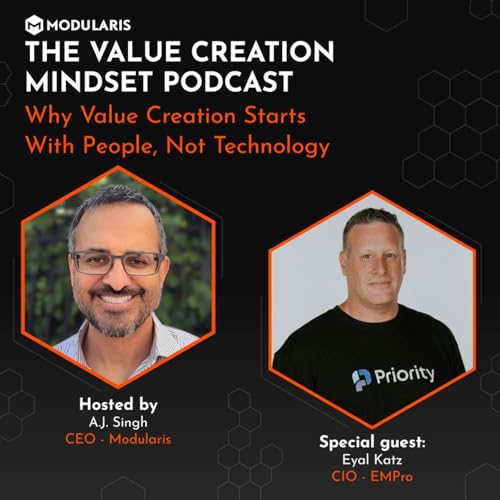
  • Why Value Creation Starts With People, Not Technology
    2026/01/09

    In this episode of The Value Creation Mindset, host A.J. Singh speaks with Eyal Katz, CIO of Priority Software and a serial product builder with decades of experience in commercial software and platforms.

    Eyal shares a practical, experience-led perspective on building real products versus one-off projects, scaling teams, and creating value in an increasingly AI-driven world. The conversation explores why probabilistic AI systems are risky in enterprise environments, how human-in-the-loop and deterministic design unlock trust, and why simplicity, persistence, and first principles still matter more than speed alone.

    This episode is essential listening for founders, CEOs, CTOs, product leaders, and engineers who want to understand how to use AI responsibly, build scalable products, and create lasting value without sacrificing discipline or judgment.

    Episode Highlights and Timestamps

    • 00:01:16 – The electricity of building software
      Why the ability to turn ideas into working products is addictive for builders.
    • 00:02:34 – Always saying yes and learning the hard way
      Early career lessons on responsibility, growth, and paying your dues.
    • 00:05:22 – Software engineers are still building products
      Why thinking like a manufacturing engineer leads to better software.
    • 00:07:10 – Hiring engineers who can solve real problems
      Why interviews rarely tell the full story and how great teams are built.
    • 00:12:21 – Agile versus waterfall misses the point
      Why extremes fail, and structure still matters.
    • 00:19:35 – Why probabilistic AI is dangerous in enterprise systems
      Trust, accuracy, and the risks of relying on 90% answers.
    • 00:21:10 – Human-in-the-loop and deterministic AI design
      How to combine AI speed with reliability and control.
    • 00:26:27 – AI as a force multiplier, not a replacement
      Why AI increases job security when used correctly.
    • 00:35:15 – Never give up
      Persistence is the real secret behind long-term success.
    • 01:18:10 – Time to value is now dramatically faster
      How experienced builders can create and deliver value at unprecedented speed.
    続きを読む 一部表示
    1 時間 22 分
  • Why Great Technology Still Fails Without the Right Decisions
    2026/01/09

    In this episode of The Value Creation Mindset, host A.J. Singh sits down with Pieter van Schalkwyk, CEO of XMPro, to explore how real value is created in complex, technology-driven businesses.

    With a background spanning mechanical engineering, industrial IoT, and enterprise software, Pieter shares hard-earned lessons on leadership, first principles, and decision-making under real-world constraints. The conversation dives into why many software and AI initiatives fail, how poor strategic focus can destroy millions in value, and why staying rational matters more than ever in an era of hype-driven innovation.

    This episode is essential listening for CEOs, CTOs, product leaders, and engineers who want practical insight into building scalable, profitable, and durable technology products while avoiding the costly mistakes that derail growth.

    Episode Highlights and Timestamps

    • 00:05:16 – First principles and staying rational
      How Pieter’s engineering background shaped his approach to leadership and decision-making.
    • 00:07:30 – Why design must come before code
      The dangers of jumping from the whiteboard straight to the keyboard.
    • 00:09:17 – Building software close to the physical world
      How real-world consequences force better discipline in engineering teams.
    • 00:14:16 – The cost of avoiding hard truths
      A candid story about uncovering millions in wasted investment and what happened next.
    • 00:21:05 – The four buckets every decision must fit into
      Revenue retention, new revenue, lifetime value, and cost reduction as a universal framework.
    • 00:26:00 – What makes software a real product
      Why stability, scalability, profitability, and serviceability all matter.
    • 00:29:28 – AI without structure creates noise, not value
      Why most of the work in AI happens outside the model itself.
    • 00:47:40 – Human judgment in AI-driven systems
      Why automation should reduce noise, not replace decision-makers.
    • 01:03:33 – Legacy, leadership, and lifting others
      A closing reflection on purpose and long-term value creation.
    続きを読む 一部表示
    1 時間 9 分