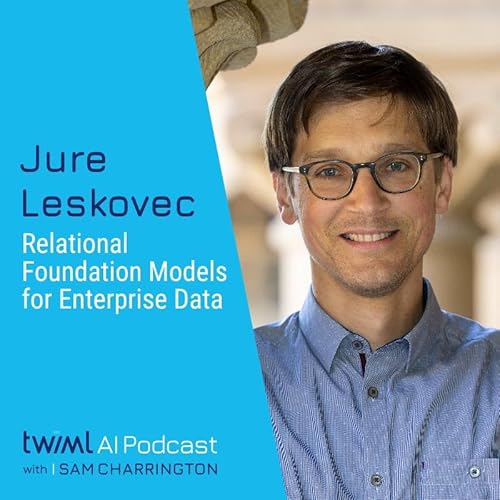
『The TWIML AI Podcast (formerly This Week in Machine Learning & Artificial Intelligence)』のカバーアート

The TWIML AI Podcast (formerly This Week in Machine Learning & Artificial Intelligence)

The TWIML AI Podcast (formerly This Week in Machine Learning & Artificial Intelligence)

著者: Sam Charrington
無料で聴く

Machine learning and artificial intelligence are dramatically changing the way businesses operate and people live. The TWIML AI Podcast brings the top minds and ideas from the world of ML and AI to a broad and influential community of ML/AI researchers, data scientists, engineers and tech-savvy business and IT leaders. Hosted by Sam Charrington, a sought after industry analyst, speaker, commentator and thought leader. Technologies covered include machine learning, artificial intelligence, deep learning, natural language processing, neural networks, analytics, computer science, data science and more.All rights reserved 政治・政府 科学
エピソード
  • Relational Foundation Models for Enterprise Data with Jure Leskovec - #768
    2026/05/21
    In this episode, Jure Leskovec, co-founder and chief scientist at Kumo and professor of computer science at Stanford, joins us to explore two fronts of his work: AI for science and relational deep learning. We begin with AI Virtual Cell, a multiscale effort to learn data-driven representations from proteins to cells to patients using single-cell RNA-seq data, protein language models like ESM, and structure models like AlphaFold—without hand-encoding biology. Jure then dives into relational deep learning, reframing enterprise databases as graphs and training neural networks directly on raw multi-table data. He explains Kumo’s Relational Foundation Model (RFM2), which performs in-context learning over subgraphs to make accurate predictions on new databases and tasks with no training, and how this approach benchmarks against RelBench and other multi-table datasets. We also discuss real-world deployments at companies like Reddit, DoorDash, and Coinbase, explainability via attention over tables and columns, integration with agentic systems, deployment options, and practical limitations. The complete show notes for this episode can be found at https://twimlai.com/go/768.
    続きを読む 一部表示
    1 時間 6 分
  • How to Find the Agent Failures Your Evals Miss with Scott Clark - #767
    2026/05/07
    In this episode, Scott Clark, co-founder and CEO of Distributional, joins us to explore how teams can reliably operate and improve complex LLM systems and agents in production. Scott introduces a Maslow’s hierarchy of observability: telemetry for logging, monitoring for known signals, and post-production or online analytics to surface unknown unknowns. We dig into examples of real-world failures Scott’s team has seen in production systems, such as “lazy” tool-use hallucinations that standard evals miss, and how mapping traces into vector fingerprints enables clustering and topic discovery to uncover emergent behaviors. Scott explains how analytics can feed the data flywheel by generating evals, guardrails, and training data, and why online, adaptive approaches are essential for non-stationary models. We also touch on practical how-to’s such as instrumentation with OpenTelemetry, the GenAI semantic conventions, and the role of dedicated analytics tools. The complete show notes for this episode can be found at https://twimlai.com/go/767.
    続きを読む 一部表示
    53 分
  • How to Engineer AI Inference Systems with Philip Kiely - #766
    2026/04/30
    In this episode, Philip Kiely, head of AI education at Baseten, joins us to unpack the fast-evolving discipline of inference engineering. We explore why inference has become the stickiest and most critical workload in AI, how it blends GPU programming, applied research, and large-scale distributed systems, and where the line sits between inference and model serving. Philip shares how research-to-production can move in hours, not months, and why understanding “the knobs” of inference—batching, quantization, speculation, and KV cache reuse—lets teams design better products and SLAs. We trace the inference maturity journey from closed APIs to dedicated deployments and in-house platforms, discuss GPU lifecycles, and survey today’s runtime landscape, including vLLM, SGLang, and TensorRT LLM. Finally, we look ahead to agents and multimodality, making the case for specialized, workload-specific runtimes when performance and efficiency matter most. The complete show notes for this episode can be found at https://twimlai.com/go/766.
    続きを読む 一部表示
    55 分
adbl_web_anon_alc_button_suppression_c
まだレビューはありません