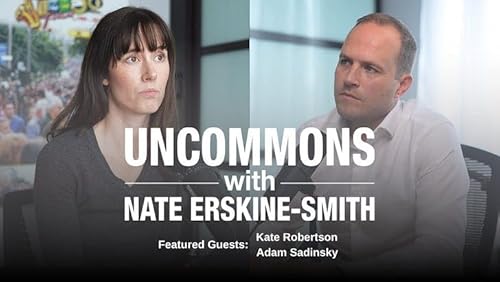
『The Strong Borders Act? with Kate Robertson and Adam Sadinsky』のカバーアート

The Strong Borders Act? with Kate Robertson and Adam Sadinsky

The Strong Borders Act? with Kate Robertson and Adam Sadinsky

無料で聴く

ポッドキャストの詳細を見る

このコンテンツについて

** There are less than 10 tickets remaining for the live recording of Uncommons with Catherine McKenna on Thursday Oct 2nd. Register for free here. **On this two-part episode of Uncommons, Nate digs into Bill C-2 and potential impacts on privacy, data surveillance and sharing with US authorities, and asylum claims and refugee protections.In the first half, Nate is joined by Kate Robertson, senior researcher at the University of Toronto’s Citizen Lab. Kate’s career has spanned criminal prosecutions, regulatory investigations, and international human rights work with the United Nations in Cambodia. She has advocated at every level of court in Canada, clerked at the Supreme Court, and has provided pro bono services through organizations like Human Rights Watch Canada. Her current research at Citizen Lab examines the intersection of technology, privacy, and the law.In part two, Nate is joined by Adam Sadinsky, a Toronto-based immigration and refugee lawyer and co-chair of the Canadian Association of Refugee Lawyers’ Advocacy Committee. Adam has represented clients at every level of court in Canada, including the Supreme Court, and was co-counsel in M.A.A. v. D.E.M.E. (2020 ONCA 486) and Canadian Council for Refugees v. Canada (2023 SCC 17).Further Reading:Unspoken Implications A Preliminary Analysis of Bill C-2 and Canada’s Potential Data-Sharing Obligations Towards the United States and Other Countries - Kate Robertson, Citizen LabKate Robertson Chapters:00:00 Introduction & Citizen Lab03:00 Bill C-2 and the Strong Borders Act08:00 Data Sharing and Human Rights Concerns15:00 The Cloud Act & International Agreements22:00 Real-World Examples & Privacy Risks28:00 Parliamentary Process & Fixing the BillAdam Sadinsky Chapters:33:33 Concerns Over Asylum Eligibility in Canada36:30 Government Goals and Fairness for Refugee Claimants39:00 Changing Country Conditions and New Risks41:30 The Niagara Falls Example & Other Unfair Exclusions44:00 Frivolous vs. Legitimate Claims in the Refugee System47:00 Clearing the Backlog with Fair Pathways50:00 Broad Powers Granted to the Government52:00 Privacy Concerns and Closing ReflectionsPart 1: Kate RobertsonNate Erskine-Smith00:00-00:01Kate, thanks for joining me.Kate Robertson00:01-00:01Thanks for having me.Nate Erskine-Smith00:02-00:15So I have had Ron Debert on the podcast before. So for people who really want to go back into the archive, they can learn a little bit about what the Citizen Lab is. But for those who are not that interested, you’re a senior researcher there. What is the Citizen Lab?Kate Robertson00:16-01:00Well, it’s an interdisciplinary research lab based at University of Toronto. It brings together researchers from a technology standpoint, political science, lawyers like myself and other disciplines to examine the intersection between information and communication technologies, law, human rights, and global security. And over time, it’s published human rights reports about some of the controversial and emerging surveillance technologies of our time, including spyware or AI-driven technologies. And it’s also really attempted to produce a thoughtful research that helps policymakers navigate some of these challenges and threats.Nate Erskine-Smith01:01-02:50That’s a very good lead into this conversation because here we have Bill C-2 coming before Parliament for debate this fall, introduced in June, at the beginning of June. And it’s called the Strong Borders Act in short, but it touches, I started counting, it’s 15 different acts that are touched by this omnibus legislation. The government has laid out a rationale around strengthening our borders, keeping our borders secure, combating transnational organized crime, stopping the flow of illegal fentanyl, cracking down on money laundering, a litany of things that I think most people would look at and say broadly supportive of stopping these things from happening and making sure we’re enhancing our security and the integrity of our immigration system and on. You, though, have provided some pretty thoughtful and detailed rational legal advice around some of the challenges you see in the bill. You’re not the only one. There are other challenges on the asylum changes we’re making. There are other challenges on lawful access and privacy. You’ve, though, highlighted, in keeping with the work of the Citizen Lab, the cross-border data sharing, the challenges with those data sharing provisions in the bill. It is a bit of a deep dive and a little wonky, but you’ve written a preliminary analysis of C2 and Canada’s potential data sharing obligations towards the U.S. and other countries, unspoken implications, and you published it mid-June. It is incredibly relevant given the conversation we’re having this fall. So if you were to at a high level, and we’ll go ahead and some of the weeds, but at a high level articulate the main challenges you see in the legislation from the standpoint ...
まだレビューはありません