エピソード

  • How the Court Neutered Trump
    2026/02/25

    The Supreme Court just struck down Donald Trump's sweeping emergency tariffs, but this case is about far more than slinkies and sombreros. When Congress passes an ambiguous law, does the president get broad discretion, or only the specific powers clearly granted to him? We unpack the Major Questions Doctrine, Justice Roberts' loaded-gun theory of taxation, Gorsuch's blistering concurrence calling out judicial inconsistency, and the surprising dissents from Kavanaugh and Thomas. This is an episode about tariffs — but it's really about who holds the power to tax, and whether the Constitution still means what it says.

    続きを読む 一部表示
    38 分
  • Grover Norquist at Burning Man (Rebroadcast)
    2026/02/19

    Burning Man is a giant, 80,000-person party in the desert, complete with a crazy amount of neon, bicycles, and narcotics. Grover Norquist is a powerful Republican, alternately famous or infamous for compelling GOP leaders to pledge never to increase spending, who attends Burning Man every year. He joins the podcast to talk about Burning Man, influential secret societies, his foray into standup comedy, and of course, taxes.

    Original air date Sep 5th, 2019

    続きを読む 一部表示
    1 時間 7 分
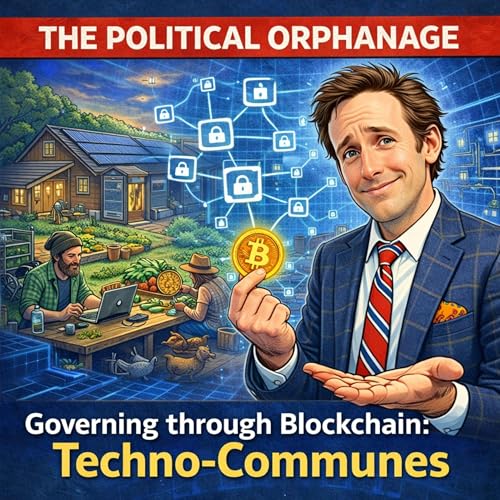
  • Governing through Blockchain: Techno-Communes (Preview)
    2026/02/17

    Jonathan Hillis is the founder and caretaker of Cabin, a network of co-living spaces which link up and vet members in other communities via blockchain technology. His "neighborhood" of intentional living is in beautiful Texas Hill Country an hour outside of Austin, where he lives with friends in a hub-and-spoke model of private accommodation surrounding communal social spaces.

    He's the former CTO of Coinbase, and you can see how his tech background influences his obsession with scalability (we talk about Metcalf's Law, and the optimum size of "one sauna teams") as well as the non-financial elements of blockchain to that end. It actually reminds me a bit of Neil Stephenson's Franchise-Organized Quasi-National Entities or "burbclaves" in Snow Crash.

    Cabin strikes me as a kind of libertarian commune (though neither Hillis nor myself ever uses the term). It's big scattered geographic network of modular co-ops you can plug into and out of. Vetting community members is a big thing in communes, and Cabin relies on blockchain technology and somethin akin to personal Yelp reviews to allow people to skip up from Austin, TX to like-minded communities in Santa Fe or Portland, or wherever.

    He joins to discuss his model, and what day-to-day life is like living in an intentional co-living community.

    続きを読む 一部表示
    15 分
  • How to Build a Commune: Samwise Rodriguez
    2026/02/16

    If you wanted to live with a bunch of buddies in a house, how would you do it? What are the mechanics of setting up, financing, and socially maintaining a commune? Samwise Rodriguez runs a commune—which combines their skills as a philanthropist, entrepreneur (and to some extent, as a polyamorist). This week we explore: how do you build your own commune?

    続きを読む 一部表示
    1 時間 12 分
  • Jeff Flake Alone on an Island with a Knife
    2026/02/11

    What happens when Trump leaves office? Do the Republicans reform or catalyze?

    Jeff Flake is the former Executive Director of the Goldwater Institute, Ambassador to Turkey, and representative and then Senator from the great state of Arizona. He is also a Knight of the Kingdom of Sweden.

    He joins to discuss what a post-Trump Republican Party will look like.

    続きを読む 一部表示
    50 分
  • The Map That Explains Everything About America: Colin Woodard
    2026/02/04

    Colin Woodard posits that America is not really a country, it's a dozen or so distinct nations with their own cultures and ideologies which are constantly battling for supremacy. His new book "Nations Apart: How Clashing Regional Cultures Shattered America." In it he argues that

    argues that deep-seated cultural divisions, stemming from different colonial settlement patterns, are the root cause of modern American political polarization, inequality, and threats to democracy. The book uses historical and data-driven analysis to show how these regional cultures clash on issues like gun control, immigration, and abortion, and proposes a renewal based on the unifying ideals of the Declaration of Independence.

    "America is Eleven Different Countries"

    https://podcasts.apple.com/us/podcast/america-is-eleven-different-countries/id1439837349?i=1000646222225

    SUPPORT THE SHOW!

    Patreon: Patreon.com/andrewheaton

    Substack: ThePoliticalOrphanage.com

    続きを読む 一部表示
    1 時間 22 分
  • America is Eleven Different Countries (Rebroadcast)
    2026/02/03

    Rudyard William Lynch is the host of WhatifAlHist, a popular history channel on YouTube.

    He joins to discuss how the origins and circumstances of America's regions permanently imprinted on its cultures and political outlooks.

    Colin Woodard's Map: https://www.businessinsider.com/the-11-nations-of-the-united-states-2015-7

    Rudyard's Map: https://preview.redd.it/cultural-map-of-america-done-by-whatifalthist-on-youtube-v0-7clddg9nunpa1.jpg?auto=webp&s=663b38b9434bdf7791fac983f0d5e5beb643b779

    Relevant Book: American Nations: A History of the Eleven Rival Regional Cultures of North America, by Colin Woodard

    続きを読む 一部表示
    2 時間 13 分
  • I Time Traveled to Talk to Medieval Yokels about Economics
    2026/01/28

    What did people in the Dark Ages think about economics? Why did poverty exist, and how do you alleviate it? To find out, I took my time machine to 1282 and 1314, to speak to barflies and a priest.

    Fr. Richard Kirby is a fourteenth century prior of Whitby Abbey and formerly the sacrist of St. Mungo's. He is a specialist in Just Price Theory, and joins the show to discuss how his fellows in the Dark Ages approach economics.

    続きを読む 一部表示
    56 分