エピソード

  • Verlon Johnson on the Nearly $1 Trillion Question: Can Medicaid Hold? | The Policy Stack
    2026/08/18

    Medicaid covers more than 70 million people, and last year it went through the largest change to its financing in its history. The 2025 reconciliation law cut an estimated $911 billion in federal Medicaid spending over ten years, added work requirements, shortened eligibility checks to every six months, and limited how states can raise money through provider taxes. For most of last year those were words on a page. Now the deadlines are real, and many of the biggest changes begin January 1, 2027.

    Lisa Bari’s guest is Verlon Johnson, EVP and Chief Government and Corporate Affairs Officer at Acentra Health. Verlon also chairs MACPAC, the commission that advises Congress on Medicaid, and spent decades at CMS. She has seen the program from the federal side, the state side, and the technology side. Together they get past the politics to the harder question of implementation: what it actually takes for states to redefine business rules, retrain eligibility workers, stand up appeals processes, and modernize eligibility systems before the clock runs out. Verlon’s throughline is one every operator will recognize: good policy deserves good implementation, and data alone doesn’t improve health, better decisions do. It’s a clear-eyed look at whether the program can hold, and what it will take to make sure the people who depend on it don’t fall through the cracks.

    続きを読む 一部表示
    39 分
  • 79% of Hospital AI Comes from EHR Vendors. Here's Why That's a Problem | The Policy Stack
    2026/07/17

    79% of hospitals are running AI tools built by their EHR vendor. Not because those tools are necessarily the best, but because the structural advantages of staying in suite make it the easier choice every single time.

    In this episode of The Policy Stack, taken from Innovaccer's Context 2026 Healthcare Autonomy conference, Lisa Bari, Head of Policy and Partnerships at Innovaccer, and Julia Adler-Milstein, PhD, Professor at UCSF, joined Ruth Reader of Second Opinion for one of the most substantive policy conversations of the conference.

    The data from Julia's recent JAMA perspective piece makes it clear: health systems are not always choosing the best AI tools available. They are choosing the most accessible ones. Until the information blocking rules that are already in law get enforced, until API performance is publicly reported, and until patients are empowered to direct their own data, that dynamic is not going to change on its own.

    #ThePolicyStack #HealthcareAutonomy #HealthPolicy

    続きを読む 一部表示
    38 分
  • The Prevention Paradox: Why America Knows What to Do and Won't Do It
    2026/06/03

    Why does almost 80% of America’s healthcare spend go to treating chronic disease while prevention barely receives a fraction of the $5 trillion health budget?

    On this episode of The Policy Stack, Lisa Bari tries to get to the root of the problem with Dr. Anand Parekh, Chief Health Policy Officer at the University of Michigan School of Public Health and author of Prevention First: Policymaking for a Healthier America.

    A veteran of two decades at HHS under George Bush and Barack Obama, Parekh explains what's actually being cut when the CDC loses 53% of its budget, why the wins from prevention are politically invisible, what the Supreme Court's ruling on ACA preventive services actually means for your next cancer screening, and why the ratio of social services to healthcare spending may be the single most predictive number in population health.

    続きを読む 一部表示
    38 分
  • Inside Medicare's Invisible Backbone: Claims Processing, AI Innovation, and the $500 Billion System Written in COBOL
    2026/04/27

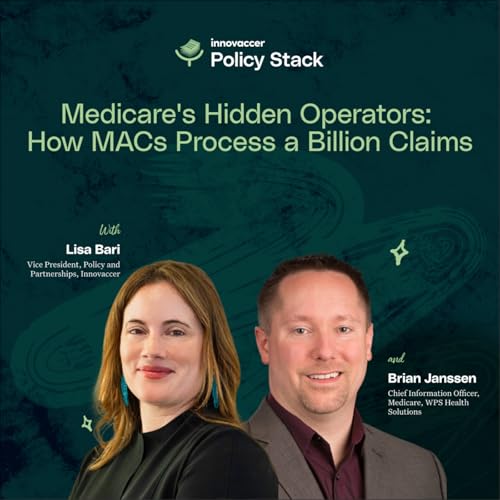
    Brian Janssen reflects on running Medicare operations at WPS Health Solutions, processing 130+ million claims annually through an infrastructure that many healthcare professionals don't know exists. He shares why MACs are "the largest backbone of processing in the country that the healthcare world doesn't really know about," how regional variation matters when Flint, Michigan's environmental crisis affects local coverage decisions differently than in rural Kansas, and the challenge of innovating with AI while maintaining FISMA High security in physical data centers in systems that can't afford a single day of payment disruption.

    続きを読む 一部表示
    48 分
  • Seven Models in One Quarter: Making Sense of CMS's Most Aggressive Innovation Push Ever
    2026/02/09

    Liza Health’s Duncan Reece reflects on decades in value-based care, from Medicare Health Support's failure to today's explosion of CMMI models launching simultaneously. He shares why MSSP's $10 billion in savings gets unfairly criticized against Medicare's $1.2 trillion spend, how Iora built its own EHR from scratch when nothing else worked for accountable care, and why the real unlock isn't payment models: it's separating necessary accountability from unnecessary complexity while technology costs plummet and AI adoption in healthcare outpaces every other industry.

    続きを読む 一部表示
    54 分
  • Finishing Interoperability: Inside CMS's Voluntary Framework and the Fight Against Portalitis
    2025/12/26

    Kristen Valdes from b.well reflects on building CMS's voluntary Health Technology Ecosystem framework after discovering that, despite a decade of interoperability policy, live demos showed only 1 out of 30+ providers could return data automatically. She shares lessons on community organizing when 500+ companies need coordination, but the government can't lead, why the real barriers are business and liability issues rather than technology, and how to prevent legacy players from relitigating settled policy when the goal is implementation, not debate.

    続きを読む 一部表示
    49 分
  • Where Are We Now? The State of Interoperability in Late 2025
    2025/12/08

    Most healthcare decisions happen far from the headlines. The Policy Stack, hosted by Lisa Bari, reveals the people and processes shaping how American healthcare really works. From state leaders to industry innovators, each episode examines the laws, funding, and political realities behind the policies that shape care.

    続きを読む 一部表示
    40 分
  • How Current Healthcare Policy Could Reshape the Future of Value-based Care
    2025/11/10

    In this live episode from Innovaccer’s Mini-Xccelerate conference in DC, Blair Childs and Dave Johnson examine the sweeping policy and market shifts transforming U.S. healthcare. They discuss the move from government-designed systems toward market accountability, how “liberating data” is key to real value-based care, and why structural incentives, not funding, determine the pace of reform. With their deep experience in health policy and strategy, they offer a grounded look at where healthcare is heading, and what it will take to finally realign incentives for better outcomes.

    続きを読む 一部表示
    38 分