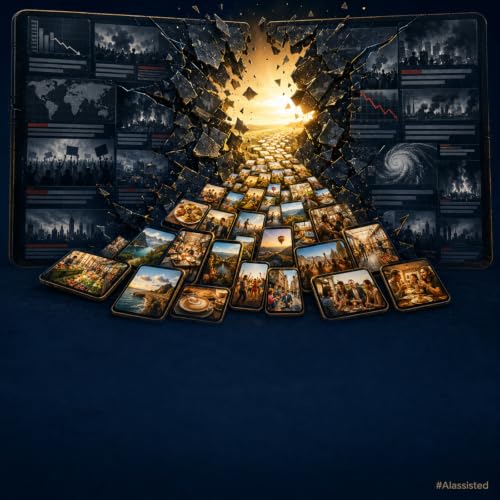
『The Other AI: Audio Briefings on Augmented Intelligence and AI Governance』のカバーアート

The Other AI: Audio Briefings on Augmented Intelligence and AI Governance

The Other AI: Audio Briefings on Augmented Intelligence and AI Governance

著者: Basil C. Puglisi
無料で聴く

The Other AI turns Basil C. Puglisi's articles, white papers, and policy briefs into audio briefings on AI governance, augmented intelligence, human judgment, and human-AI collaboration. The format is built for the time and conditions in which people actually learn, whether running, driving, riding a train, or working on something else.

Episodes are AI-narrated for clean, consistent production, and human review approves each publication before release. The complete original work, including details, sources, and citations, lives at basilpuglisi.com.

Topics include HAIA-RECCLIN, Factics, Checkpoint-Based Governance, enterprise AI adoption, AI policy, cognitive enhancement, and the future of human authority over automated systems.

This podcast is for executives, researchers, consultants, educators, policy thinkers, and AI practitioners who want more than AI hype. The show focuses on evidence, dissent, governance, measurable outcomes, and the role of human judgment when machines become more capable.

Basil Puglisi 2009
政治・政府
エピソード
  • The On-Ramp Problem: Navigating AI Automation and Human Augmentation
    2026/07/05

    Welcome to The Other AI. In this deep dive episode, we explore "The On-Ramp Problem," based on the research of Basil C. Puglisi. While headline AI job numbers appear stable, cutting the data by age reveals a sharp contraction in early-career employment for highly AI-exposed roles. We discuss how AI is rapidly absorbing the junior tasks—like retrieving, summarizing, and formatting—that traditionally served as the "on-ramp" for workers to learn their jobs.

    Join us as we unpack the critical choice between automation and augmentation, the financial pressures pushing companies toward cheaper replacement paths, and insights from Erik Brynjolfsson's Canaries Dashboard. We also look at the operational answer to this crisis: using person-scale measurements like the Human Enhancement Quotient (HEQ) and Augmented Intelligence Score (AIS) to ensure humans are actively grown through AI collaboration at governed checkpoints, rather than simply replaced.

    If we can only fix what we can measure, are we measuring the right thing, or only counting the jobs after they are already gone?

    続きを読む 一部表示
    21 分
  • The On-Ramp Problem: AI, Entry-Level Jobs, and the Measurement Gap
    2026/07/02

    The AI jobs numbers look calm until you cut them by age. This episode examines the June 2026 Stanford Digital Economy Lab and ADP Research data, which shows early-career workers in the most AI-exposed jobs contracting near 4 percent a year while their least-exposed peers keep growing, and it works through why the entry-level on-ramp is the first thing AI removes.

    The conversation covers the augmentation versus automation split that decides whether jobs grow or vanish, the limit of a population dashboard that can diagnose the trend but cannot see whether any single worker is being grown or replaced, and the case for measuring the person in real time with a named human at the checkpoint. It closes on the hardest question the data raises: if AI absorbs the tasks that used to train people, where does the next generation of capable, accountable workers come from.

    Read the full article, with the complete data, the honest caveats, and every source:

    https://basilpuglisi.com/ai-jobs-on-ramp-measurement/

    The Other AI: Audio Briefings on Augmented Intelligence and AI Governance

    Spotify: https://open.spotify.com/show/033dvhzMIcWLdY7IUgsu7F

    Apple Podcasts: https://podcasts.apple.com/us/podcast/id1896506152

    Amazon Music: https://music.amazon.com/podcasts/923d1a79-533f-4623-bae3-e2ba83453dfb

    YouTube playlist: https://www.youtube.com/playlist?list=PL

    続きを読む 一部表示
    21 分
  • The Same Algorithm That Distorted America Is the One Shaping AI
    2026/06/30

    For one strange summer, the world saw America with no editor in the middle, and the footage did not match the story it had been sold. This episode uses that moment to get at something bigger than soccer.

    In June 2026, a Pew survey put global favorability toward the United States at 37 percent. Then millions of World Cup visitors arrived, pointed their phones at grocery aisles, Texas barbecue, and strangers giving directions, and broadcast an America that looked nothing like the dystopia on the feed. For a few weeks, ordinary tourists became broadcasters and bypassed the machine that usually decides what the world sees.

    Here is why that matters for anyone thinking about AI. The outrage machine is not a metaphor. It is algorithmic curation that selects for intensity over accuracy, because emotionally charged stories travel faster and further than measured truth. That same dynamic is the water AI swims in. Models are trained on the record this machine produces, they are tuned to the engagement it rewards, and they can hand a user a confident, fluent answer that is wrong in exactly the way the loudest sources are wrong.

    The fix is the same in both worlds, and it has a name. Source custody. Keep what you saw, when you saw it, and what it actually showed, then weigh it. Hold the warm clip and the bleak headline to the same test, and hold a fluent AI answer to that test too. In AI governance terms, convergence is not proof, the most repeated slice is not the whole, and a human has to stay in custody of the evidence.

    The World Cup handed Americans a mirror. It also handed anyone building with AI a warning about trusting a system engineered to sell intensity back to you as truth.

    Read the full essay: https://basilpuglisi.com/world-cup-real-america/

    Basil C. Puglisi, MPA

    A Human-AI Collaboration

    #AIassisted using the HAIA Ecosystem

    続きを読む 一部表示
    33 分
adbl_web_anon_alc_button_suppression_t1
まだレビューはありません