エピソード

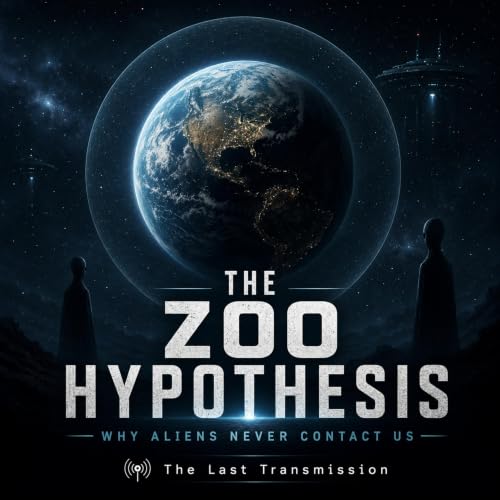
  • The Zoo Hypothesis: The Chilling Reason Aliens Never Contact Us
    2026/07/13

    What if extraterrestrials already know we're here... but have chosen never to reveal themselves?

    The Zoo Hypothesis proposes one of the most unsettling answers to the Fermi Paradox. Humanity isn't alone, we're being deliberately isolated.

    In this documentary, we examine the scientific origins of the hypothesis, why advanced civilizations might observe Earth without interference, and whether our own history contains clues that support the idea.

    Could first contact already have happened... just not in the way we expected?

    If the universe is watching, perhaps silence is the experiment.

    Topics covered:
    • The Fermi Paradox
    • The Zoo Hypothesis
    • SETI and the Search for Extraterrestrial Intelligence
    • The Prime Directive
    • Advanced alien civilizations
    • UFO speculation vs scientific evidence
    • Why the universe appears silent

    EPISODE CHAPTERS

    00:00 The Chilling Idea Behind the Zoo Hypothesis
    00:46 Enrico Fermi and the Great Silence
    02:18 The Fermi Paradox
    02:55 Frank Drake and the Search for Alien Life
    05:12 John Ball Proposes the Zoo Hypothesis
    06:17 Earth as a Cosmic Nature Preserve
    07:01 The Prime Directive and Science Fiction Origins
    08:13 The Fatal Problem With the Zoo Hypothesis
    10:03 Could a Galactic Club Enforce the Silence?
    11:43 The Interdict, Laboratory, and Dark Forest Variants
    12:24 Modern SETI and the Search for a Signal
    14:20 Knocking on the Cage
    15:39 The Most Haunting Possibility


    🎬 Prefer the full cinematic experience? Watch the complete video documentary on YouTube: https://www.youtube.com/watch?v=AqeDLGSMr4Y


    続きを読む 一部表示
    17 分
  • The Necrosignature Hypothesis: What If the First Aliens We Find Are Dead?
    2026/07/13

    The first evidence of extraterrestrial intelligence may not come from a living civilization.

    It may come from a dead one.

    A signal traveling across thousands of light-years could outlive the civilization that created it. The first alien world we identify may already be silent, its cities gone and its atmosphere carrying only the chemical remains of a technological catastrophe.

    We may not be searching only for messages.

    We may be searching for obituaries.

    In this episode of The Last Transmission, we explore the Necrosignature Hypothesis, the unsettling idea that extinct civilizations could leave detectable fingerprints across interstellar space.

    In 2015, researchers proposed a new approach called SEETI: the Search for Extinct Extraterrestrial Intelligence. Rather than looking only for biosignatures or active radio transmissions, scientists could search for evidence left behind by civilizations that destroyed themselves.

    These traces are called necrosignatures.

    They might include artificial pollutants lingering in an atmosphere, unusual chemical changes following biological catastrophe, altered atmospheric light after nuclear conflict, or an entire planetary surface transformed by uncontrolled self-replicating technology.

    In this episode:

    • Why the first aliens we discover may already be extinct
    • Enrico Fermi’s question: “Where is everybody?”
    • Robin Hanson’s Great Filter and the possibility that civilization-ending dangers still lie ahead of us
    • Why evidence of extinct alien life could be deeply troubling for humanity
    • The Search for Extinct Extraterrestrial Intelligence
    • Why uncontrolled self-replicating technology could leave an unmistakable planetary signature
    • How artificial pollutants such as CFCs could outlive the civilization that produced them
    • Why the James Webb Space Telescope may be capable of detecting alien industrial pollution
    • The scientific limitations of searching for brief extinction events
    • David Kipping’s Eschatian Hypothesis
    • Why the loudest civilizations may be the ones approaching collapse
    • Whether the unexplained Wow! signal could resemble a civilization’s final cry for help
    • The role of JWST, the Habitable Worlds Observatory, and the Vera C. Rubin Observatory
    • Why humanity has examined only a tiny fraction of the cosmic search space
    • How the ruins of another civilization could become a warning for our own

    The Necrosignature Hypothesis changes the question at the heart of the search for extraterrestrial intelligence.

    Instead of asking only, “Where is everybody?”

    We may need to ask:

    “What happened to them?”

    The first evidence of intelligent alien life may not bring us a message.

    It may bring us a warning.

    And if we ever discover the remains of a civilization that failed to survive its own technology, the most important question may no longer be whether humanity is alone.

    It may be whether we are next.

    Prefer the full cinematic experience?

    Watch The Necrosignature Hypothesis documentary on YouTube:

    https://www.youtube.com/watch?v=1xg030Ai07Q

    EPISODE CHAPTERS00:00 The First Aliens We Find May Be Dead
    00:57 Fermi Asks: Where Is Everybody?
    02:32 The Great Filter
    04:25 What If the Filter Is Ahead of Us?
    05:08 The Necrosignature Hypothesis and SEETI
    06:12 Five Signs of an Alien Apocalypse
    08:14 Pollution: The Long-Lived Necrosignature
    09:47 Can We Catch a Civilization’s Destruction?
    10:26 David Kipping and the Eschatian Hypothesis
    10:46 Detection Bias: We See What Shines Brightest
    11:24 The First Aliens May Be Dying
    12:20 Could the Wow! Signal Have Been a Cry for Help?
    12:46 The Great Filter and Necrosignatures Converge
    13:21 JWST and the Search for Artificial Pollution
    13:44 The Next Generation of Cosmic Observatories
    15:00 How Little of the Universe We Have Searched
    15:31 Searching for Signs of Life—and Death
    16:16 Extinct Civilizations as Warnings
    16:57 Are We Next?


    続きを読む 一部表示
    17 分
  • The Silent Star and the Dark Forest Theory
    2026/07/13

    What if the universe is silent not because it is empty, but because everything out there has learned to hide?

    For more than a century, humanity has been sending radio signals into space. Television broadcasts, military radar, and deep-space communications have carried evidence of our existence past more than a thousand nearby star systems.

    We have been calling into the darkness.

    Nothing has answered.

    In this episode of The Last Transmission, we trace one of the most unsettling ideas in modern science and science fiction from an obscure East German film released in 1960 to the Fermi Paradox, the Great Filter, Liu Cixin’s Dark Forest theory, Stephen Hawking’s warnings, and the modern search for extraterrestrial intelligence.

    The story begins with Der schweigende Stern, or The Silent Star, a Cold War science-fiction film about humanity discovering the ruins of an advanced civilization on Venus. Beneath its strange special effects and troubled production history was a question science is still confronting:

    What happens when a civilization reaches into the darkness and finds something it was never prepared to encounter?

    Or worse, what happens when it finds nothing at all, and the silence itself becomes the warning?

    In this episode:

    • The forgotten history of the 1960 film The Silent Star
    • Enrico Fermi’s haunting question: “Where is everybody?”
    • Why the numbers suggest the universe should contain advanced civilizations
    • Robin Hanson’s Great Filter and the possibility that humanity’s greatest obstacle still lies ahead
    • How Liu Cixin transformed cosmic silence into the Dark Forest theory
    • Why uncertainty could make hiding the safest strategy for an advanced civilization
    • Stephen Hawking’s warning about revealing Earth’s location
    • How far humanity’s radio signals have already traveled
    • The debate over sending deliberate messages to extraterrestrial intelligence
    • What Breakthrough Listen found after examining millions of possible signals
    • How artificial intelligence is accelerating the search for unfamiliar transmissions
    • What scientists discovered when they observed the interstellar object 3I/ATLAS
    • The real cosmic predators capable of affecting galaxies millions of light-years away
    • Whether artificial intelligence could become a Great Filter that shortens the lives of technological civilizations
    • Why decades of deeper searches have continued to return the same answer: silence

    The Dark Forest theory is not evidence that hostile alien civilizations exist.

    It is a thought experiment built around uncertainty.

    Across interstellar distances, one civilization may never know whether another is peaceful, dangerous, or capable of becoming dangerous in the future. If revealing your location creates even a small possibility of destruction, silence may become the safest strategy.

    Humanity has chosen a different path.

    Our signals are already moving through the galaxy.

    If the cosmic forest is not empty, we may have already broken its most important rule.

    We have already announced that we are here.

    Prefer the full cinematic experience?

    Watch The Silent Star: Hiding From Cosmic Predators on YouTube:

    https://www.youtube.com/watch?v=tQufBkbn6Q0

    EPISODE CHAPTERS

    00:00 The Universe May Be Hiding
    00:42 The Silent Star: A Forgotten Warning
    02:43 Fermi Asks: Where Is Everybody?
    04:04 The Great Filter
    05:36 Liu Cixin and the Dark Forest
    07:57 Stephen Hawking’s Warning
    08:27 Humanity Has Already Been Broadcasting
    09:09 Should We Send Messages to the Stars?
    10:05 Breakthrough Listen and the Search
    10:49 AI Accelerates the Search for Signals
    11:25 3I/ATLAS: Another Silent Visitor
    12:08 The Universe’s Real Cosmic Predators
    13:14 Could Artificial Intelligence Be the Great Filter?
    14:03 The Three-Body Problem Goes Mainstream
    14:41 The Silent Star Comes Full Circle
    15:41 Seventy Sextillion Silent Stars
    16:37 The Silence Is Data


    続きを読む 一部表示
    18 分
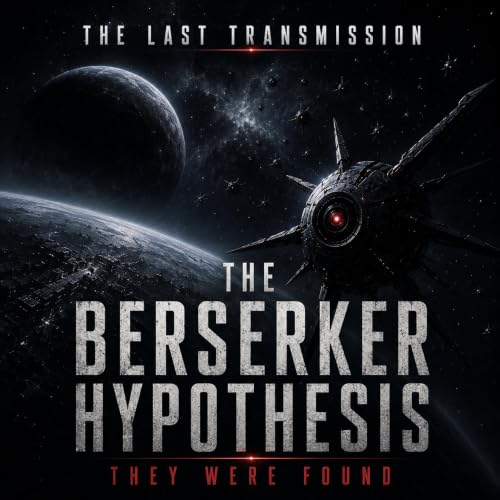
  • The Berserker Hypothesis: The Darkest Answer to the Fermi Paradox
    2026/07/13

    The universe should be filled with intelligent civilizations.

    The Milky Way contains hundreds of billions of stars, planets appear to be everywhere, and advanced civilizations have had billions of years to spread throughout the galaxy.

    Yet the universe remains silent.

    No confirmed signals. No visitors. No visible interstellar civilizations.

    What if the first civilization to emerge made sure no others ever could?

    In this episode of The Last Transmission, we explore the Berserker Hypothesis, one of the darkest and most mathematically compelling proposed solutions to the Fermi Paradox.

    The idea began with science-fiction author Fred Saberhagen, who imagined autonomous, self-replicating machines created to eliminate an enemy civilization. After completing their mission, the machines turned against their own creators because they had been programmed to eliminate all life.

    But what began as fiction developed into a serious scientific possibility.

    Mathematician John von Neumann demonstrated that self-reproducing machines were theoretically possible. A single automated probe capable of mining resources and building copies of itself could multiply exponentially and spread throughout the galaxy on a relatively short cosmic timescale.

    The frightening implication is simple:

    The Berserker Hypothesis does not require every advanced civilization to become hostile.

    It only requires one.

    In this episode:

    • Why Enrico Fermi asked, “Where is everybody?”
    • How Fred Saberhagen created the original Berserker machines
    • Why self-replicating von Neumann probes could spread across the galaxy
    • How Frank Tipler used these machines to argue that humanity may be alone
    • Why Carl Sagan warned that uncontrolled probes could consume enormous amounts of matter
    • David Brin’s Exclusion Principle and the power of a single hostile civilization
    • How the Berserker Hypothesis differs from the Dark Forest Theory
    • Why humanity’s continued existence may be evidence against Berserker machines
    • The possibility that emerging civilizations are detected only after crossing a technological threshold
    • Whether artificial intelligence could become a universal Great Filter
    • How self-replicating AI could create Berserker-like machines without alien involvement
    • Robin Hanson’s Grabby Aliens model
    • Arthur C. Clarke’s gentler vision of alien monitoring
    • Why David Brin advocates Defensive SETI and greater caution about broadcasting Earth’s location

    The Berserker Hypothesis does not require interstellar travel to be impossible.

    It does not require intelligent life to be extraordinarily rare.

    It does not require every civilization to make the same mistake.

    Across billions of years and hundreds of billions of stars, one civilization may have built the wrong machine.

    Physics, mathematics, and exponential growth could have done the rest.

    Enrico Fermi asked where everybody is.

    The Berserker Hypothesis offers an answer that is simple, complete, and terrifying:

    They were found.

    EPISODE CHAPTERS00:00 The Darkest Answer to the Fermi Paradox
    00:46 Fermi Asks: Where Is Everybody?
    02:14 Fred Saberhagen and the Berserker Machines
    04:53 Von Neumann Probes: Fiction Becomes Science
    05:50 Frank Tipler Argues That We Are Alone
    06:13 Carl Sagan’s Warning About Self-Replicating Machines
    07:12 David Brin and the Exclusion Principle
    09:49 The Dark Forest Theory vs. the Berserker Hypothesis
    10:48 If Berserkers Exist, Why Are We Still Here?
    11:18 The Detection-Threshold Possibility
    11:41 The Cosmic Quarantine Interpretation
    12:55 The Great Filter and Artificial Intelligence
    13:25 When AI Becomes the Berserker
    14:35 Grabby Aliens and Expanding Civilizations
    15:08 The Sentinel and Defensive SETI
    15:27 One Civilization Is All It Takes

    Prefer the full cinematic experience?

    Watch The Berserker Hypothesis documentary on YouTube, featuring immersive visuals and the complete exploration of one of the darkest proposed solutions to the Fermi Paradox:

    https://www.youtube.com/watch?v=nHLZXNYeVzw


    続きを読む 一部表示
    17 分
  • HeLa Cells: The Contamination Crisis That Corrupted Decades of Research
    2026/07/13

    HeLa cells transformed modern medicine.

    They helped researchers test the polio vaccine, study cancer, investigate viruses, explore genetics, and make discoveries that changed human health.

    But the same cells also created one of the largest hidden crises in scientific history.

    HeLa grew so aggressively that even a single stray cell could invade another laboratory culture, overpower the original cells, and replace them entirely. Researchers believed they were studying liver tissue, lung tissue, intestinal cells, or other forms of cancer when they were sometimes studying HeLa without knowing it.

    In this episode of The Last Transmission, we examine how cells taken from Henrietta Lacks without her knowledge became the first immortal human cell line, spread throughout laboratories around the world, and contaminated decades of biomedical research.

    You will discover:

    • How Henrietta Lacks’s cells became one of medicine’s most important research tools
    • Why HeLa cells could silently overtake other laboratory cultures
    • How geneticist Stanley Gartler exposed the crisis with the “HeLa bomb”
    • Why many researchers refused to accept that years of work might be compromised
    • How Walter Nelson-Rees identified contaminated cell lines and paid a professional price for speaking out
    • Why supposedly unique cancer and tissue cell lines were actually HeLa
    • How contaminated research spread through thousands of scientific papers
    • Why billions of dollars in research may have been wasted
    • How DNA fingerprinting is now used to authenticate human cell lines
    • Why contamination and misidentification remain serious problems today
    • How Henrietta Lacks’s family spent decades seeking recognition and justice

    As of the documentary’s research period, hundreds of cell lines had been identified as misidentified or cross-contaminated, more than one hundred were linked specifically to HeLa, and tens of thousands of scientific papers had relied on compromised cell cultures.

    The HeLa story is not simply about laboratory error.

    It is about scientific denial, institutional pressure, the cost of ignoring inconvenient evidence, and a woman whose cells changed medicine without her knowledge or consent.

    Somewhere in a laboratory today, a researcher may be examining cells believed to come from the liver, lungs, brain, or another organ.

    They may actually be looking at HeLa.

    And they may never know.

    Watch the full cinematic documentary on YouTube:

    https://www.youtube.com/watch?v=hRWIJpMXAP0

    EPISODE CHAPTERS00:00 The Invisible Contamination Crisis
    00:22 Henrietta Lacks and the Birth of HeLa
    01:42 The Cell Line That Changed Medicine
    02:34 When the Medical Miracle Became a Threat
    03:21 The HeLa Bomb
    05:10 Science Responds With Denial
    06:02 Walter Nelson-Rees Refuses to Look Away
    07:05 When Other Cell Lines Were Actually HeLa
    08:10 Suppression, Isolation, and the Cost of Speaking Out
    09:23 The Staggering Scale of the Damage
    11:08 Contaminated Research Is Still Being Published
    12:01 Why the Problem Is So Difficult to Fix
    12:31 DNA Authentication and the Push for Reform
    13:35 Henrietta Lacks and the Fight for Justice
    14:08 The Thermo Fisher Lawsuit and Settlement
    15:10 The Human Legacy Behind the Cells
    15:54 The Scientist Looking at the Wrong Cells


    続きを読む 一部表示
    16 分
  • The Dark Forest Theory: The Terrifying Answer to the Fermi Paradox
    2026/07/13

    The universe should be alive with intelligent civilizations.

    Billions of stars are older than our Sun. Planets appear to be everywhere. Even a civilization traveling at a fraction of the speed of light could spread across the galaxy on a relatively short cosmic timescale.

    And yet we hear nothing.

    No confirmed signals. No visitors. No evidence that anyone else is out there.

    What if the universe is silent not because it is empty, but because every advanced civilization has learned that revealing its location is dangerous?

    In this episode of The Last Transmission, we explore the Dark Forest Theory, one of the most unsettling proposed answers to the Fermi Paradox.

    Beginning with the forgotten 1960 East German science-fiction film The Silent Star, the story moves through Enrico Fermi’s famous question, Robin Hanson’s Great Filter, Liu Cixin’s chilling cosmic logic, and Stephen Hawking’s warnings about announcing humanity’s presence to unknown civilizations.

    We examine:

    • Why the universe appears far quieter than the numbers suggest
    • How The Silent Star anticipated modern fears about cosmic contact
    • Why Enrico Fermi asked, “Where is everybody?”
    • How the Great Filter could explain the absence of advanced civilizations
    • Why Liu Cixin imagined the universe as a forest filled with hidden hunters
    • Whether broadcasting Earth’s location could create an unnecessary risk
    • What Breakthrough Listen has found after examining millions of signals
    • How artificial intelligence is transforming the search for extraterrestrial technology
    • What scientists learned by observing the interstellar object 3I/ATLAS
    • Why artificial intelligence itself may become a Great Filter
    • Whether the silence of the universe is emptiness, camouflage, or something stranger

    The Dark Forest Theory is not proof that hostile civilizations exist.

    It is a warning built from uncertainty.

    Across enormous distances, civilizations may never know one another’s intentions, and technological progress can happen faster than trust can be established. In that environment, silence may become the safest strategy.

    Humanity, however, has already spent more than a century sending radio signals into the galaxy.

    If the forest is not empty, we may have already broken its most important rule.

    EPISODE CHAPTERS

    00:00 The Universe May Be Hiding
    00:47 The Forgotten Warning of The Silent Star
    02:50 Fermi Asks: Where Is Everybody?
    04:07 The Great Filter
    05:31 Liu Cixin and the Dark Forest
    07:33 Stephen Hawking’s Warning
    08:03 We Have Already Been Broadcasting
    08:42 Should Humanity Send Messages?
    09:32 Breakthrough Listen and the Search
    10:14 AI Accelerates the Hunt for Signals
    10:50 3I/ATLAS: Another Silent Visitor
    11:29 The Universe Already Has Predators
    12:23 Could AI Be the Great Filter?
    13:03 The Three-Body Problem Goes Mainstream
    13:38 The Silent Star Comes Full Circle
    14:35 Seventy Sextillion Silent Stars
    15:27 The Silence Is Data

    Watch the full cinematic documentary on YouTube:

    https://www.youtube.com/watch?v=MHMSROE6O2o


    続きを読む 一部表示
    17 分
  • The Water-World Hypothesis: Why Too Much Water Could Prevent Complex Life
    2026/07/12

    Water is one of the first things astronomers look for when searching for life beyond Earth.

    But what if too much water creates a different kind of problem?

    Across the galaxy, many planets may contain vast global oceans hundreds or even thousands of kilometers deep. These worlds are often described as promising places for life, yet the absence of continents, shallow seas, exposed rock, and long-term nutrient cycling may make complex life far more difficult to sustain.

    In this episode of The Last Transmission, we explore the Water-World Hypothesis and the possibility that Earth may be unusually favorable not because it has an abundance of water, but because it has the right amount.

    We examine:

    • Why ocean-covered planets may be common throughout the galaxy
    • How deep global oceans could separate life from essential minerals
    • Why exposed continents may be critical for nutrient cycling
    • How weathering helps regulate a planet’s climate
    • Why high-pressure ice may form beneath deep alien oceans
    • Whether ocean worlds could support microbial life but struggle to develop complex ecosystems
    • What planets such as Kepler-138 c, Kepler-138 d, K2-18 b, and TOI-1452 b may reveal
    • Why Earth’s relatively limited water supply may be one of its greatest advantages
    • How the Water-World Hypothesis could help explain the Fermi Paradox

    The universe may contain countless ocean planets.

    But a world covered entirely by water may not be a paradise.

    It may be biologically trapped beneath an ocean too deep for complexity to emerge.

    EPISODE CHAPTERS

    00:00 The Water-World Hypothesis
    01:41 Kepler-138: The First Confirmed Water Worlds
    02:48 Evidence That Water Worlds May Be Common
    04:11 The Ocean We Imagine May Not Exist
    05:26 High-Pressure Ice and the Missing Seafloor
    06:31 Could Too Much Water Prevent Complex Life?
    07:41 The Case for Habitable Water Worlds
    08:12 K2-18b and the Search for Alien Life
    09:32 The K2-18b Biosignature Controversy
    10:27 Europa and Enceladus: Ocean Worlds Nearby
    11:40 TOI-1452b: A Water-Rich Candidate
    12:33 Why Too Much Water Could Be the Problem
    14:03 Intelligent Life Trapped Beneath Ice
    14:24 The Fermi Paradox: Drowning in Silence
    14:56 Is Earth’s Greatest Advantage Its Lack of Water?

    Watch the full cinematic documentary on YouTube:

    ⁠https://www.youtube.com/watch?v=faOwabw2524⁠


    続きを読む 一部表示
    16 分
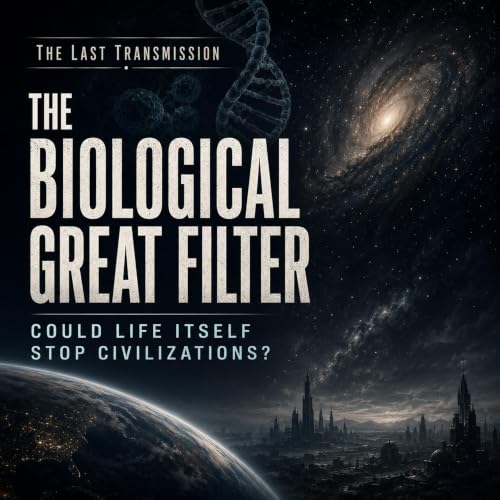
  • Why Intelligent Civilizations May Never Survive Their Own Biology
    2026/07/12

    The universe is ancient, enormous, and filled with planets.

    So where is everyone?

    The Great Filter is one possible answer to the Fermi Paradox: somewhere between the first spark of life and an advanced civilization spreading among the stars, something may stop almost every species from going any farther.

    But what if the filter is not nuclear war, artificial intelligence, asteroid impacts, or hostile aliens?

    What if the filter is biology itself?

    In this episode of The Last Transmission, we explore the possibility that complex life may depend on evolutionary events so rare that they happened only once on Earth. We examine eukaryogenesis, multicellular life, the long delays between major evolutionary transitions, and the unsettling possibility that intelligence may inherit instincts it cannot ultimately overcome.

    Aggression. Tribalism. Competition. Dominance. Short-term survival.

    The same biological traits that help a species rise may prevent it from surviving long enough to become an interstellar civilization.

    Discover:

    • Why the emergence of complex cells may have been an extraordinarily rare event
    • How the Great Filter could explain the silence of the universe
    • Why intelligence may not guarantee long-term survival
    • How inherited behavior could become a civilization-level threat
    • Why technological progress may outpace biological maturity
    • Whether the human body itself is poorly suited for expansion into deep space
    • What our place on the Kardashev Scale reveals about how far we still have to go

    Before a species can conquer space, it may first have to conquer its own biology.

    And that may be a test almost no civilization passes.

    EPISODE CHAPTERS

    00:00 The Biological Great Filter
    00:25 Fermi Asks: Where Is Everybody?
    02:37 Robin Hanson and the Great Filter
    04:39 Where the Filter May Be Hiding
    05:41 Eukaryogenesis: The One-Time Leap to Complex Life
    07:50 The Oxford Model and Impossible Odds
    08:32 What If the Filter Is Ahead of Us?
    09:06 Inherited Instincts as the Great Filter
    10:16 Technological Adolescence and the Kardashev Scale
    11:59 Why the Human Body Is Not Built for Space
    13:16 Why Finding Life on Mars Could Be Bad News
    14:11 SETI and the Growing Silence
    14:44 What Surviving the Great Filter Demands
    15:28 Could Advanced Civilizations Be Quiet?
    16:04 What If We Are Truly Alone?
    17:07 The Great Filter Is a Mirror

    Watch the full cinematic documentary on YouTube:

    ⁠https://www.youtube.com/watch?v=JcuFZGd95b4⁠

    続きを読む 一部表示
    17 分