『The Geek In Review』のカバーアート

The Geek In Review

The Geek In Review

著者: Greg Lambert & Marlene Gebauer
無料で聴く

このコンテンツについて

Welcome to The Geek in Review, where podcast hosts, Marlene Gebauer and Greg Lambert discuss innovation and creativity in legal profession.Greg Lambert & Marlene Gebauer 経済学
エピソード
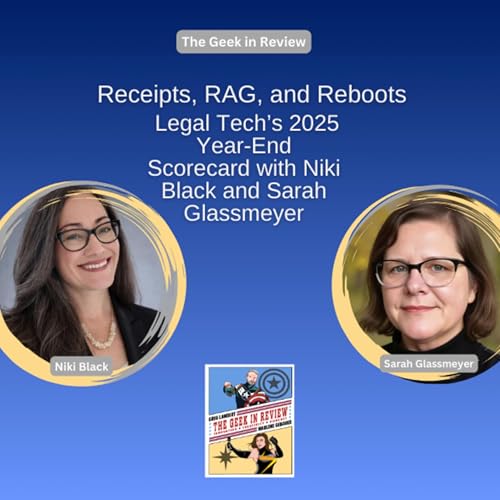
  • Receipts, RAG, and Reboots: Legal Tech’s 2025 Year-End Scorecard with Niki Black and Sarah Glassmeyer
    2025/12/29

    The Geek in Review closes 2025 with Greg Lambert and Marlene Gebauer welcoming back Sarah Glassmeyer and Niki Black for round two of the annual scorecard, equal parts receipts, reality check, and forward look into 2026. The conversation opens with a heartfelt remembrance of Kim Stein, a beloved KM community builder whose generosity showed up in conference dinners, happy hours, and day to day support across vendors and firms. With Kim’s spirit in mind, the panel steps into the year-end ritual: name the surprises, own the misses, and offer a few grounded bets for what comes next.

    Last year’s thesis predicted a shift from novelty to utility, yet 2025 felt closer to a rolling hype loop. Glassmeyer frames generative AI as a multi-purpose knife dropped on every desk at once, which left many teams unsure where to start, even when budgets already committed. Black brings the data lens: general-purpose gen AI use surged among lawyers, especially solos and small firms, while law firm adoption rose fast compared with earlier waves such as cloud computing, which crawled for years before pandemic pressure moved the needle. The group also flags a new social dynamic, status-driven tool chasing, plus a quiet trend toward business-tier ChatGPT, Gemini, and Claude as practical options for many matters when price tags for legal-only platforms sit out of reach for smaller shops.

    Hallucinations stay on the agenda, with the panel resisting both extremes: doom posts and fan club hype. Glassmeyer recounts a founder’s quip, “hallucinations are a feature, not a bug,” then pivots to an older lesson from KeyCite and Shepard’s training: verification never goes away, and lawyers always owed diligence, even before LLMs. Black adds a cautionary tale from recent sanctions, where a lawyer ran the same research through a stack of tools, creating a telephone effect and a document nobody fully controlled. Lambert notes a bright spot from the past six months: legal research outputs improved as vendors paired vector retrieval with legal hierarchy data, including court relationships and citation treatment, reducing off-target answers even while perfection stays out of reach.

    From there, the conversation turns to mashups across the market. Clio’s acquisition of vLex becomes a headline example, raising questions about platform ecosystems, pricing power, and whether law drifts toward an Apple versus Android split. Black predicts integration work across billing, practice management, and research will matter as much as M&A, with general tech giants looming behind the scenes. Glassmeyer cheers broader access for smaller firms, while still warning about consolidation scars from legal publishing history and the risk of feature decay once startups enter corporate layers. The panel lands on a simple preference: interoperability, standards, and clean APIs beat a future where a handful of owners dictate terms.

    On governance, Black rejects surveillance fantasies and argues for damage control, strong training, and safe experimentation spaces, since shadow usage already happens on personal devices. Gebauer pushes for clearer value stories, and the guests agree early ROI shows up first in back office workflows, with longer-run upside tied to pricing models, AFAs, and buyer pushback on inflated hours. For staying oriented amid fractured social channels, the crew trades resources: AI Law Librarians, Legal Tech Week, Carolyn Elefant’s how-to posts, Moonshots, Nate B. Jones, plus Ed Zitron’s newsletter for a wider business lens. The crystal ball segment closes with a shared unease around AI finance, a likely shakeout among thinly funded tools, and a reminder to keep the human network strong as 2026 arrives.

    続きを読む 一部表示
    1 時間 12 分
  • The Record, Rewired: Verbit and the Next Era of Court Reporting - JP Son and Matan Barak
    2025/12/22

    For decades, “the record” has meant one thing: a text transcript built by skilled stenographers, trusted by courts, and treated as the backbone of due process. In this episode of The Geek in Review, Marlene Gebauer and Greg Lambert sit down with JP Son, Verbit’s Chief Legal Officer, and Matan Barak, Head of Legal Product, to talk about what happens when a labor shortage, rising demand, and better speech technology collide. Verbit has been in legal work since day one, supporting court reporting agencies behind the scenes, but their latest push aims to modernize the full arc of proceedings, from depositions through courtroom workflows, with faster turnaround and more usable outputs.

    A core tension sits at the center of the conversation: innovation versus legitimacy. Marlene presses on whether digital records carry the same defensibility as stenographic ones, and JP frames Verbit’s posture as support, not replacement. Verbit is not a court reporting agency; their angle is tooling that helps certified professionals and agencies produce better outcomes, including real-time workflows that once required heavy manual effort. The result is less “robots replace reporters” and more “reporters with better gear,” which feels like the only way this transition avoids an industry food fight in every courthouse hallway.

    From there, the discussion shifts into the practical, lawyer-facing side: LegalVisor as a “virtual second chair.” JP describes it as distinct from the official transcript, a real-time layer built to surface insights, track progress, and support strategy while the deposition is happening. Matan adds the design story, discovery work, shadowing, and interviews to build for what second chairs are already doing, hunting inconsistencies, chasing exhibits, and keeping the outline on track. A key theme: the transcript is not going away, because lawyers still rely on it for clients, remote teammates, and quick backtracking, but the value climbs when the transcript turns into a live workspace with search, references, and outline coverage in front of you while testimony unfolds.

    Accuracy and trust show up as recurring guardrails. Greg pokes at the “99 percent accurate” claims floating around the market, and Matan makes the point every litigator appreciates, the missing one percent contains the word that flips meaning. Verbit’s “human in the loop” posture and its Captivate approach focus on pushing accuracy toward the level legal settings require, including case-specific preparation by extracting names and terms from documents to tune recognition in context. The episode also tackles confidentiality head-on, with JP drawing a hard line: Verbit does not use client data to train generative models, and they keep business pipelines separate across verticals.

    Finally, the crystal ball question lands where courts love to resist, changing the definition of “the record.” Marlene asks whether the future record becomes searchable, AI-tagged video rather than text-first transcripts. JP says not soon, pointing to centuries of text-based infrastructure and the slow grind of institutional acceptance. Matan calls the shift inevitable, arriving in pieces, feature by feature, so the system evolves without pretending it is swapping the engine mid-flight. Along the way, there are glimpses of what comes next, including experiments borrowing media tech, such as visual description to interpret behavior cues in video. The big takeaway feels simple: the record stays sacred, but the work around it no longer needs to stay stuck.

    Listen on mobile platforms: ⁠⁠⁠⁠⁠⁠⁠⁠⁠⁠⁠⁠⁠⁠⁠Apple Podcasts⁠⁠⁠⁠⁠⁠⁠⁠⁠⁠⁠⁠⁠⁠⁠ | ⁠⁠⁠⁠⁠⁠⁠⁠⁠⁠⁠⁠⁠⁠⁠Spotify⁠⁠⁠⁠⁠⁠⁠⁠⁠⁠⁠⁠⁠⁠⁠ | ⁠⁠⁠⁠⁠⁠⁠⁠⁠⁠⁠⁠⁠⁠YouTube⁠⁠⁠⁠⁠⁠⁠⁠⁠⁠

    [Special Thanks to ⁠Legal Technology Hub⁠ for their sponsoring this episode.]

    ⁠⁠⁠⁠⁠Email: geekinreviewpodcast@gmail.com
    Music: ⁠⁠⁠⁠⁠⁠⁠⁠⁠⁠⁠⁠⁠⁠⁠⁠⁠⁠Jerry David DeCicca⁠⁠⁠⁠⁠⁠⁠⁠⁠

    続きを読む 一部表示
    37 分
  • Data First, Partner Better. Jennifer McIver on Legal Ops Benchmarks, AI Agents, and Pricing Reality Checks
    2025/12/15
    This week on The Geek in Review, we sit down with Jennifer McIver, Legal Ops and Industry Insights at Wolters Kluwer ELM Solutions. We open with Jennifer’s career detour from aspiring forensic pathologist to practicing attorney to legal tech and legal ops leader, sparked by a classic moment of lawyer frustration, a slammed office door, and a Google search for “what else can I do with my law degree.” From implementing Legal Tracker at scale, to customer success with major clients, to product and strategy work, her path lands in a role built for pattern spotting, benchmarking, and translating what legal teams are dealing with into actionable insights.Marlene pulls the thread on what the sharpest legal ops teams are doing with their data right now. Jennifer’s answer is refreshingly practical. Visibility wins. Dashboards tied to business strategy and KPIs beat “everything everywhere all at once” reporting. She talks through why the shift to tools like Power BI matters, and why comfort with seeing the numbers is as important as the numbers themselves. You cannot become a strategic partner if the data stays trapped inside the tool, or inside the legal ops team, or inside someone’s head.Then we get into the messy part, which is data quality and data discipline. Jennifer points out the trap legal teams fall into when they demand 87 fields on intake forms and then wonder why nobody enters anything, or why every category becomes “Other,” also known as the graveyard of analytics. Her suggestion is simple. Pick the handful of fields that tell a strong story, clean them up, and get serious about where the data lives. She also stresses the role of external benchmarks, since internal trends mean little without context from market data.Greg asks the question on everyone’s bingo card, what is real in AI today versus what still smells like conference-stage smoke. Jennifer lands on something concrete, agentic workflows for the kind of repeatable work legal ops teams do every week. She shares how she uses an agent to turn event notes into usable internal takeaways, with human review still in the loop, and frames the near-term benefit as time back and faster cycles. She also calls out what slows adoption down inside many companies, internal security and privacy reviews, plus AI committees that sometimes lag behind the teams trying to move work forward.Marlene shifts to pricing, panels, AFAs, and what frustrates GCs and legal ops leaders about panel performance. Jennifer describes two extremes, rigid rate programs with little conversation, and “RFP everything” process overload. Her best advice sits in the middle, talk early, staff smart, and match complexity to the right team, so cost and risk make sense. She also challenges the assumption that consolidation always produces value. Benchmarking data often shows you where you are overpaying for certain work types, even when volume discounts look good on paper.We close with what makes a real partnership between corporate legal teams and firms, and Jennifer keeps returning to two themes, communication and transparency, with examples. Jennifer’s crystal ball for 2026 is blunt and useful, data first, start the hard conversations now, and take a serious look at roles and skills inside legal ops, because the job is changing fast.Links:Jennifer McIver’s LinkedIn pageWolters Kluwer ELM Solutions homepageLegalVIEW Insights reports homepageLegalVIEW DynamicInsights pageTyMetrix 360° pageListen on mobile platforms: ⁠⁠⁠⁠⁠⁠⁠⁠⁠⁠⁠⁠⁠⁠⁠Apple Podcasts⁠⁠⁠⁠⁠⁠⁠⁠⁠⁠⁠⁠⁠⁠⁠ | ⁠⁠⁠⁠⁠⁠⁠⁠⁠⁠⁠⁠⁠⁠⁠Spotify⁠⁠⁠⁠⁠⁠⁠⁠⁠⁠⁠⁠⁠⁠⁠ | ⁠⁠⁠⁠⁠⁠⁠⁠⁠⁠⁠⁠⁠⁠YouTube⁠⁠⁠⁠⁠⁠⁠⁠⁠⁠[Special Thanks to ⁠Legal Technology Hub⁠ for their sponsoring this episode.]⁠⁠⁠⁠⁠Email: geekinreviewpodcast@gmail.comMusic: ⁠⁠⁠⁠⁠⁠⁠⁠⁠⁠⁠⁠⁠⁠⁠⁠⁠⁠Jerry David DeCicca⁠⁠⁠⁠⁠⁠⁠⁠⁠
    続きを読む 一部表示
    35 分
まだレビューはありません